The most consequential thing about Operation Hawkeye Strike is not the bombs themselves, but the message America just nailed to ISIS’s door: if you kill our people, we will hunt you across an entire country.
Story Snapshot
- Operation Hawkeye Strike ties a nationwide air campaign in Syria directly to the murder of two Iowa Guardsmen and their interpreter.
- The new Syrian government is no longer an obstacle but a coalition partner, changing the entire geometry of the ISIS fight.
- CENTCOM’s “we will find you and kill you” vow signals a sharper, more unapologetic doctrine of retaliation and deterrence.
- The real test is whether relentless strikes and new alliances can break ISIS’s insurgent model instead of replaying past half‑measures.
How one ambush near Palmyra triggered a national air war on ISIS
On December 13, a lone ISIS‑affiliated gunman opened fire on a U.S. convoy near Palmyra, Syria, killing two Iowa National Guard soldiers, Sgt. Edgar Brian Torres‑Tovar and Sgt. William Nathaniel Howard, along with American interpreter Ayad Mansoor Sakat. The attacker died in the firefight, but ISIS clearly intended more than a bloody headline; it probed whether America still had the will to respond with more than sterile press releases and limited, deniable raids.
Six days later, Washington answered with scale and symbolism. On December 19, U.S. forces and Jordanian jets launched the first wave of Operation Hawkeye Strike, hitting roughly 70 ISIS targets across central Syria, from weapons depots to logistical hubs. The operation’s name was no accident; tying it to Iowa’s Hawkeye identity turned a dusty ambush into a national cause, making clear that killing Guard soldiers on patrol carries the same weight as attacking active‑duty troops.
Operation Hawkeye Strike: from isolated raids to countrywide pressure
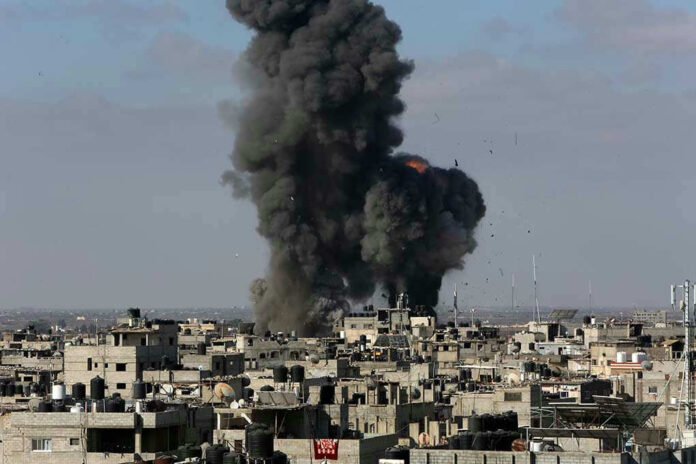
Hawkeye Strike marks a shift from episodic, single‑target raids to large‑scale, multi‑day pressure across Syria’s ISIS belt. In the ten days after the initial bombardment, CENTCOM reported at least eleven missions that killed seven ISIS members, captured others, and eliminated four weapons caches.[3] Instead of “surgical” strikes that ISIS treats as a cost of doing business, the campaign aims to shred its infrastructure, disrupt logistics, and make any attack on Americans invite a systemic reckoning.
The latest wave, launched around 12:30 p.m. Eastern on a Saturday, extended that logic. U.S. aircraft, backed by unnamed partner forces, struck additional ISIS sites “throughout Syria,” not just in the familiar eastern pockets. That phrasing matters. A group that once relied on the Syrian desert as a sanctuary now faces a coalition willing to hit it from Deir ez‑Zor to central Syria. For readers who value clear lines between friend and foe, this is the opposite of the old muddle where Washington condemned Assad while quietly bombing his enemies.
A new map: Assad is gone, Damascus joins the anti‑ISIS coalition
The strikes land in a Syria that would have been unrecognizable five years ago. Bashar al‑Assad is out, a new government under President Ahmed al‑Sharaa is in, and Damascus has formally joined the global coalition against ISIS. U.S. envoy Tom Barrack now flies into the capital not to lecture a pariah, but to coordinate on Aleppo’s transition, security reforms, and joint efforts to keep ISIS from exploiting the power vacuum. That alignment finally treats ISIS as the common enemy it has always been.
Syrian Democratic Forces, long America’s main partner, still raid ISIS cells, arrest militants in Deir ez‑Zor and Tabqa, and supply ground intelligence. But they now operate in a more crowded field, sharing the anti‑ISIS stage with the central government’s forces. From a conservative, common‑sense perspective, that convergence is overdue. When a death cult like ISIS is the threat, it makes sense to work with any actor willing to contain it, provided U.S. commanders keep leverage and clarity over who is shooting at whom.
Deterrence, justice, and what America is really signaling
CENTCOM’s language around Hawkeye Strike is far blunter than the usual Pentagon boilerplate. The command declared these strikes part of an “ongoing commitment to root out Islamic terrorism” and warned, “If you harm our warfighters, we will find you and kill you anywhere in the world, no matter how hard you try to evade justice.” That is not the vocabulary of process‑driven counterterrorism; it is the language of deterrence grounded in justice for murdered Americans.
Critics might argue that air power alone never erased ISIS in the past, and they are right. Historical patterns show ISIS morphing from a territorial caliphate into a nimble insurgency once its strongholds fell. But those same patterns also show something else: when the United States maintains pressure, backs capable local partners, and refuses to shrug off attacks on its people, ISIS spends more time surviving than plotting. Combining massed strikes, the arrest of ISIS’s alleged military leader for the Levant, and closer U.S.–Syrian cooperation stacks the odds against the group’s resurgence.
Sources:
ABC News – US carries out additional ‘large-scale’ strikes on ISIS targets in Syria
Military Times – US launches retaliatory strikes against ISIS in Syria
KOMO News – US launches attack against ISIS in Syria
Wikipedia – Timeline of the Islamic State (2025)