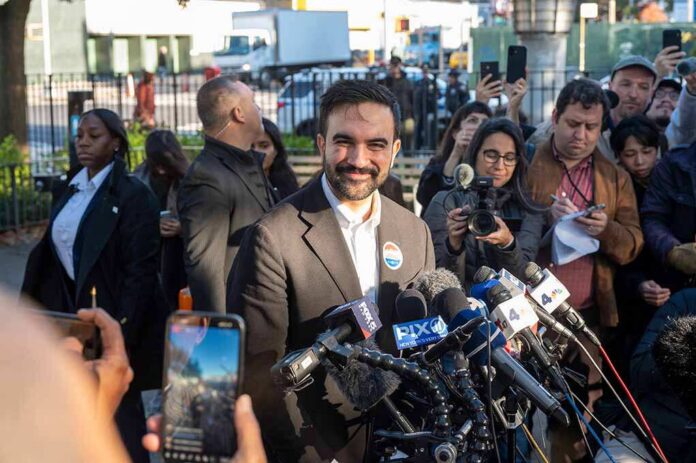
New York’s mayor marked October 7 by mourning Israeli victims—and then blasted Israel’s Gaza campaign as an “ongoing genocide,” triggering a diplomatic firestorm and a raw fight over what remembrance should sound like.
Story Snapshot
- Mamdani’s statement paired grief for Israeli victims with charges of “genocide,” “apartheid,” and “war crimes.”
- Israel’s Foreign Ministry slammed him as echoing Hamas propaganda, escalating the backlash.
- Jewish outlets said he used a sacred day of mourning to attack Israel’s conduct in Gaza.
- Supporters argued he condemned Hamas, honored victims, and criticized policy, not Jews.
What Mamdani Said, Word for Word
The official release from City Hall opened with facts most New Yorkers know by heart. Hamas murdered more than 1,100 Israelis and abducted 251 on October 7. Mamdani called those acts “horrific war crimes,” said the day remains “profoundly painful,” and expressed grief with families still living that loss. Then he pivoted. He wrote that suffering “did not begin nor end that day,” and condemned Israel’s Gaza war as a “devastating, ongoing genocide,” invoking “occupation,” “apartheid,” and “war crimes.”
That combination—condolence followed by harsh indictment—lit the fuse. The move placed him outside the common script used by many leaders on the anniversary, which centers remembrance, names antisemitism plainly, and avoids weighty legal labels that demand proof in court. The phrase “ongoing genocide” is not just moral language. It is a legal charge with heavy implications, and it eclipsed his opening about Hamas and hostages in the public’s ear.
How Israel and Jewish Groups Responded
Israel’s response went far beyond a polite demurral. Its Foreign Ministry accused Mamdani of serving as a Hamas mouthpiece, said he was repeating lies, and charged that he only stood with Jews “when they are dead.” That rhetoric showed how charged the moment had become and ensured the dispute would dominate the cycle. Jewish-leaning outlets argued he gave mourners only a brief nod before turning the day into an attack on Israel’s conduct.
National media captured the split. Coverage noted his opening condemnation of Hamas and prayers for hostages. But it also highlighted the backlash over his language about “genocide” and “apartheid.” Critics said a mayor should unite the city on days of grief, not recast them as policy broadsides. Supporters countered that remembrance means nothing if it ignores ongoing civilian suffering in Gaza and United States complicity. Both frames traveled fast; few read past the most charged words.
The Pattern, Not a One-Off
Reporters tied the statement to a longer record. In 2023, Mamdani said peace “can only begin by ending the occupation and dismantling apartheid.” That history explains why some readers saw the 2026 post less as a stray line and more as a consistent stance. The track record matters because voters judge intent by repetition. When a leader repeats high-charge terms on sacred dates, many hear a deliberate shift of the spotlight away from Jewish victims.
𝐌𝐀𝐌𝐃𝐀𝐍𝐈 𝐒𝐏𝐄𝐍𝐃𝐒 𝐌𝐎𝐒𝐓 𝐎𝐅 𝐇𝐈𝐒 𝐎𝐂𝐓𝐎𝐁𝐄𝐑 𝟕 𝐒𝐓𝐀𝐓𝐄𝐌𝐄𝐍𝐓 𝐀𝐓𝐓𝐀𝐂𝐊𝐈𝐍𝐆 𝐈𝐒𝐑𝐀𝐄𝐋, 𝐍𝐎𝐓 𝐌𝐎𝐔𝐑𝐍𝐈𝐍𝐆 𝐇∗𝐌𝐀𝐒’ 𝐕𝐈𝐂𝐓𝐈𝐌𝐒
Three years to the day since H∗mas stormed the border and m∗rdered more than 1,100 Israelis, New York City… pic.twitter.com/gXvBraFPLr
— M.A. Rothman (@MichaelARothman) October 7, 2026
CNN’s summary offered his camp’s best defense. He honored Israeli victims and hostages while criticizing policy decisions by the Israeli and United States governments. That is a political position, not an ethnic attack, they argue. Fair point on paper. But on an anniversary defined by slaughter and kidnappings, words that sound like courtroom indictments will read to many families as an attempt to balance the ledger. On days of mourning, most people do not want a ledger.
What This Says About Leadership and Common Sense
Anniversary messages test judgment more than ideology. A leader can condemn Hamas without caveat. A leader can debate Gaza policy on any other day. Merging the two in one breath—on October 7—feels to many like moving the goalposts on grief. That is why backlash rose so quickly. American conservative values prize moral clarity, respect for the dead, and unity in crisis. Those values demand the order of operations be simple: first mourn, then debate.
None of this excuses online hate or sloppy charges of antisemitism against any critic of Israel. Criticism of a government is not the same thing as hatred of a people. But language matters, timing matters, and solemn days matter most. When a mayor invokes “genocide” and “apartheid” on the very date of the massacre, he should expect that the headline will bury his condolences and that trust with many Jewish New Yorkers will fray. That cost is real, and it lands at City Hall.
The Practical Road Back
Repair starts with a clear rule: separate remembrance from geopolitics on sacred days. Say the names of the dead. Stand against antisemitism without hedging. Then, on a new day, argue policy with care, facts, and a tone that seeks peace rather than points. Voters can handle hard truths, but they want leaders who know when to speak which truth. On October 7, the city needed a shepherd, not a prosecutor. Many read Mamdani’s statement and felt they got the latter.
Sources:
wjla.com, edition.cnn.com, breitbart.com, redstate.com, washingtonexaminer.com, frontiersin.org
© restoreamericanglory.com 2026. All rights reserved.