
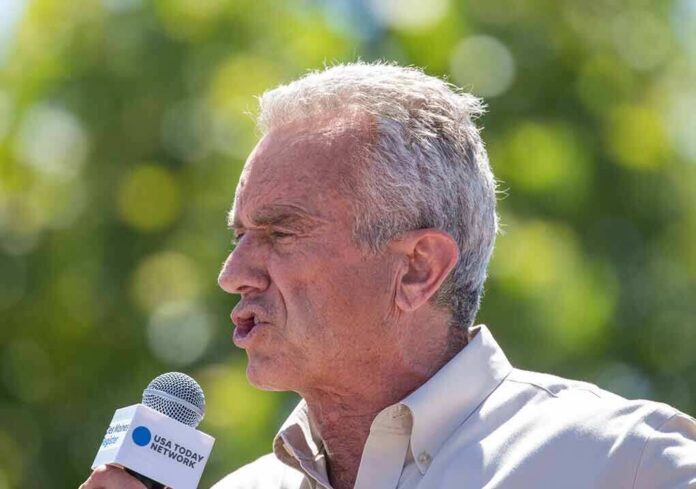
Robert F. Kennedy Jr. told a Michigan campaign crowd that 500 million Arabs have never produced a Nobel Prize winner, a notable scientist, or a single important piece of literature.
Quick Take
- Health and Human Services Secretary Robert F. Kennedy Jr. made the claims at a Republican rally in Grand Rapids, Michigan, on October 27, 2026.
- He said Arabs “don’t produce science,” don’t win the Nobel Prize, Fields Medal, or Wolf Prize, and “don’t produce literature.”
- Named Nobel laureates Ahmed Zewail, Naguib Mahfouz, Tawakkol Karman, and Omar Yaghi directly contradict the claim.
- Kennedy tied the remarks to a broader attack on the Muslim Brotherhood during a speech backing Republican candidate Mike Rogers.
What Kennedy Told The Grand Rapids Crowd
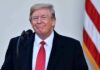
Kennedy stood before a Republican rally crowd and made a sweeping claim about an entire region of the world. He said, “There are 500 million Arabs in the world, and yet they don’t produce science, they don’t win the Nobel Prize, they don’t win the Fields prize, they don’t win the Wolf Prize, they don’t produce literature.” The quote appeared in both Mediaite and Newsweek reporting on the event.
Kennedy did not pull these lines out of thin air. He was building toward a specific political point about the Muslim Brotherhood, arguing that people under its influence embrace an ideology built on “victimization, of murder, of genocide.” That context matters. Criticizing a political and religious organization is different from making a blanket statement about hundreds of millions of people.
The Prize Records Tell A Different Story
Facts are stubborn things, and the Nobel Foundation keeps good records. Egyptian scientist Ahmed Zewail won the Nobel Prize in Chemistry in 1999. Egyptian novelist Naguib Mahfouz won the Nobel Prize in Literature in 1988. Yemeni journalist Tawakkol Karman shared the Nobel Peace Prize in 2011. Each name is a direct rebuttal to the claim that Arabs “don’t win the Nobel Prize”.
Journalist Justin Baragona added another name to the list: Omar Yaghi, who won the Nobel Prize in Chemistry and the Wolf Prize in 2018. Baragona also pointed to Lebanese writer Rabih Alameddine and Egyptian-American journalist Omar El Akkad, both recent National Book Award winners. Whatever definition of “Arab” Kennedy had in mind, these examples complicate the picture considerably.
A Longer History Gets Left Out Of The Speech
Pediatrician and vaccine researcher Peter Hotez pushed back hard online, noting that medieval Arab scholars preserved the works of Aristotle, Hippocrates, and Galen, passing them down to fuel the European Renaissance. He also cited his late colleague Zewail as living proof against Kennedy’s claim. Physician Zachary Rubin made a similar point, writing that Arab scientists, physicians, and mathematicians shaped medicine, astronomy, and math for centuries, and that dismissing those contributions is “neither accurate nor constructive”.
None of this erases the real debate Kennedy was trying to have about the Muslim Brotherhood’s ideology and its influence on American politics. Reasonable people can and should scrutinize extremist organizations without apology. But folding an entire ethnic population of 500 million people into that critique skips past a mountain of contrary evidence sitting in plain sight at the Nobel Foundation and major literary award archives.
Why The Framing Carries Real Political Risk
Scholars who study American political rhetoric have long noted a pattern where Arabs, Muslims, specific governments, and extremist groups get blended into one undifferentiated category, especially during moments of political tension. That blending makes for punchy rally lines, but it also hands critics an easy opening. When a claim can be knocked down with four names and a Wikipedia search, the message gets overshadowed by the correction.
Kennedy made these remarks while campaigning for Republican candidate Mike Rogers, who has repeatedly linked his opponent, Abdul El-Sayed, to the Muslim Brotherhood. That backdrop means the comments will likely be read through a partisan lens as much as a factual one. Sweeping generalizations rarely survive contact with specific names, dates, and prize committees, and this case is no exception.
💥 US political controversy erupts as HHS Secretary RFK Jr. faces severe backlash over remarks regarding Arab contributions to science and culture during a GOP rally in Michigan.
Defending cultural dignity, rejecting sweeping generalizations, and upholding mutual respect… https://t.co/VRBk0oZDyY
— Ing.SALEM ZAGHLOUL (@SalemZ5350) October 27, 2026
Voters deserve sharper arguments than broad strokes painted over an entire population. Kennedy has a legitimate point to make about extremist ideology wherever it takes root. That point gets weaker, not stronger, when it’s wrapped in a claim that Nobel records and library shelves can disprove in minutes.
Sources:
mediaite.com, jihadwatch.org, x.com, yahoo.com
© restoreamericanglory.com 2026. All rights reserved.