
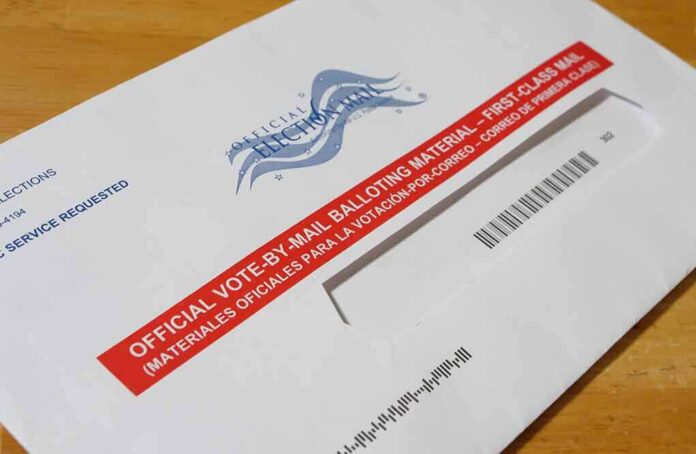
The fight over 20,000 flagged California registrations now turns on one blunt question: count now or verify first.
Story Snapshot
- Justice Department sued California, citing more than 20,000 likely noncitizen registrations.
- Feds asked courts to set aside linked mail ballots until citizenship checks finish.
- Ninth Circuit judges pressed the government on timing, methods, and the “emergency” posture.
- California officials challenged the list’s accuracy and said many flagged voters may be citizens.
What the government asked the courts to do and why it matters
The Department of Justice filed suit against California and named election officials after federal immigration and investigative agencies flagged more than 20,000 registered voters as likely noncitizens. The government did not ask to halt the statewide count. It asked to set aside ballots linked to those names while counties confirmed citizenship. That is a narrow remedy on paper, but a heavy lift during an active election with tight deadlines and large mail volumes.
Federal lawyers framed the case around a simple rule: only citizens can vote in federal races. They argued the court must prevent unlawful ballots from mixing into the count because you cannot “unring the bell” after certification. That logic aligns with common sense and long-standing law. It also raises a practical test: is the federal list accurate enough, and current enough, to justify pausing these ballots before final tabulation while officials verify citizenship one by one?
Inside the Ninth Circuit hearing: speed, method, and skepticism
The Ninth Circuit convened as ballots moved through signature checks and sorting. Judges pressed the government on why it sought emergency appellate relief while the district judge already set a near-term hearing. They also probed how the list was built, when it was built, and who handled the data. Reports from the courtroom described open doubts about the list’s provenance and the administration’s rush to the appeals court before a district ruling. One judge’s questions suggested concern about accuracy and timing more than the underlying legal ban on noncitizen voting.
That line of inquiry follows a standard courts apply close to elections. Judges weigh the risk of confusion and disruption against the need to correct a problem midstream. The government’s ask was targeted, but execution still requires quick, precise matches at the ballot level. The panel’s skepticism about method and emergency posture does not decide the merits, yet it signals the court wants more detail before ordering new handling steps in the counting rooms.
California’s pushback: accuracy claims, voter history, and risk of error
California Secretary of State Shirley Weber said the federal government had not provided evidence proving the flagged individuals are noncitizens, emphasizing the “likely” label and the lack of person-by-person proof submitted to the state. Los Angeles County reported a preliminary review that found many records with signs of citizenship, including birth in the United States, and numerous names with no history of voting. County counsel argued that segregating ballots based on an unreliable list could disenfranchise lawful voters. Those claims, if borne out at scale, would weaken the government’s factual footing.
CALIFORNIA BALLOT CASE UPDATE: NINTH CIRCUIT QUESTIONS DOJ’S EMERGENCY REQUEST
October 26, 2026
On Sunday, October 25, a three-judge Ninth Circuit panel heard arguments on the Justice Department’s emergency request to make California and Los Angeles County set aside ballots…
— Receipts Matter (@ReceiptsMatter) October 26, 2026
These counterpoints do not erase the federal concern. They do force a crucial question about error rates. If a list is a year old or does not reflect naturalizations, then a pause could sweep in citizens along with any noncitizens. Conservative values call for two guardrails at once: protect every lawful vote, and keep unlawful votes out. That balance needs transparent matching rules, recent data, and a clear chain of custody. Without that, courts tend to slow down fast fixes, especially days before certification.
What would satisfy both the law and common sense
The path forward is not mystical. The government can file sworn declarations that explain the matching process in plain terms, disclose the date stamps on each database check, and show how it excluded naturalized citizens. Counties can report how many flagged registrants actually returned ballots, and how many of those ballots already cleared signature and eligibility checks. A court-appointed expert can sample the list to estimate the false-positive rate. Those steps would let a judge weigh the real risk on both sides, not just the rhetoric.
The narrowness of the requested remedy remains the government’s strongest card: do not count a subset until we confirm. Yet narrow does not mean trivial if the list is shaky. The state’s best answer is not to block scrutiny, but to demand proof that meets election standards. That is how you defend legal voters and keep faith with the public. The Ninth Circuit will rule on process soon. The merits judgment will turn on evidence. Results, not press releases, will decide this one.
Sources:
thegatewaypundit.com, ashtalks.substack.com, justice.gov, washingtonpost.com, democracydocket.com, pbs.org, apnews.com, npr.org
© restoreamericanglory.com 2026. All rights reserved.