
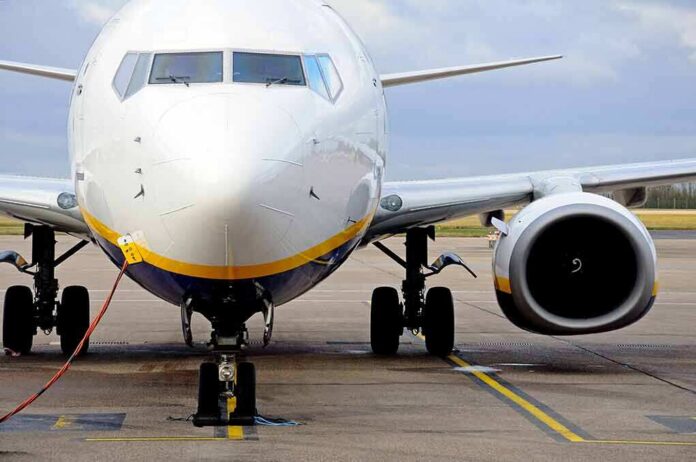
A British Airways 777 crew reported a shiny metallic object flashing past just 50 feet above their right wing minutes after takeoff from Heathrow.
Story Snapshot
- The crew radioed a near miss at about 5,800 feet shortly after departure from Heathrow.
- The object looked silver, metallic, and reflective, about the “size of four toasters”.
- Investigators recorded the event as an unknown object, not a confirmed drone.
- The flight continued to New York with no evasive action and no damage reported.
A near miss over Surrey, described in plain language
British Airways pilots departing Heathrow for New York on June 24, 2026, told air traffic control a “shiny silver” object shot by at close range. The crew put the pass at about 50 feet above the aircraft’s altitude, on the jet’s right side, while climbing through roughly 5,800 feet. Controllers logged the words and asked follow-up questions. The pilots said the object was probably metallic and reflective, and when pressed on size, compared it to about four toasters.
The United Kingdom Airprox Board, which evaluates near-miss reports, treated the case as an unknown object. The board did not settle on a drone, balloon, or debris and used the “unk obj” category in reporting. That classification matters. It signals investigators found enough detail to accept the encounter, yet not enough to say what the object was or who launched it. British Airways said the crew did not need to maneuver and the flight carried on to New York as planned.
What the crew saw, and why their words matter
Pilots do not like guesswork near wings. The crew provided specific descriptors instead of vague terms. “Shiny,” “silver,” “metallic,” “reflective,” and the toaster-size cue create a mental picture that controllers can use. The altitude estimate and the direction of travel add more anchors. No crew wants to overstate a threat, but they will be clear when something slices by so close. Their account is consistent with a brief, fast pass within a narrow vertical gap.
No radar track or additional sensor record appears in the public summaries. That is common in quick, tight encounters with small objects. Primary radar can miss low-profile shapes. Many small craft carry no transponder. Even so, the clarity of the crew’s radio call supports the event’s timeline and geometry. The description of a fast, opposite-direction pass at climb-out altitude is within known patterns for near-airport airspace conflicts.
The risk picture: reduced safety, even without a label
Airprox cases judge whether safety was reduced, not whether the object earns a label. The United Kingdom Airprox Board has processed a steady flow of reports that involve drones and “other” unidentified items. In 2024, the board assessed 298 events, with 90 involving unmanned aircraft or other objects. In 2022, it handled 277 events, with 82 in that category. The stream is not a spike; it is a trend line with weekly cadence.
British Airways Flight's Near-Miss With Mystery Object Revealed: "Size Of 4 Toasters"https://t.co/kbAs6Yzax9 pic.twitter.com/AoRJ8gYX1q
— NDTV World (@NDTVWorld) October 26, 2026
Metal near a wing at a few hundred knots is not academic. A strike on a flap track fairing or slat could mean damage and a return to land. A hit on a windshield or engine could become worse. The crew’s account suggests a margin that was too small for comfort but large enough to avoid contact. Some outlets reported different phrasings of risk in the board’s assessment, but the core stands: the object got close, the identity stayed unknown, and the airplane landed in New York without incident.
What common sense says to do next
Airports need clear air corridors, and small objects do not belong there. Law enforcement and aviation authorities should press harder on detection near big hubs. That includes better primary radar tuning, more ground cameras, and targeted patrols in hot zones under climb paths. Operators of small craft should face real penalties for reckless flights. A system that can find and stop a rogue quadcopter before it reaches 6,000 feet protects families in row 32 and crews on the line.
Airlines should continue promoting pilot reporting culture. Detailed, calm calls like this one help controllers build fast mental maps and help investigators spot patterns. British Airways crews followed that playbook. The United Kingdom Airprox Board’s choice to keep the object unnamed fits the facts made public. The lesson is simple and tight: enforce the corridor, improve detection, and keep the reporting sharp. That is how you turn a near miss into better odds next time.
Sources:
insiderpaper.com, dronexl.co, metro.co.uk, independent.co.uk, aviationa2z.com, thescottishsun.co.uk, m.dailyadvent.com, airproxboard.org.uk
© restoreamericanglory.com 2026. All rights reserved.