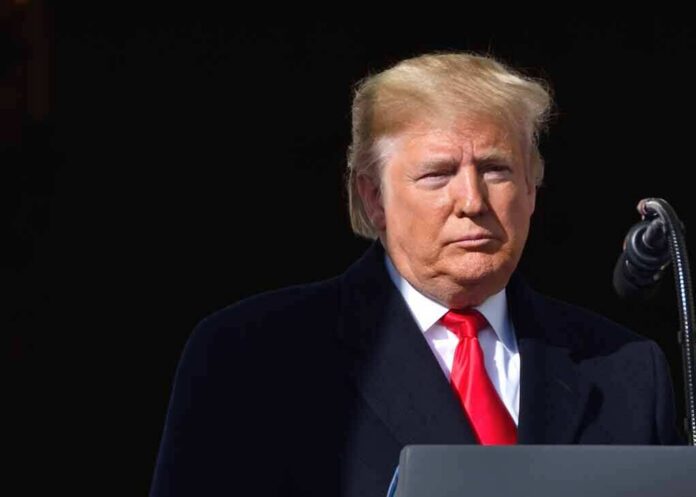
When storms grounded aircraft in North Texas, President Trump told his team to drive to Oklahoma anyway.
Story Snapshot
- Bad weather blocked air travel from Denton, Texas, to Durant, Oklahoma.
- The White House switched plans and sent the president by motorcade, about 85 miles.
- Trump told the crowd his staff urged a cancelation; he refused and went by car.
- The convoy moved fast to make the rally window, drawing media notice.
Weather grounded aircraft, so the White House rolled the motorcade
The White House said storms forced a change from helicopter or plane to a motorcade after the Denton event, with the next rally set in Durant, Oklahoma, roughly 85 miles away. Reporters traveling with the president logged the shift and the late start in Durant. Local and national outlets aligned on the basic sequence: aircraft stayed on the ground; the convoy took U.S. 75 north; the rally began late but still happened. That is the through-line that matters to voters sizing up grit and follow-through.
Trump leaned into the story from the stage. He said aides suggested canceling because rotor and fixed-wing options were off the table, and that they warned of safety and timing risks. He answered with a simple directive to load up and go. He framed it as keeping a promise to show up for supporters, which fits a leadership ethic many conservatives value: accept the constraint, adjust the plan, finish the job. The audience got the message because they lived the delay.
Motorcades are built for these pivots
Presidential travel always includes a ground fallback. The United States Secret Service and advance teams map primary and alternate routes weeks ahead, working with state and local law enforcement, hospitals, and highway managers. They pre-stage vehicles, decoys, counterassault elements, and bomb squads. They also plan for road closures that move on command. That is why a trip like Denton to Durant can flip from air to ground with minutes of notice and still hold together under pressure.
Air planners give presidents priority, but priority does not beat lightning or low ceilings. Federal aviation officials can clear airspace. They cannot part storm cells. Forecast units tied to presidential travel track weather with tighter security and timelines, then feed go or no-go calls to the detail. When visibility, ceiling, or wind shear cross lines, the aircraft stays parked and the armored limousine becomes the point solution. It is not glamour. It is discipline and checklists designed for the worst day.
Speed, risk, and the optics of resolve
Coverage highlighted reports that the convoy pushed hard to make the window, with estimates that vehicles neared highway triple digits in stretches. Motorcades move as protected bubbles, so speeds and spacing look aggressive compared with routine traffic. Law enforcement blocks ramps and intersections to cut exposure time. The risk trade is plain: fewer minutes on open roads reduces vulnerability. The press sees drama. The protection teams see math and threat modeling, done in advance for exactly this kind of pivot.
Trump’s telling of the exchange with aides landed because it sounded like a workplace moment. Staff warn of constraints; the boss decides. Here, the decision matched limited government common sense: meet people where they are, even when it is not convenient. No new spending. No special gadget. Just tires, fuel, and a route that was already planned. That is a quiet lesson about how strong systems beat chaos. When the air door closes, the ground door opens, and the mission continues.
What this trip says about governing under pressure
Rallies are not emergencies, but they are tests. They test planning, chain of command, and the will to show up. This Oklahoma run showed the standard playbook at work. The White House communicated a clear reason for the switch. The route existed before the rain. The law enforcement partners executed their blocks. The president arrived late but kept the commitment. That is how institutions should work when weather and chance shove plans off course.
🚨 BOOM: President Trump made the roughly 100-MILE trip from Texas to Oklahoma by motorcade after bad weather grounded the planned aircraft — with the press pool reporting speeds reaching about 98 MPH! 🇺🇸🔥
Trump even posted that “The Beast” was going faster than it had ever… pic.twitter.com/QilpmQ5ujs
— The Golden Age (@QAceofTruth) October 2, 2026
Some will fixate on the spectacle of a racing convoy. That misses the point. The real takeaway is that the system worked because people did their jobs and a leader made a call aligned with the plan’s built-in options. Voters do not need perfect skies from their presidents. They need steadiness, accountability, and the humility to use the tools already paid for and practiced. On a wet night in Red River country, that is exactly what they got.
Sources:
facebook.com, apnews.com, nbcnews.com, nbcrightnow.com, abcnews.com, click2houston.com, bastillepost.com, ranker.com, foxweather.com, faa.gov, forth.news
© restoreamericanglory.com 2026. All rights reserved.