
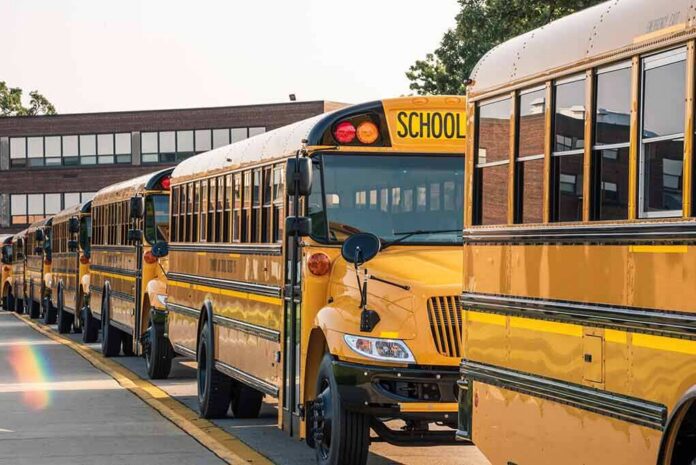
Six nonverbal special education children were driven around Brooklyn for over four hours before reaching school, and the official timeline leaves no wiggle room about how badly adults failed them.
Story Snapshot
- The bus arrived at P.S. 289 at 1:25 p.m., more than four hours late.
- The driver went to the wrong schools before dispatch sent him to the right one.
- GPS and a parent’s trackers undercut the driver’s pickup story.
- The driver and matron were removed from student duties after the probe.
A Clear Timeline That Demands Accountability
Investigators found the six students were due at P.S. 289 between about 8:20 and 9:00 a.m. The bus arrived at 1:25 p.m., creating a delay of more than four hours. That span covers a full morning of lost class time, missed meals, and rising fear for families. The clarity of the arrival time matters. It strips away excuses and focuses attention on duties adults owed to children who cannot advocate for themselves.
Reports say the driver, identified in coverage as Eric Chery, got lost and drove to two wrong schools before dispatch finally directed him to the correct one. Routing mistakes happen, but not for hours with six vulnerable kids aboard. Common sense says a driver must stop, call, and verify the route fast. When that does not happen, a simple error becomes a preventable crisis. That is why the timeline is the story, not traffic or confusion.
Evidence That Cut Through Excuses
Department of Education GPS data reportedly showed the bus near a student’s home at 10:59 a.m., although the driver claimed all pickups were done by 10:00 a.m.. A parent’s trackers in two children’s bags showed they were still moving around Brooklyn near midday, not in class. These datapoints anchor the narrative. They match the late arrival and paint a picture of a meandering route while school and families waited for answers.
One child arrived soaked in urine after removing her diaper and leggings during the ordeal, according to the probe summaries in local reporting. That detail is hard to read, but it is necessary. It speaks to unmet basic care on a ride that never should have stretched that long. It also shows why special education routes require sharper checks, faster communication, and people who act with urgency when kids show distress.
Supervision And Communication Broke Down
The bus matron, a seasoned worker, told investigators she did not communicate with the driver that morning and did not contact the school, depot, or anyone else for help, according to coverage of the report. That admission, if accurate, points to a second line of failure on top of the wrong turns. A matron sits in the core safety role for nonverbal children. Silence during hours of delay is not just a missed step; it defies the job’s purpose.
SCHOOL BUS SCARE: Six nonverbal students spent more than four hours on a school bus before arriving at their Brooklyn school, according to a city investigation.#News12 #Brooklyn #SchoolBusScare https://t.co/h6kx4P5vy7
— News12BK (@News12BK) October 17, 2026
The contractor placed both employees on administrative leave after the incident. Reporting says they are not allowed on buses or near students, and problem codes were used to stop future work with Department of Education vendors. Those steps match the seriousness of the findings and align with conservative values of clear standards and consequences. Adults charged with protecting children must face swift discipline when they fail those children.
A Bad Morning Inside A Troubled System
This was an extreme case, but the wider system is strained. The New York City Comptroller reports more than 150,000 transportation complaints in 2023–24, including many tied to students with disabilities. City materials describe real-time vendor delay reporting and performance tracking, yet families still endure chronic late buses and no-shows. System fixes will not excuse personal failures, but they can block a single error from snowballing for hours with kids on board.
What Parents Should Expect Tomorrow Morning
Parents deserve three basics on every route: a driver who follows the map, a matron who speaks up fast, and a dispatcher who tracks buses and calls in help. The case at P.S. 289 broke all three. The proof sits in the clock. It also sits in GPS points and a mother’s trackers. Schools should audit special education routes now, drill communication rules, and verify that every bus has working location tools that staff actually watch.
Sources:
nypost.com, worldjournal.com, pix11.com, wlox.com, local12.com, cbsnews.com, council.nyc.gov, comptroller.nyc.gov
© restoreamericanglory.com 2026. All rights reserved.