
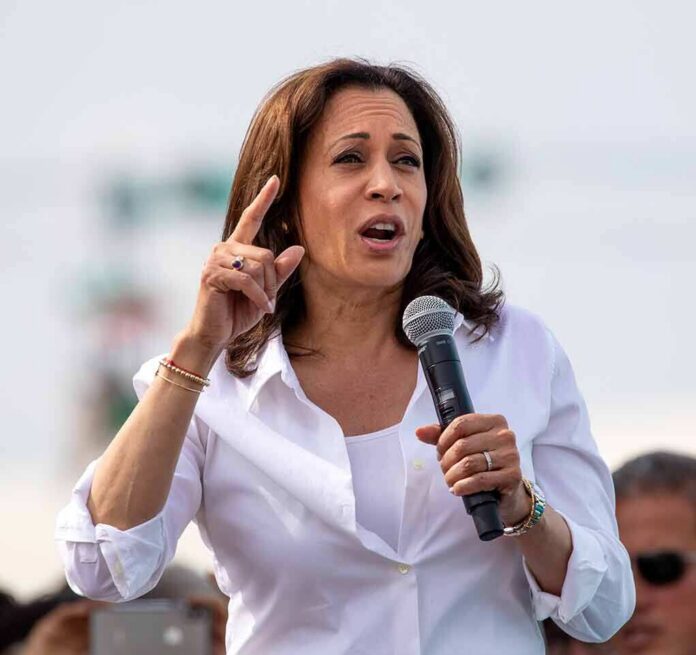
Kamala Harris mapped a late-October sprint through key states to lift Democrats and keep herself in the game.
At a Glance
- Harris’s office shared a schedule for Oct. 21–30 with stops across multiple states.
- The itinerary paired Harris with named Democratic nominees and defined event goals.
- Her midterm push began in Michigan for Senate nominee Abdul El-Sayed.
- Harris said her focus was “midterms, midterms, midterms,” punting 2028 talk.
A Documented Itinerary With Named Candidates
The Associated Press reported a schedule from Harris’s office listing events in Nevada, Mississippi, New Hampshire, Wisconsin, and Georgia, plus a virtual Florida stop across October 21–30. The plan linked Harris to specific candidates and purposes. She was set to appear with Nevada’s Aaron Ford, Mississippi’s Scott Colom, New Hampshire’s Chris Pappas, Wisconsin’s David Crowley, and Georgia Senator Jon Ossoff. This was not vague “support.” It was a route with names, venues, and reasons to be there.
The trip design fit a familiar playbook. National figures often target states with tight races, strong party bases, or early influence on future contests. Reports tied Harris’s schedule to union halls, campus forums, and party events, rather than only large rallies. That mix aims to energize core voters, show up for activists, and earn local news. It also positions a familiar face on screen in places Democrats must defend or hope to flip.
The First Stop: Michigan, Then West And South
Harris opened her midterm swing in Michigan on a Tuesday, on behalf of Senate nominee Abdul El-Sayed. She then moved west to Nevada and down to Mississippi before heading to New Hampshire and Wisconsin, with Georgia closing the loop near month’s end. The Florida event was virtual. Each stop had a purpose beyond applause lines. The plan listed a Culinary Workers Union meeting in Nevada, a reproductive-care discussion in New Hampshire, and voter-protection events in Georgia.
The Michigan choice carried extra weight. Harris lost the state to President Trump two years earlier. Returning on behalf of another candidate framed the visit as work, not nostalgia. Her message matched that frame. When asked about her future, she said, “Right now – midterms, midterms, midterms”. That line drew a clear boundary. Help 2026 candidates now. Leave 2028 for later. The discipline matters when every camera asks the same question.
Why These Events Matter To Democrats
Campaigns need more than rallies in October. Unions can turn out voters with structure and lists. Voter-protection events can recruit poll watchers and hotline staff. County galas can raise real money, even late. A reproductive-care forum in New Hampshire can reach persuadable moderates who rank the issue high. These are not glamorous moments. They are the nuts and bolts that win close races. The itinerary shows a team trying to cover those bases.
Vice President Kamala Harris is embarking on a 2026 midterm campaign tour from October 21 to October 30 to support Democratic candidates.
Here's her schedule so far: pic.twitter.com/bXxaLCdata
— Fabi 🪷 (@kamala_things) October 14, 2026
Observers linked the map to 2028 tea-leaf reading. That is common and often lazy. The best evidence of purpose is what a politician says and does. Harris said the focus was the midterms, and the events look like midterm work: labor engagement, targeted conversations, legal prep, and party fundraising. Some will still see a shadow primary. Voters who value accountability can judge her by whether candidates she backed gained volunteers, dollars, or votes.
Political Reality Check For Both Parties
Democrats want every advantage in states where turnout swings control. Republicans know this script too. Big names visit, fire up the base, and lend staff and media muscle. The question is impact. Research on political endorsements is mixed, but on-the-ground help can matter when margins are thin. What matters most is execution: did local teams convert appearances into sign-ups, small-dollar spikes, and ballot requests? The reported schedule gave them chances to do so.
Results, not optics, will settle the score. If Harris’s stops drove stronger field operations, campaigns will say so. If they did not, that will show as well. For now, the facts are clear: her office planned a late-October, multi-state push with named candidates, defined events, and a message focused on 2026. The rest is follow-through. Voters will sort the rest, as they always do, one door knock and one ballot at a time.
Sources:
twitchy.com, santacruzsentinel.com, washingtonexaminer.com
© restoreamericanglory.com 2026. All rights reserved.