

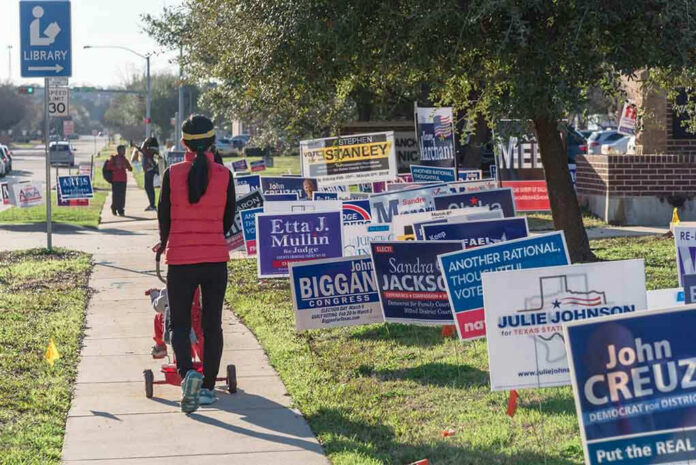
An AirTag hidden in a campaign sign pinged from a state lawmaker’s property and turned a quiet local race into a police case days before voters weighed in.
Story Snapshot
- Police tracked a missing campaign sign to Representative Anne Hughes’s property using an AirTag.
- Hughes returned several signs and received a misdemeanor larceny summons, not a custodial arrest.
- The challenger’s campaign reported multiple missing signs and flagged locations to police.
- Hughes admitted removing signs but argued they were illegally placed in a state right of way.
What Police Say Happened
Easton police said the opponent’s campaign filed a complaint after several signs vanished near Route 59 and Judd Road. At least one sign had an AirTag. That tracker pinged on property owned by Representative Anne Hughes. Police followed up, and Hughes returned several signs, including the one with the tracker. Officers then issued a misdemeanor summons for sixth-degree larceny, which covers property worth five hundred dollars or less under Connecticut law.
The timeline moved fast. Reports said signs disappeared. The tracker pinged from Hughes’s property within about two days. The campaign’s complaint, the AirTag data, the recovery of signs, and the police action formed the backbone of the case. This was a probable cause call, not a conviction. Courts decide guilt. But for most voters, the image that stuck was simple: missing signs, a digital breadcrumb, and a return trip with a stack of placards.
What Hughes Admits And Claims
Hughes acknowledged removing the signs and apologized. She said she should have called police or the opponent’s campaign instead. She also claimed the signs were in a state right of way and broke placement rules. She said she had collected signs from several campaigns, not just her opponent’s, because she saw them dumped or posted on public property. She defended free speech while saying enforcement, not self-help, should set boundaries on where signs go.
That defense raises a real question that shows up every election season. Some roads are off-limits for private signs. State transportation officials warn campaigns not to place signs on state property, including rights of way. But even if a sign sits in a no-post zone, the law still frowns on private citizens grabbing it. The safe path is to report it and let officials remove and store it. That split—illegal placement versus illegal removal—often confuses well-meaning people.
Why The AirTag Changed The Stakes
The AirTag turned a he-said, she-said into a concrete lead. The tracker created location proof that a missing sign sat on Hughes’s property. It did not prove who lifted it from the roadside or why it was moved. But it gave police a place to knock and a reason to ask questions. This is common sense crime solving with modern tools: follow the signal, find the item, then piece together intent and authority from statements and context.
No discipline for Connecticut lawmaker accused of taking campaign signs, House speaker says https://t.co/KmzgeksLdp
— Record-Journal (@Record_Journal) November 2, 2026
From a conservative lens, the facts line up this way. Property rights and rule of law matter, even in small things. Campaigns should not plant signs where they are banned. Citizens, including lawmakers, should not take other people’s property, even when they think the placement breaks rules. Call it in. Document it. Let the proper authority handle it. That is what equal treatment under the law looks like. The apology helps, but the process still counts.
What Is Known Versus What Is Still Open
Known: the campaign reported missing signs; an AirTag pinged from Hughes’s property; police recovered signs; Hughes admitted removal; a larceny summons followed. Unknown: a court-tested finding on whether each sign sat on forbidden state property; whether Hughes intended to keep the signs or only hold them for pickup; and how a judge will weigh the mix of apology, stated motive, and placement claims under the statute. A summons signals probable cause, not a final verdict.
Voters can draw a clear takeaway without pretending to be jurors. Temptation runs high in charged weeks before an election. But ends do not justify means. Campaigns should map legal sign locations and keep records. Supporters should resist vigilante cleanup. Police should collect and log misplaced signs when asked. Technology will keep raising the bar. If you move a thing that is not yours, expect a ping, a knock, and paperwork to follow.
Sources:
townhall.com, nbcconnecticut.com, thehour.com, hartfordbusiness.com, ctmirror.org, connecticut.news12.com, nytimes.com, law.justia.com
© restoreamericanglory.com 2026. All rights reserved.