
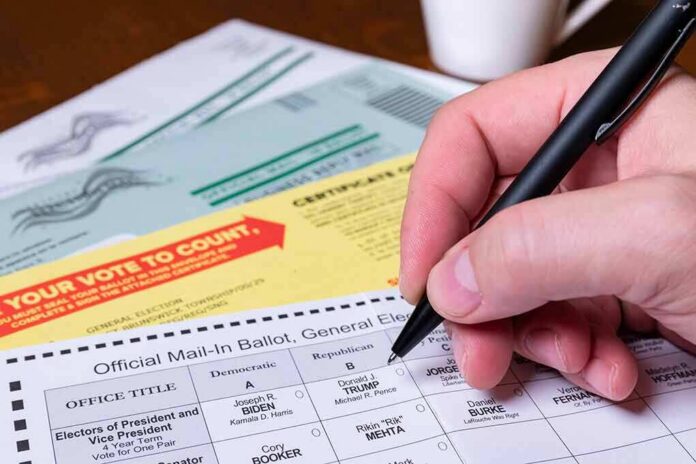
President Trump demanded prosecutors charge Mary Peltola’s campaign after a New York Times investigation found Democrats allegedly recruited a second man named Dan Sullivan to split votes away from Alaska’s Republican senator.
Quick Take
- A New York Times investigation reportedly found Peltola campaign staff, lawyers, and Democratic Senatorial Campaign Committee officials worked to recruit spoiler candidates, including a man named Daniel J. Sullivan.
- The Alaska Supreme Court ordered the second Sullivan onto the ballot even after state election officials said his filing was meant to “confuse or mislead” voters.
- The Department of Justice sued to block certification of Alaska’s Senate results if incumbent Dan Sullivan loses by a narrow margin.
- The Peltola campaign and the Democratic Senatorial Campaign Committee both deny recruiting any candidate into the race.
- President Trump called the alleged scheme election rigging and said those involved “should be prosecuted.”
What The New York Times Investigation Describes
The New York Times reported that Peltola campaign aides, campaign lawyers, and officials with the Democratic Senatorial Campaign Committee ran an internal project nicknamed “ballot composition.” Its goal, according to the report, was to dilute Republican turnout by placing confusing names on the ballot. Alaska Public Media summarized the account, which relied on interviews, text messages, and documents reportedly prepared for a possible lawsuit.
The man at the center of the story, Dan J. Sullivan of Petersburg, is a retired teacher who shares his name almost exactly with Senator Dan Sullivan, the Republican incumbent. Reporting also claims campaign aides told a staffer to search for as many Alaskans named Dan Sullivan as possible, a detail that suggests the name match was not an accident.
A Ballot Fight That Reached The State’s Highest Court
Before the Times report surfaced, Alaska’s own election officials had already flagged the Petersburg teacher’s candidacy. The Division of Elections director ruled that Sullivan filed his paperwork “with a purpose to confuse or mislead and to thereby compromise the ballot’s fairness,” according to the Anchorage Daily News. Despite that finding, the Alaska Supreme Court ordered him included on the ballot, ruling that the law did not allow officials to block him outright.
That court order means the second Sullivan appeared on the same Senate ballot as the sitting senator, a legal reality even as questions swirled about why he entered the race. The Supreme Court’s decision did not resolve who recruited him or why, leaving that question to later reporting and investigation.
President Trump And The Justice Department Response
President Trump seized on the Times report, accusing Peltola’s team of trying to rig the election and insisting those responsible face charges. His comments came as the Department of Justice pursued its own legal action, having already filed suit seeking to block certification of Alaska’s results if voter confusion over the two Sullivans affected the outcome.
The federal lawsuit asks a court to potentially delay certifying the race if the Republican incumbent loses narrowly, arguing confused votes meant for Senator Sullivan could have gone to his namesake instead. Some election law specialists quoted by the New York Times called the legal theory behind that lawsuit weak, even as the underlying recruitment allegations drew separate scrutiny.
Peltola Campaign Pushes Back
Mary Peltola’s campaign flatly denied the allegations. A spokesperson told The Hill the campaign had no involvement with either Sullivan candidacy and did not recruit any spoiler candidates into the race. The Democratic Senatorial Campaign Committee issued a similar denial, saying it played no role in bringing Sullivan or any other Republican into the contest. Peltola herself dismissed the story as a distraction while campaigning in Soldotna, according to Alaska Public Media.
Those denials matter. They represent the campaign’s direct, on-record response to a story built largely on anonymous texts, interviews, and internal documents the Times has not published in full. Readers deserve to weigh both the detailed allegations and the campaign’s flat rejection of them before drawing final conclusions.
What Comes Next For Alaska’s Senate Race
No criminal charges have been filed against Peltola or her staff, and no court has ruled the alleged recruitment effort was illegal. The Department of Justice’s certification lawsuit remains unresolved, and any criminal investigation into the alleged scheme would need to establish far more than suspicious timing. Still, for conservatives watching Alaska, the pattern the Times describes, deliberately placing a voter’s namesake on the ballot, demanding scrutiny regardless of who ultimately gets prosecuted.
A bombshell New York Times investigation just exposed the "Ballot Composition Project"—a covert operation to place decoy candidates on the Alaska ballot and siphon votes. Now, the DOJ is stepping in.https://t.co/tuWV6ZE84i
— Watcher Reports (@WatcherReports) October 29, 2026
Alaska’s election fight now sits in both a courtroom and the court of public opinion, with the Times investigation, the Supreme Court’s ballot order, and the Justice Department’s lawsuit all moving on separate tracks toward the same unanswered question: who really wanted two Dan Sullivans on the ballot, and why.
Sources:
thegatewaypundit.com, washingtonexaminer.com, newser.com, cnbc.com, adn.com, alaskapublic.org, nytimes.com
© restoreamericanglory.com 2026. All rights reserved.