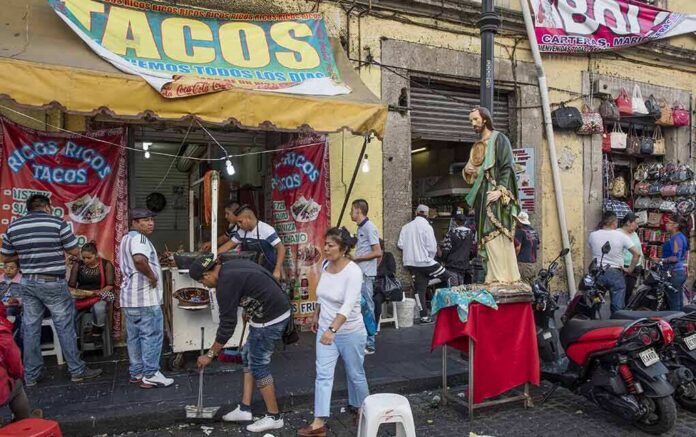
Workers sprinted down West Tennessee Street as flashing lights closed in, and by week’s end the taco stand was gone.
Story Snapshot
- Security video shows staff running as officers pursued near a Tallahassee taqueria.
- Reports say two men and one woman were detained during the operation.
- The business shut its West Tennessee Street location after the incident.
- The exact agency behind the enforcement action remains unclear in public reports.
What Happened On West Tennessee Street
Late September on a busy Tallahassee strip, a routine evening turned into a chase. A 20-second surveillance clip captured workers from a popular taco stand running along West Tennessee Street as law enforcement followed on foot and by vehicle, with lights visible in the frame. The confrontation began as a traffic stop that witnesses and local coverage describe as sliding into an immigration enforcement action near the stand’s food truck setup. By the end, three people were in custody, and fear spread fast.
Two men and one woman were detained, according to syndicated reporting that tracked the fallout after the chase. One detainee was later held at a state-run immigration detention facility in Baker County, known by critics as the “Deportation Depot,” signaling that this was no brief street check. The restaurant’s owners said the team scattered during the pursuit, and several employees never came back. Within days, the West Tennessee Street site went dark.
The Closure And The Community Shock
The owners announced the closure of the Tennessee Street location on social media and urged customers to visit the mall site instead. Local coverage described how the panic rolled into a staffing collapse. Workers quit, families worried, and a small business that thrived on foot traffic and loyal regulars lost its core crew. That kind of instant disruption can crush a food operation built on tight margins. A storefront can bounce back from a slow week. It cannot run without cooks and cashiers.
One owner’s account added more context, saying officers had targeted one employee, but the sudden arrival triggered a broader flight. She called the raid unfair and said her staff were simply trying to work and support families, a claim many customers likely share on a human level. That plea tugs at a real debate: how a country balances lawful enforcement with community trust. Compassion matters. So does the rule of law. Both truths can collide on a sidewalk at dinner rush.
Agency Questions, Legal Unknowns
Reporters asked who ran the operation. Public answers did not lock down the badge. Outlets contacted federal immigration authorities and state law enforcement, but they did not receive a clear, on-the-record attribution naming the exact agency or task force responsible. That gap now feeds doubt and online spin. Strong government work still needs strong communication. When officials leave blanks, activists and partisans fill them. That weakens public confidence even if the operation followed the law.
The lawful basis for each detention also remains outside public view. No warrant affidavits, charging documents, or detailed incident reports surfaced in the initial coverage window. That does not prove anything improper happened, but it keeps the hardest questions open. Who was targeted, why, and under what authority? Those answers live in forms and logs, not in a 20-second clip. Until records arrive, the video drives the narrative while the paperwork sits behind a closed door.
How To Read The Footage Without Getting Played
Short clips punch our brains. They do not explain procedures, status, or probable cause. This Tallahassee tape shows a chase and fear; it does not show the entire lead-up or the legal trigger. Nationally, immigration operations often surface first on video and only later in documents, which means the first take can harden before the facts are complete. Smart viewers can hold two ideas: respect the officers’ duty to enforce the law, and demand timely, specific disclosure so the public can judge fairly.
ICE RAID IN TALLAHASSEE: TAQUERIA SHUTS DOWN AFTER WORKERS ARE DETAINED
A popular taqueria in Tallahassee, Florida, has reportedly closed its Tennessee Street location following an immigration enforcement operation involving U.S. Immigration and Customs Enforcement (ICE).… pic.twitter.com/qlnj5a207R
— CSB News USA (@csbnewsus) September 29, 2026
Common sense suggests a path forward that aligns with conservative values: clear rules, even-handed enforcement, and honest communication. Agencies should publish basic incident summaries fast, with who, what, where, and legal basis. Small businesses should keep immaculate hiring and verification files so they are not exposed to avoidable risk. Communities should reject mob narratives and wait for records. Order and empathy both belong in a country that believes laws mean something and people deserve dignity.
Sources:
facebook.com, tallahassee.com, wtxl.com, wctv.tv
© restoreamericanglory.com 2026. All rights reserved.