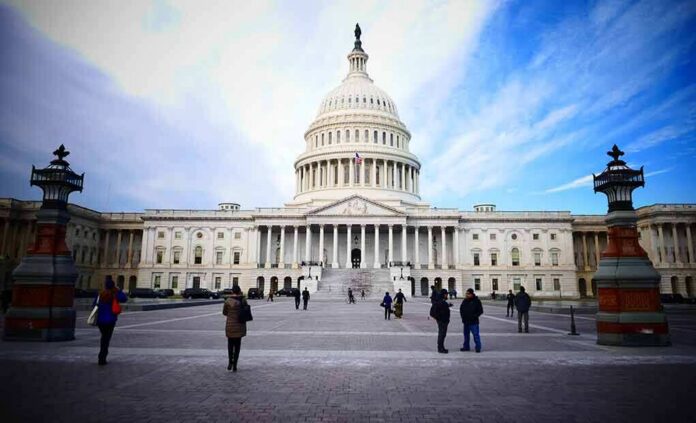
A Republican-led House just voted to clip President Trump’s authority on Iran, reviving the same Washington habit of second‑guessing the commander in chief right in the middle of a war.
Story Snapshot
- House passes a symbolic War Powers Resolution directing President Trump to end or scale back U.S. military engagement with Iran.
- Four Republicans break ranks, giving Democrats the margin to push through a 215–208 rebuke of the president’s Iran strategy.
- Supporters say Congress is reasserting its constitutional war powers; critics warn it undercuts U.S. leverage while Iran watches.
- The fight spotlights the long-running tug‑of‑war over who really controls American military action: Congress or the commander in chief.
House Sends Trump a Public Rebuke on Iran
The United States House of Representatives has passed a War Powers Resolution aimed squarely at President Trump’s handling of the conflict with Iran, voting 215–208 to demand that he end what critics in Congress are openly calling the “war” with Tehran.[1][3] Four Republicans crossed over to join Democrats, giving the measure its margin in a chamber that is otherwise led by Trump’s own party.[1][3] News outlets describe the vote as a direct “rebuke” of the president’s military approach toward Iran.[1]
Coverage of the vote repeatedly stressed that this resolution is more symbolic than binding, because it still must clear the Senate and face the reality of presidential opposition.[1][3] Under the War Powers Resolution passed in the 1970s, presidents are supposed to seek congressional approval if hostilities last beyond specific time limits, but in practice both parties’ presidents have stretched that law for decades.[1] The House measure fits that pattern: a high‑profile message vote that stakes a claim to congressional authority while leaving the real legal fight unresolved.[1][3]
What the Resolution Actually Does — and Does Not Do
The text of the House measure directs the president, under section 5(c) of the War Powers Resolution, to remove United States forces from what the House labels “unauthorized hostilities” in the Islamic Republic of Iran.[3] Supporters argue this is about reasserting Congress’s Article I power to declare war and to decide when America stays in a protracted conflict.[1] They emphasize that, after months of U.S. and Iranian forces trading blows, the time limits in the War Powers law demand a fresh congressional decision.[1][3]
Reporters and members alike acknowledge that, even while using sharp language, the measure will not immediately stop ongoing military operations.[1][3] Instead, it puts political pressure on the White House and on senators who must now decide whether to side with Trump or with those calling the conflict a “reckless and costly war of choice.” Senate leaders are already working with their own Iran War Powers proposal, creating yet another round of Washington brinkmanship over who ultimately decides when troops fight and when they come home.[3]
Trump’s Defense: Hostilities Are Over, War Powers Clock Stopped
Inside the administration, officials have pushed back on the premise that additional authorization is needed, arguing that formal hostilities have already ceased.[1] According to reporting on the debate, the White House has pointed to a declared ceasefire in the Iran conflict and described the situation as moving toward a “satisfying conclusion” rather than open‑ended war.[1] That framing is crucial, because if hostilities are considered over, the administration claims the War Powers Resolution’s 60‑day clock no longer forces a new vote in Congress.[1]
⚠️ 🇺🇲 🇺🇦 The House passed the Ukraine Support Act 226-195 Thursday – 18 Republicans and one independent defying Speaker Johnson and the White House to vote with Democrats.
The bill: over $1 billion in direct military aid, up to $8 billion in loans for Ukraine, and sweeping new… https://t.co/1Gz5k3hecq pic.twitter.com/FzE2i8ew4u
— The Tectonic (@thetect0nic) June 5, 2026
This clash echoes decades of disputes between presidents and lawmakers over the scope of commander‑in‑chief authority.[1] Congress often tries to draw lines once operations stretch on, while presidents of both parties insist they must retain flexibility to respond quickly to threats and protect American forces.[1][3] For Trump supporters, the concern is not just legal theory; it is whether elected legislators, many of whom opposed Trump’s foreign policy from day one, should hold a veto over battlefield decisions as adversaries like Iran carefully watch for any daylight between Congress and the president.
Why This Fight Matters to Conservatives Who Back Trump
For many conservatives, especially those who supported Trump’s promises to end endless wars without tying America’s hands, this House vote raises familiar frustrations.[1] Lawmakers who cheered past interventions now claim to be rediscovering restraint, but they directed their fire at a president who campaigned on avoiding new wars and demanding better deals.[1][3] The resolution’s sponsors frame it as a constitutional stand, yet the practical effect is to signal division in Washington while Iran’s rulers test U.S. resolve and probe for weakness.[1]
At the same time, this episode highlights a broader pattern: Congress often uses war‑powers fights to score points against the president, knowing most such measures stall or are vetoed.[1][3] That dynamic risks turning serious questions about war, peace, and the safety of U.S. troops into just another partisan weapon. Conservatives who value a strong but accountable military can reasonably see this vote as one more reminder that defending the Constitution also means ensuring foreign adversaries never doubt that America will stand united when it has to fight.
Sources:
[1] YouTube – What to know as House rebukes Trump with vote to limit war powers
[3] YouTube – House votes to rein in Trump’s military action against Iran
© restoreamericanglory.com 2026. All rights reserved.