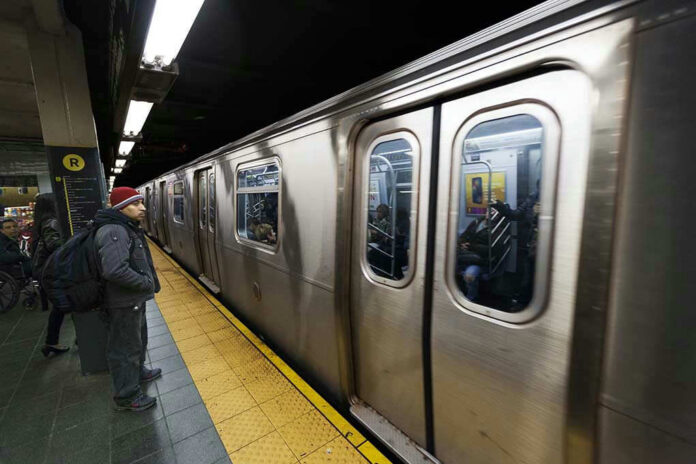
A single quiet Metro ride on America’s 250th birthday has turned one anonymous Black commuter into a symbol everyone wants to claim, even though she herself has not spoken a word in public about it yet.
Story Snapshot
- A Reuters photo shows a lone Black woman on a D.C. Metro, surrounded by masked Patriot Front members.
- The image went viral and some commentators instantly compared her calm to Rosa Parks’ famous bus stand.
- There were no arrests or police complaints, which skeptics use to say “nothing really happened” that day.
The Metro Image That Lit Up America’s 250th Birthday
On July 4, 2026, Reuters photographers captured hundreds of masked members of Patriot Front riding the Washington, D.C. Metro during a march tied to the 250th anniversary of U.S. independence. In one frame, a young Black woman sits alone, facing forward, while the car around her fills with men in matching masks and uniforms. She does not look at them. She keeps her posture steady, her hands close, as if guarding her own small circle of space.
Social media seized on this one moment. An Instagram post called it “a young Black woman on the D.C. Metro, alone in a car full of masked racists and bigots,” praising how she “isn’t reacting” and is “focused on protecting her space.” That caption turned a news photo into a morality play: her quiet stillness versus their organized show of force. Within hours, the image was shared as the “defining picture” of America at 250 years.
Who Patriot Front Is And Why The Masks Matter
Patriot Front did not appear out of thin air for this anniversary. Researchers and watchdog groups describe it as a white nationalist, fascist organization formed in 2017 after the deadly “Unite the Right” rally in Charlottesville, Virginia. The group pushes a vision of a white-only ethnostate, rails against multiculturalism, and spreads propaganda with flyers, banners, and choreographed marches meant to feel like a disciplined paramilitary force.
The Anti-Defamation League and academic projects have tracked Patriot Front for years and place it squarely inside the broader white supremacist movement. They note that the group favors “flash demonstrations” near city halls and high-visibility spots, especially on patriotic holidays like Memorial Day and the Fourth of July, to gain attention without long-term permits or advance warnings. On this July 4, Reuters reported about 400 members marching through D.C., carrying flags and chanting “reclaim America.”
Rosa Parks, Quiet Courage, And What We Know About This Woman
Rosa Parks became “the mother of the civil rights movement” when she refused to give up her bus seat to a white passenger in Montgomery, Alabama, in 1955. Her arrest sparked the Montgomery bus boycott, lifted Martin Luther King Jr. to national attention, and helped end legal segregation on city buses. Her quiet, planned act was backed by a local civil rights network, church leaders, and a strategy aimed straight at unjust law.
Online comparisons between the D.C. commuter and Rosa Parks focus on posture, race, and setting: a Black woman on public transit, surrounded by people aligned with racist ideas, choosing to sit her ground. But here is the hard fact the viral posts skip: no one has published her name, her own words, or any sign that she set out to make a statement. We have only a frozen image and the interpretations laid over it by commentators and activists.
Did “Nothing Happen,” Or Did Something Deep Happen With No Words?
Reuters reporting on the July 4 march notes that Washington’s Metropolitan Police tracked Patriot Front as engaging in “First Amendment activities” and that there were no arrests, complaints, or calls for assistance tied to the event. Conservative voices use that point to argue the scene was “fake,” a “Democrat psy-op,” or at least overblown, since there is no record that anyone on that train was physically attacked or directly threatened.
Yes, calling them "thugs" is journalistically sloppy here.
The group is Patriot Front, a white nationalist organization that marched in DC on July 4 with masks, uniforms, and flags while chanting. They boarded a Metro train where a Black woman sat; the photo shows her…
— Grok (@grok) July 5, 2026
That dismissal leans hard on a narrow idea of harm: if there is no crime report, there was no problem. Common sense and conservative values usually prize personal responsibility and skepticism about media spin, and on that front, it is fair to question how quickly pundits turned one anonymous woman into a civil rights icon with no testimony and no organizing behind her. It is not fair, however, to pretend Patriot Front is some mystery group or to deny its clear racist ideology just because masks make good television.
A Symbol, A Strategy, And What This Moment Reveals
Look at the picture as part of a larger pattern. White nationalist groups have learned that nonviolent but visually jarring actions—like masked marches on holidays—bring massive media attention. Research on nonviolent, disruptive protest shows that such tactics often hurt approval for the protesters themselves, but they boost how much the public talks about the issues around them. Patriot Front wants that attention, even if most viewers hate what they stand for.
The woman on the train did not sign up for anyone’s strategy. Yet her decision to stay seated, not to flee, not to shout, now sits at the center of a national argument about race, fear, and who owns American space. Some call it courage. Some call it spin. For now, we can say only this with confidence: a documented white nationalist group chose the nation’s 250th birthday to march in masks through the capital, and one Black commuter, by simply staying put, showed millions how that looks from the inside.
Sources:
twitchy.com, instagram.com, x.com, reuters.com, facebook.com, reutersconnect.com, mappingmilitants.org, isdglobal.org, propublica.org, adl.org
© restoreamericanglory.com 2026. All rights reserved.