
An Air Force major in full dress blues walked onto the Capitol steps, called for Donald Trump’s impeachment, and put the clash between the Constitution and military control on live display.
Story Snapshot
- Major Jason Watson, an active-duty Air Force officer, was arrested on Capitol grounds after a peaceful impeachment protest in uniform.
- He followed Representative Al Green’s push for Trump’s impeachment and accused Trump of violating limits on war powers.
- Military rules clearly ban political protests in uniform, putting Watson’s oath to the Constitution against the regulations that govern his career.
- The case exposes how far the system will go to silence uniformed dissent and warns other service members what it might cost.
An officer, a sign, and a pair of handcuffs
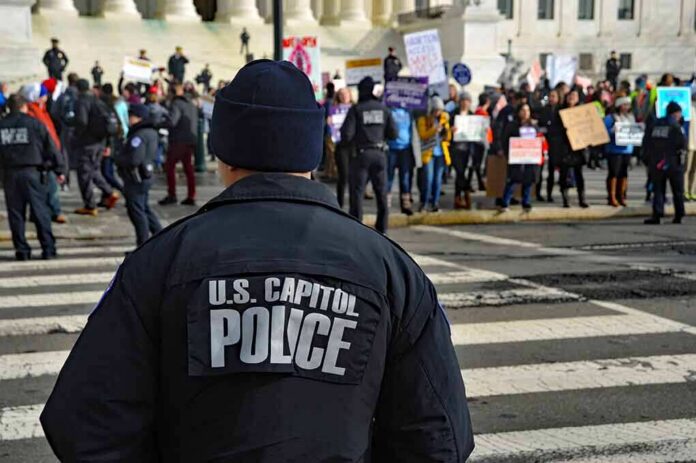
Major Jason Watson did not sneak into the Capitol or storm through a broken door. He walked up the steps in his Air Force uniform, held a sign calling for Donald Trump’s impeachment, removal, and conviction, and stood there in open, nonviolent protest. He urged members of Congress to back impeachment articles, echoing Representative Al Green’s long-standing effort to remove Trump from office. Capitol Police then arrested him on the spot, in full view of cameras and passersby, for what supporters describe as civil disobedience.
Watson is no fringe character. He is an active-duty United States Air Force officer with roughly seventeen years of service and commendations that include the Defense Meritorious Service Medal. That means he has spent almost two decades carrying out orders from presidents of both parties. His protest did not come from ignorance of the system. It came from inside it. That is why his arrest hits differently than a random activist shouting on a sidewalk; this was a decorated insider saying the Commander in Chief had crossed a line.
The charges behind his accusations
Watson accused Trump of violating the War Powers Act by ordering military strikes against Iran and Venezuela without proper Congressional approval. He claimed those strikes caused deaths and suggested Trump’s actions served the wishes of wealthy donors. These are serious charges, but there is a gap: the available public record does not yet confirm his specific casualty numbers or donor control claims. For now, they remain allegations from a concerned officer, not findings from a court or a Pentagon report.
Where Watson’s claims connect to broader history is in the long debate over how presidents use force. For more than two centuries, presidents have leaned on laws like the Insurrection Act to deploy military power in ways many citizens later question. Legal experts warn that these broad powers give presidents wide room to act first and seek permission later. Watson’s protest fits into that larger worry: a fear that unchecked executive force overseas and at home can drift far from what the Constitution intended.
The rules he knowingly broke
Supporters frame Watson’s stand as a pure free speech moment. Military law does not see it that way. Official guidance from Air Education and Training Command makes it very clear: service members are barred from appearing in uniform at political meetings, rallies, or demonstrations. The guidance cites Department of Defense Instruction 1325.06 and Air Force Instruction 51-508, which together spell out that off-base protests in uniform are not allowed. This is not a gray area policy memo. It is black-and-white regulation.
Other military guidance says the same thing in plain language. An Army garrison explainer on political activism tells troops they may attend protests, but they must never wear the uniform when they do so. The reason is not hard to understand. The uniform belongs to the country, not to one party, candidate, or cause. Wearing it at a partisan event makes it look like the Armed Forces themselves have taken a side. That is exactly what the Pentagon wants to avoid and exactly what Watson chose to risk.
Oath versus orders: the core clash
Watson’s defenders say his oath to support and defend the Constitution outranks any regulation about where he can stand in uniform. In their view, when a president violates the law, a loyal officer must speak up, even if it means breaking lesser rules. That argument taps straight into American conservative values: the idea that the Constitution is higher than any politician, and that duty sometimes means saying “no” to power rather than “yes.” It also matches a long pattern of “dissent in uniform” when wars or presidents cross moral lines.
Active-duty U.S. Air Force Major Jason Watson was arrested on July 1, 2026, on the steps of the U.S. Capitol after publicly demanding the impeachment of President Donald Trump and Vice President JD Vance. Wearing his military uniform, he held a sign that read "Impeach. Convict.…
— 🇺🇸Yooper🇺🇸 (@Yooperhomestead) July 1, 2026
The problem is that the military justice system does not grant officers a personal veto over regulations. Courts have long upheld limits on speech for active-duty members, especially when it involves the uniform and partisan politics. Conservative common sense cuts both ways here. On one hand, many Americans want warriors who think for themselves and push back when they see illegal orders. On the other hand, they know a military where each officer decides which rules to obey quickly stops being a military and becomes a loose group of armed factions.
The real stakes: career, pension, and silence
Watson now faces possible court-martial and the loss of his pension if the Air Force decides to throw the book at him. That punishment would signal to every other service member that public dissent in uniform, even nonviolent and carefully worded, can destroy a twenty-year career. Major outlets like Reuters and Yahoo News already frame the story as a violation of military regulations that threatens his future, not as a test case for free speech. That framing shapes public opinion before any judge hears full arguments.
Critics see a deeper problem. When the system hits the loudest voice with maximum force, other would-be whistleblowers stay quiet. The message becomes clear: speak up in uniform and you might lose your livelihood, your health care, and your retirement. For a force that depends on honest reporting and moral courage, that is a dangerous signal. Conservatives who value accountability should ask a simple question here. Does crushing a nonviolent protest on the Capitol steps make America’s military stronger, or does it just make its leaders safer from criticism?
Sources:
thegatewaypundit.com, freespeechforpeople.org, yahoo.com, instagram.com, reddit.com, aetc.af.mil, jbsa.mil, static.e-publishing.af.mil
© restoreamericanglory.com 2026. All rights reserved.