Minnesota Gov. Tim Walz and the state’s Board of Pardons cleared the criminal record of a man who pleaded guilty to sexually abusing a 10-year-old girl, a move that gives him a legal foothold to fight his deportation to Laos.
Story Snapshot
- The Minnesota Board of Pardons voted unanimously on June 10, 2026, to pardon Tou Lue Vang, who pleaded guilty to first-degree criminal sexual conduct against a child.
- Vang, 42, came to the U.S. as a child from Laos and was facing deportation. The pardon clears his record and gives him a chance to contest his removal order.
- The victim, who was 10 years old when the abuse started, sent a letter supporting the pardon.
- The Department of Homeland Security blasted the decision, saying the pardon wipes out the very conviction that justified deporting Vang.
What the Board of Pardons Actually Did
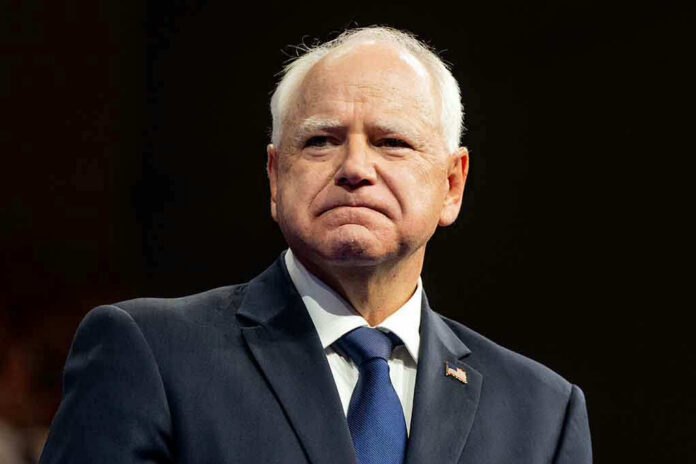
The Minnesota Board of Pardons is made up of three people: Gov. Tim Walz, Attorney General Keith Ellison, and State Supreme Court Chief Justice Natalie Hudson. All three voted yes. The board cleared Vang’s conviction for first-degree criminal sexual conduct, a guilty plea he entered in a deal that kept him out of prison. That conviction was the legal basis for his deportation order. Wiping it out gives Vang’s lawyers something to work with in immigration court.
A state pardon does not guarantee Vang stays in the country. Federal immigration judges are not bound by a state board’s decision. But legal experts note that for many categories of crime, a governor’s pardon can erase a conviction for immigration purposes, removing the automatic trigger for deportation and handing the case back to a judge’s discretion. That is precisely what the Department of Homeland Security says it fears here.
The Victim’s Letter and the Board’s Reasoning
The board did not act carelessly or in secret. The nine-member Clemency Review Commission reviewed Vang’s petition in April 2026 and recommended the pardon, with four members in favor and two against. Vang submitted a letter expressing remorse. The victim, now an adult, also submitted a letter endorsing the pardon. Attorney General Ellison’s office confirmed the victim’s support to The New York Times, calling the full process thorough and transparent.
That victim letter matters. It is not nothing. Survivors of childhood sexual abuse rarely engage with pardon proceedings at all, and when one does, it deserves weight. Still, the victim’s forgiveness, as meaningful as it is personally, does not erase the public interest question at the center of this fight: whether a state board should have the power to neutralize a federal deportation order by wiping a serious criminal conviction from the books.
The Federal Government’s Response
The Department of Homeland Security did not hold back. Acting Assistant Secretary Lauren Bis confirmed that Vang lost his legal immigration status specifically because of his conviction for the repeated sexual assault of a 10-year-old girl. Bis stated directly that the pardon would cancel the criminal conduct conviction that formed the basis of his removal order. That is not spin. That is the legal mechanics of what happened, stated plainly by the agency responsible for enforcing immigration law.
The three-person Minnesota Board of Pardons:
Gov. Tim Walz
A.G. Keith Ellison
Chief Justice Natalie HudsonUnanimously granted this child rapist a pardon.
He was being fast-tracked for deportation because of the conviction. https://t.co/VL0mvzIKV4
— Sean Nienow (@SNienow) July 2, 2026
This is the second time in June 2026 that the Minnesota Board of Pardons moved quickly to pardon a noncitizen facing deportation. The board also unanimously pardoned Jai Vang, a 49-year-old Laotian man convicted of aggravated robbery in 1994 at age 18, after Immigration and Customs Enforcement picked him up during Operation Metro Surge. Walz called a special session specifically to get that pardon done before deportation could be completed. A pattern is forming, and it is hard to miss.
The Bigger Problem With This Pattern
Walz said publicly that immigration status alone is not a reason to grant a pardon. That is a defensible legal principle. But the timing of these special sessions, called urgently the moment Immigration and Customs Enforcement moves on someone, tells a different story. The practical effect is that Minnesota’s pardon board is functioning as a last-minute brake on federal deportation enforcement. Whatever the stated reasoning, that is the result.
Conservative critics and common sense point to the same concern. The pardon power exists to correct injustice, not to serve as a procedural escape hatch from federal immigration law. When a state board rushes to erase a child sexual abuse conviction the moment a deportation clock starts ticking, it is reasonable to ask who exactly is being protected and from what. The victim’s forgiveness is her own. The pardon’s immigration consequences belong to everyone.
Sources:
townhall.com, youtube.com, foxnews.com, fox9.com, mn.gov
© restoreamericanglory.com 2026. All rights reserved.