
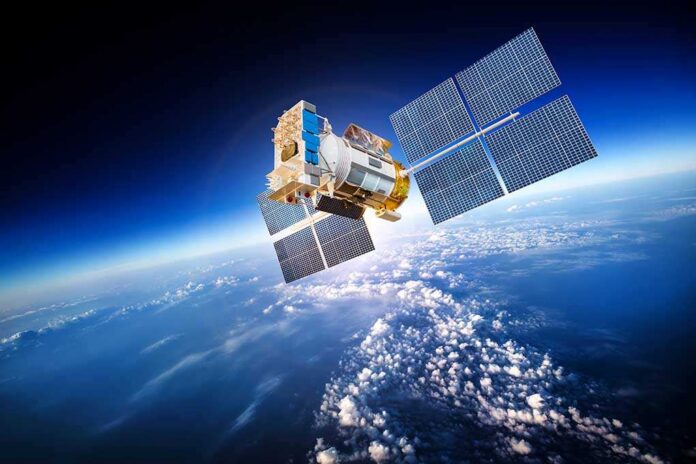
NASA just fired a robot tow truck into orbit to grab a falling $250 million telescope before it burns up over our heads.
Story Snapshot
- A startup’s robot, Link, has launched to rescue NASA’s aging Swift space telescope before reentry
- The mission will try a first-ever capture of a satellite never meant to be serviced, using three robotic arms
- If Link can push Swift about 300 kilometers higher, scientists may get roughly ten more years of discovery
- The months-long rescue could define how America handles its expensive, dying hardware in space
A $250 Million Telescope Starts Falling Out Of The Sky
NASA’s Neil Gehrels Swift Observatory has spent more than twenty years hunting the brightest explosions in the universe, the violent gamma-ray bursts that light up distant galaxies. Launched in 2004, Swift was a workhorse, not a headline act. It quietly fed data to scientists, far from the drama of rockets and moon landings. Now, thanks to thicker upper atmosphere from strong solar activity, that quiet veteran is sinking faster than planned and could reenter before year’s end.
Reentry is a polite word for “burns up and is gone forever.” There is no gentle retirement for a low-orbit telescope without fuel. When its orbit decays enough, drag wins and the craft comes down in a blaze. That would erase a still-useful observatory that cost taxpayers hundreds of millions to build and launch. For a country already worried about waste and debt, watching a healthy science asset die in a fireball is not most people’s idea of good stewardship.
The Bargain-Basement Space Tow Truck
Instead of shrugging and writing a check for a replacement, NASA cut a deal that sounds like something out of a frugal entrepreneur’s playbook. In September 2025, the agency awarded Arizona-based Katalyst Space Technologies a $30 million contract to develop a rescue spacecraft called Link. That price includes the spacecraft and the launch. CBS analysts have already called it “bargain basement in the space world.” By big-program NASA standards, this is a used pickup, not a new luxury SUV.
Katalyst is not an old giant contractor with decades of flight heritage. It is a startup built around in-orbit servicing and refueling. The company says it went from contract award to a flight-ready spacecraft in about nine months, a timeline traditional programs would consider almost reckless. For conservatives used to bloated budgets and endless delays, the idea of a nimble private outfit delivering a complex vehicle this fast and this cheap is exactly the kind of experiment many have wanted NASA to try.
Catching A Falling Telescope With Robot Arms
The plan itself is deceptively simple: Link finds Swift, grabs it, and fires its thrusters until the telescope is safely higher. In practice, the job borders on insane. Swift was never designed for servicing. It has no docking ports, no handholds meant for rescue, no extra fuel to help. Link carries three robotic arms, rendezvous sensors, and xenon thrusters meant to clamp onto old ground-handling fixtures still bolted to Swift’s body.
To work, Link must creep up on a school-bus-sized machine traveling around 17,000 miles per hour, match its path with millimeter-level precision, and latch onto hardware that engineers on the ground are watching through cameras and models. The capture and orbit-raising are expected to take several weeks to months, not minutes. Every day, navigation errors, sensor glitches, or small mechanical flaws could turn a seventy-million-pound effort into twisted metal drifting uselessly.
Historic First Or Expensive Gamble?
Mainstream coverage has hammered one phrase: “first-of-its-kind,” paired with “high-risk.” Reporters are not wrong. No one has ever successfully used a commercial robot to capture a United States government satellite that was not built with servicing in mind. NASA’s own plans for its On-orbit Servicing, Assembly, and Manufacturing 1 mission, meant to refuel a non-serviced satellite, have slipped for years because the technical challenges are brutal.
NASA’s Swift observatory (launched in 2004) is falling back to Earth, but startup Katalyst Space launched its LINK spacecraft today. LINK, the first fully autonomous U.S. satellite servicing mission, will rendezvous, grapple with robotic arms, and boost Swift’s orbit by 240 km,…
— Sakura | Emerging Tech (@SakuraTech21) July 4, 2026
Here is where common sense and conservative instincts collide. On one hand, throwing away a working $250 million telescope because it is falling early feels like classic government waste. Spending $30 million on a private fix that could buy ten more years of science is smart, lean, and shows respect for taxpayer money. On the other hand, entrusting a unique national asset to a startup on a compressed schedule, using a retiring Pegasus XL rocket on its final flight, sounds like rolling the dice with the family heirlooms.
Why This Rescue Matters Far Beyond Swift
If Link pulls off the capture and the push to roughly 600 kilometers, Swift becomes more than a saved telescope. It becomes proof that aging satellites and observatories are not single-use items. Space becomes a place where hardware can be serviced, boosted, and repurposed, not just left to die or clutter up orbit. That shift has huge implications for military assets, commercial communications, and Earth-observing satellites that underpin weather, farming, and energy planning.
A future where robotic space tugs keep billion-dollar satellites alive longer aligns closely with American conservative values about asset protection, defense readiness, and minimizing waste. It favors smaller, specialized companies over sprawling mega-contractors and could cut the need for constant replacement programs driven more by bureaucracy than by real need. But that future only sells if missions like Swift Boost actually work. Until the telemetry, video, and orbital tracking data show a higher Swift and a clean separation, this story remains an unresolved gamble watched closely by fans and skeptics alike.
Sources:
washingtontimes.com, livescience.com, nytimes.com, space.com, usatoday.com, pbs.org, apnews.com, en.wikipedia.org, katalystspace.com, instagram.com, facebook.com
© restoreamericanglory.com 2026. All rights reserved.