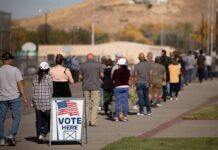


Democrats took back control of both the House and the Senate in the 2026 midterms, flipping seven Republican-held Senate seats in states the GOP had controlled for decades.
Quick Take
- Democrats won majority control of the House and Senate, according to Reuters and the Associated Press.
- Seven Republican-held Senate seats flipped, including long-held GOP strongholds like Texas, Kansas and South Carolina.
- Vote counting continued in Alaska and Mississippi after election night ended.
- The results follow a well-documented historical pattern of midterm losses for a sitting president’s party.
The Numbers Behind Election Night
Reuters and the Associated Press both called the election for Democrats, reporting that the party secured majorities in the House and Senate. Democrats needed to flip just a handful of seats to retake the Senate. They flipped seven: Iowa, Kansas, Maine, North Carolina, Ohio, South Carolina and Texas. That gives the party full control of Congress heading into the second half of President Trump’s term.
A Democratic-led House changes how Washington works day to day. Reuters reported the new majority puts Democrats in position to challenge President Trump’s agenda and open hearings and investigations into his administration. That power shift alone makes this election more than a symbolic protest vote. It hands the opposition party real tools to slow or block White House priorities.
Breakthroughs In Deep-Red Territory
The most striking part of election night happened in states Democrats have not won in a generation. NBC News reported wins by James Talarico in Texas, Adam Hamilton in Kansas and Annie Andrews in South Carolina, calling them victories in states where Democrats had not captured a Senate seat for decades. Roy Cooper won in North Carolina and Sherrod Brown held on in Ohio, rounding out a map that looked nothing like recent cycles.
U.S. News described the overall pattern as extraordinary gains into territory Republicans had long considered safe. Whether that marks a lasting shift in how these states vote, or a one-time reaction to this political moment, is a question only future elections can answer. For now, the numbers on the board are real and countable.
Alaska And Mississippi Still Counting
Not every contest wrapped up on election night. Reuters reported that counting continued in Mississippi’s Senate race, with candidate Colom narrowly ahead as ballots kept coming in. Alaska’s results were also still being finalized. Close races taking extra days to count is a normal part of how American elections work, not a sign anything went wrong.
The Associated Press ran continuous live updates through the following days as officials processed remaining ballots. These final tallies could add or subtract a seat or two from each party’s total, but they won’t change the headline outcome. Democrats already secured enough seats elsewhere to claim both chambers.
History’s Long Pattern Of Midterm Backlash
Voters punishing the president’s party at midterm is nothing new. Since 1946, the party holding the White House has lost House seats in 18 of 20 midterm elections, losing an average of about 26 seats each time. Political scientists call this the “presidential penalty,” a long-running pattern where the sitting president’s party almost always loses ground partway through the term.
That history matters for how Americans should read this election. A Democratic sweep fits squarely inside a pattern that has played out for nearly 80 years, regardless of which party held power. It tells us less about a permanent change in how the country votes and more about how voters typically respond once a president has been in office for two years.
An unexpected Democratic surge across the Deep South is raising questions about the Republican Party's grip on states long considered reliably red, after Tuesday's midterm elections delivered several major upsets and surprisingly close contests. https://t.co/IbEHKdTnXh
— NBC Montana (@NBCMontana) November 5, 2026
President Trump now faces a Congress controlled entirely by the opposition for the remainder of his term. That reality will shape everything from his legislative agenda to how his administration responds to subpoenas and oversight hearings. The coming weeks of certified results, committee assignments and early legislative fights will show just how much this new Congress intends to use the power voters just handed it.
Sources:
reuters.com, usnews.com, rmb.reuters.com, apnews.com, journals.uchicago.edu
© restoreamericanglory.com 2026. All rights reserved.