

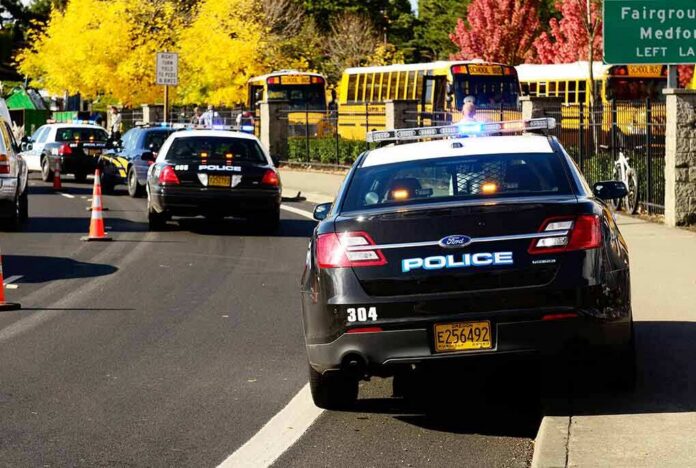
Prosecutors say a 15-year-old mixed chemicals in a Portland high school cafeteria to unleash toxic gas—and they charged him with domestic terrorism and attempted murder for it.
Story Snapshot
- Police and prosecutors filed 19 counts, including domestic terrorism and multiple attempted murder charges.
- Investigators say the student brought chemicals from home, mixed them in the cafeteria, and passed out from the fumes.
- The incident triggered a major hazmat response and sent students and staff for medical checks, officials said.
- Police initially said the student appeared to act alone, with no ongoing threat to the public.
Charges That Signal a New Line in the Sand
Multnomah County prosecutors charged the Benson Polytechnic High School student with 19 felonies after a September 8 chemical release inside the school cafeteria. The list includes domestic terrorism in the first and second degrees and a dozen counts tied to attempted murder or attempted aggravated murder, according to public court briefings and local reporting. Police described a serious incident, a mass emergency response, and a student in critical condition after inhaling the gas produced by the mixture. The scale of the charges shows how leaders now treat school-based chemical attacks as potential mass harm.
Portland Police said the teen brought common household chemicals from home and mixed them on campus. They said he then lost consciousness from the fumes as a visible cloud spread, prompting evacuations and medical screenings for students and staff. The police update emphasized the criminal nature of the acts and listed counts that match attempts to kill and to terrorize, signaling prosecutors read the student’s conduct as intentional and deadly, not a prank gone wrong. That intent claim will be the fight in court.
What Investigators Say Happened Inside the Cafeteria
Investigators identified the target substances as a toxic gas cocktail that can include hydrogen sulfide and hydrogen cyanide, both dangerous at low concentrations. Officials said the mixture released noxious fumes in a shared space where students and staff would be most exposed during the morning rush. Police said the teen collapsed from inhalation, which aligns with the risks of those gases in confined spaces. First responders moved fast, set up decontamination, and stabilized the student, who was later expected to survive, according to police.
Prosecutors described evidence they say shows preparation and intent. Local outlets reported statements in court describing a bag of chemicals, protective goggles, and behavior that fits a plan rather than a spur-of-the-moment stunt. Prosecutors also said the teen aimed to hurt classmates while harming himself, which explains the mix of terrorism and attempted murder counts alongside the student’s own medical crisis. If surveillance video and digital records back that claim, a jury will likely see design, not accident.
How Authorities Framed Risk, Motive, and Public Safety
Portland Police said early on that investigators believed the student acted alone and that there was no ongoing threat to the school or the public, which helped calm a rattled community. Police also told reporters they were still working to determine motive and would not speculate before finishing interviews and lab work. That early caution made sense for a hazmat scene. Prosecutors later filled in their theory of intent once they had more facts they felt stood up to charging standards.
A student at Benson Polytechnic High School in Portland is facing a domestic terrorism charge after a chemical incident.https://t.co/unuXPpa9fi
— MyNorthwest (@Mynorthwest) October 2, 2026
From a public safety lens, the charging decision reflects a common sense standard: when someone makes a toxic cloud in a school cafeteria, the law should treat it like an attack. American conservative values draw a bright line here. Schools are sacred spaces. If a person knowingly spreads poison in a lunchroom, leaders must use the strongest laws on the books. The terrorism framework exists for exactly this kind of deliberate harm against civilians in a communal place.
What Comes Next and What It Means
The case now moves through court, where the state must prove intent, not only exposure. Expect defense arguments about the teen’s mental state, capacity, and whether he meant to kill versus scare or self-harm. Prosecutors will point to choice of location, timing, tools, and digital footprints to show planning and awareness of risk. A judge will also weigh whether to shift this juvenile case into adult court, a step the district attorney has discussed in public forums.
Three takeaways stand out for parents and policymakers. First, the hazard is simple chemistry, not exotic weapons. That raises hard questions about home storage and school screening. Second, digital behavior matters; what a student searches and posts can become evidence of intent and risk. Third, clarity in emergency response saved lives: fast evacuation, open communication, and honest updates kept fear from turning into panic. None of that replaces accountability. It shows how accountability and preparedness work together.
Sources:
foxnews.com, portland.gov, opb.org, noticias.foxnews.com, katu.com, youtube.com
© restoreamericanglory.com 2026. All rights reserved.