
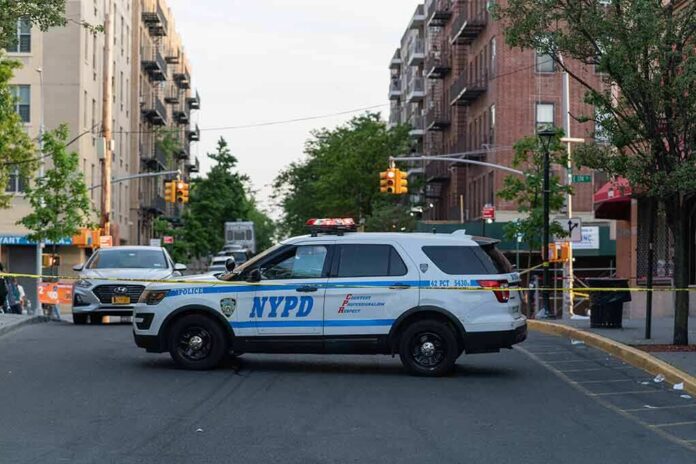
A man yelling “Allahu Akbar” while stabbing an Asian and a Jewish victim in broad daylight on Manhattan’s Upper West Side has turned one quiet neighborhood block into a test case for how America talks about hate, mental illness, and public safety.
Story Snapshot
- Police say suspect Raul Morales yelled “Allahu Akbar” while stabbing both victims, according to witness accounts.
- The victims were an Asian man and a Jewish man, attacked minutes apart in broad daylight near Central Park.
- The New York Police Department is investigating both stabbings as possible hate crimes and also flags mental health as a factor.
- The case shows how fast headlines lock in a narrative before motive is proven with hard evidence.
What Happened On The Upper West Side
Two men were stabbed, minutes apart, on a weekday afternoon in Manhattan’s Upper West Side, a place many New Yorkers see as safe and quiet. Police say 51-year-old Raul Morales attacked a 57-year-old Asian man and a 50-year-old Jewish man near West 84th Street and Central Park West, about two blocks apart. Both men were stabbed in the torso, rushed to Mount Sinai Morningside, and are expected to survive, which matters when we talk about justice instead of funerals.
New York Police Department Commissioner Jessica Tisch says that, based on victim and witness statements, Morales yelled “Allahu Akbar” during both attacks. That phrase became the spine of every headline within hours. Officers arrested Morales after he ran and barricaded himself in an apartment building; a bystander helped point police to where he was hiding. Police say there is no known link between Morales and either victim, or between the victims themselves, which rules out a personal feud.
Hate Crime Theory And Identity Of The Victims
The New York Police Department is openly treating these as possible hate crimes, not just random street violence. That matters because the victims were not just “two men.” One was described as Asian. The other was described as Jewish and reportedly walking near a synagogue in the middle of a major Jewish fast day. City and community leaders quickly labeled the attack as apparently antisemitic, linking it to a wider rise in attacks on visibly Jewish people.
From a common sense conservative view, motive should not be guessed from a slogan alone, but we also should not ignore patterns. When an attacker allegedly targets an Asian man and a Jewish man, yells a phrase often heard in extremist attacks, and does so in broad daylight near a synagogue, it is reasonable for police to test the hate-crime theory hard. That is not “political correctness”; it is taking seriously the idea that some crimes aim to frighten whole communities, not just injure one body.
The Mental Health Angle And Investigative Caution
Here is where the story branches. In the same breath that Commissioner Tisch mentioned “Allahu Akbar,” she also said the initial investigation suggested mental health may have been a factor. That is not a small footnote. It means detectives saw something in Morales’s behavior that made them think of illness or crisis, not only ideology. They have not yet released a psychiatric report or prior treatment record to prove that.
For now, we only know what officials say: motive is still under investigation, charges are not yet clear, and everything is still fluid. That is the proper legal stance. The law treats hate-crime intent as a high bar. You need more than a phrase. You need evidence that the suspect chose victims because of their identity and acted out of bias, not confusion or delusion. A thorough investigation will look at digital history, past statements, and any post-arrest remarks about Jews, Asians, or religion.
Media Narratives, “Allahu Akbar,” And Public Fear
Older readers have seen this pattern before. A violent act happens. Someone shouts “Allahu Akbar.” Headlines lock in. Commentators rush to call it terrorism or, on the opposite end, rush to blame mental illness and dismiss ideology. In this case, national and local outlets front-loaded the phrase and the victims’ identities, which pushes the hate-crime frame to the center of public debate before evidence is complete.
Raul Morales, 51, was taken into custody after reportedly shouting "Allahu Akbar" & stabbing two people blocks apart on Manhattan’s Upper West Side.
Both victims survived, and NYPD investigators are determining whether to charge the separate attacks as hate crimes. pic.twitter.com/7DBB3dJjnx— John f Kennedy JR (@Amelia_Davilzc) July 24, 2026
From a conservative, law-and-order perspective, both pieces matter. We should demand strong policing, harsh punishment when hate is proven, and honest reporting that does not hide the religious or ethnic context. At the same time, we should expect prosecutors to build motive on facts, not vibes. Mental health talk should not be used to water down serious bias when clear proof exists, but it also should not be brushed aside when illness is real and documented.
What To Watch Next As The Case Unfolds
The real story here is unfinished. Detectives now need to lock down the basic record: body camera footage, 911 calls, surveillance video, written witness statements, and any statement Morales made after arrest. These materials can show whether he repeated the phrase, said anything about Jews or Asians, or displayed clear signs of psychosis or intoxication. Court filings and charging documents will tell us whether the district attorney believes they can prove hate-crime intent beyond a reasonable doubt.
For ordinary citizens, especially those who live in cities, the stakes are simple and serious. People want streets where you can walk to synagogue or through the park without worrying about being stabbed for who you are. They also want a justice system that calls things what they are, whether that is ideological violence, untreated mental illness spilling onto the sidewalk, or both. This Upper West Side case sits right at that crossroads, and how New York handles it will echo far beyond one block.
Sources:
townhall.com, abcnews.com, youtube.com, timesnownews.com, facebook.com, jns.org, jpost.com, thegatewaypundit.com, x.com, instagram.com
© restoreamericanglory.com 2026. All rights reserved.