
When a former president calls political opponents “traitors” and suggests death as punishment, American democracy is tested at its breaking point—are we witnessing a new era of political warfare or the unraveling of constitutional norms?
Story Snapshot
- Donald Trump’s “traitors” accusation ignites controversy and Democratic outrage.
- Calls for punishment by death shock even veteran political observers.
- Liz Cheney’s reflections on Dick Cheney offer historical perspective on political accountability.
- Military’s role in resisting unlawful orders becomes a focal point for debate.
Trump’s Rhetoric Pushes Political Boundaries
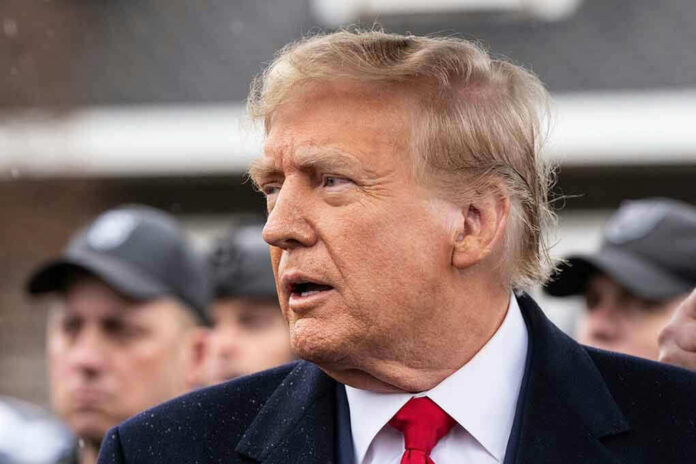
President Trump, never one to shy from controversy, escalated political tensions Wednesday by labeling a group of Democrats as “traitors.” His remarks did not stop there—he advocated for their imprisonment and even suggested death as the appropriate punishment. The outcry was immediate, with Democrats denouncing the comments as not just dangerous rhetoric, but an attack on the very foundation of American democracy. The shockwaves rippled across Capitol Hill, igniting a fresh debate about the limits of political speech and the real-world consequences of incendiary language.
Trump’s comments arrived after several lawmakers called for military personnel to resist unlawful orders from the administration. The assertion that elected officials would encourage the armed forces to question presidential directives became fuel for Trump’s rebuke. His words raised questions about the separation of powers, the role of dissent in government, and the sanctity of constitutional checks and balances. For readers over forty, echoes of McCarthy-era accusations and Nixon’s enemies list resurface, reminding us that the boundaries of acceptable political discourse shift with every generation—yet the consequences remain stubbornly real.
Liz Cheney’s Historical Reflection: Cheney vs. Trump
Amid this firestorm, Liz Cheney offered a pointed reflection on her father, former Vice President Dick Cheney. She contrasted Dick Cheney’s controversial but measured handling of internal dissent with Trump’s bombastic and punitive approach. Liz Cheney’s commentary reminds the public that American history is replete with bitter political divides, but the stakes today feel different. The specter of politicians advocating death for their adversaries marks a departure from even the harshest moments of twentieth-century partisanship. Cheney’s remarks challenge readers to consider what kind of accountability—moral, legal, and historical—should be expected from those who wield power.
Cheney’s intervention is not merely a family affair. It is a deliberate attempt to inject historical perspective into the current crisis and to urge Americans to recall the lessons learned from previous administrations. As political rhetoric becomes increasingly weaponized, Cheney’s warning is clear: unchecked language can lead to unchecked actions. Her stance signals a broader conflict within the Republican Party, as moderates and institutionalists grapple with the legacy of Trumpism and its impact on the GOP’s identity.
Military Loyalty and the Dilemma of Unlawful Orders
The heart of the controversy lies in the question of military obedience. When Democratic lawmakers urged members of the armed forces to resist unlawful orders, they invoked one of the most fraught issues in American governance. The military oath is to the Constitution, not to any individual president—a bedrock principle that has prevented abuses of power and safeguarded the republic through turbulent times. Trump’s reaction, however, reframed the debate as one of loyalty to the executive, rather than fidelity to legal norms.
For conservatives grounded in constitutional principles and common sense, the expectation is clear: the military must act as a bulwark against tyranny, not a tool for personal vendettas. When lawmakers publicly discuss the possibility of resisting presidential orders, and the president responds by calling for their death, a line is crossed that demands a sober reckoning. The American tradition of civilian control over the military depends on robust safeguards and mutual respect between branches of government. This episode forces the nation to confront uncomfortable questions about the fragility of those safeguards in the face of escalating polarization.
Political Accountability and the Future of American Discourse
As the aftermath of Trump’s remarks unfolds, the debate over political accountability intensifies. Democrats have called for censure, investigations, and public condemnation. Some Republicans, including Liz Cheney, have distanced themselves from Trump’s rhetoric, arguing that such statements betray the conservative values of limited government and respect for the rule of law. The path forward remains uncertain. Will American politics recalibrate toward civility and constitutional order, or will the cycle of escalation continue, with each side seeking ever more extreme measures to punish its opponents?
The episode is a stark reminder that the health of American democracy depends not just on laws and institutions, but on the conduct of those in power. Readers who lived through Watergate, the Clinton impeachment, or the aftermath of 9/11 know that political storms eventually pass—but the damage to norms and trust can linger for generations. As the nation watches and waits, the question remains: is this the breaking point, or simply another chapter in America’s long struggle to reconcile liberty with loyalty?
Sources:
Trump calls Democrats’ message to troops seditious behaviour, punishable by death