

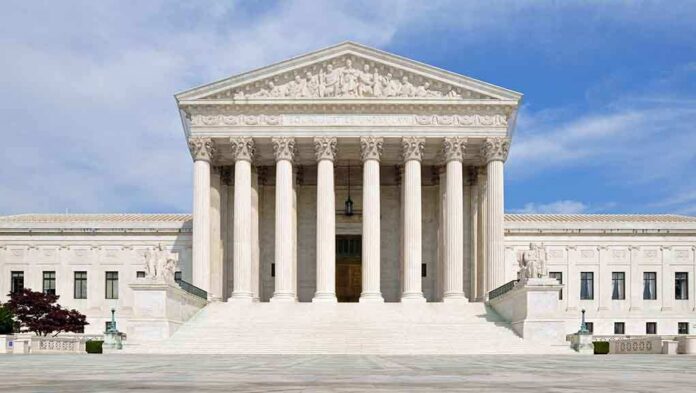
The Supreme Court just handed Republicans the keys to redraw political power in Texas, overruling a district court that spent months proving the state’s new congressional map was built on racial gerrymandering.
Story Snapshot
- Supreme Court issued emergency stay allowing Texas’s 2025 congressional map to proceed despite district court ruling it an unconstitutional racial gerrymander
- Three-judge panel produced 160-page opinion finding “clearcut” evidence Texas legislators used race to draw lines favoring Republican candidates
- Decision affects millions of Texas voters, potentially eliminating multiple Democratic districts and shifting national House balance
- Court used controversial “shadow docket” process, overriding detailed fact-finding with minimal explanation weeks before elections
The District Court Found What Texas Tried to Hide
The three-judge district court didn’t issue its ruling lightly. After a full trial examining witness testimony, internal communications, and alternative map proposals, the panel documented how Texas legislators made race the predominant factor in drawing congressional boundaries. The court identified three smoking guns: redistricting triggered by racial targets allegedly set by the Justice Department, governor’s communications explicitly emphasizing race in map decisions, and the absence of viable race-neutral alternatives that could achieve the same district configurations. Texas claimed compliance with federal law, but the evidence showed race driving the pen, not legal requirements.
This wasn’t partisan handwringing. The district court’s 160-page opinion represented months of careful analysis, the kind of thorough judicial work that typically commands appellate deference. Texas Republicans aimed to secure additional House seats after the census, a legitimate political goal. But the Constitution draws a bright line between using partisanship and using race to achieve electoral advantage. The lower court found Texas crossed that line, reassigning millions of voters based on skin color rather than political preference, violating the Fourteenth and Fifteenth Amendments in pursuit of Republican gains.
Shadow Docket Justice Reverses Months of Fact-Finding
The Supreme Court’s emergency stay came through its shadow docket, the expedited process reserved for urgent matters requiring immediate intervention. With minimal written explanation, the Court blocked the district court’s injunction, allowing Texas to use the challenged map in upcoming elections. The timing matters enormously. Lower courts traditionally avoid disrupting elections on the eve of voting, citing stability concerns. The district court acknowledged this principle but found the constitutional violations too severe to ignore. The Supreme Court flipped that calculus, prioritizing election timing over racial gerrymandering evidence the lower court called “strong” and “direct.”
The dissenting justices captured the stakes plainly: the stay “disserves millions of Texans” whose districts were redrawn based on race. They noted the district court “did everything one could ask” in conducting a thorough trial and producing detailed findings, only to be overruled without substantive explanation. This use of the shadow docket bypasses the normal appellate process where parties submit full briefings and courts issue reasoned opinions. Instead, Texas gets its preferred map for the next election cycle while the merits case proceeds, potentially cementing Republican gains before any final ruling.
National Implications Beyond Texas Borders
Texas isn’t operating in a vacuum. Analysis suggests if other states adopt similar aggressive redistricting strategies, between six and twelve Democrat-held congressional districts could vanish, a swing larger than recent House majority margins. The Supreme Court’s decision effectively lowers the risk calculus for state legislatures considering racially gerrymandered maps. If a detailed district court opinion backed by months of evidence can be stayed on the shadow docket, what deterrent remains? The Brennan Center characterized the ruling as creating a “political system primed for distortion,” enabling map manipulation that entrenches power regardless of voter preferences.
The precedent also weakens lower court authority in redistricting disputes. District judges hear evidence, assess witness credibility, and apply constitutional standards through rigorous fact-finding. That institutional role depends on appellate courts respecting factual determinations unless clearly erroneous. Here, the Supreme Court intervened before any standard appellate review, signaling that emergency stays can override even the most thorough district proceedings when political stakes run high. This approach may encourage more litigation gamesmanship, with states racing to implement challenged maps before courts can intervene effectively.
The Constitutional Line Between Politics and Race
Supreme Court precedent permits partisan gerrymandering but prohibits racial gerrymandering. States can draw maps to favor one party over another, a practice the Court has declined to police under the political question doctrine. Race is different. The Fourteenth Amendment’s Equal Protection Clause and the Fifteenth Amendment’s voting protections forbid using race as the predominant factor in redistricting. The challenge lies in disentangling the two, since race and party affiliation often correlate. Texas argued its map targeted Democrats, not racial minorities, a defense the district court rejected after examining the evidence showing race predominated over partisanship in line-drawing decisions.
🚨 BREAKING: Supreme Court hands Republicans a redistricting win by striking down lower court block on Texas map pic.twitter.com/0V9MXFzRCv
— Fox News (@FoxNews) April 27, 2026
That distinction matters for constitutional governance. Allowing states to cloak racial gerrymandering as partisan strategy renders the Fourteenth and Fifteenth Amendments toothless. The district court recognized this, finding Texas’s defense inconsistent with the facts. The Supreme Court’s stay doesn’t resolve the merits, but it allows the challenged map to shape representation before any final determination on whether Texas violated the Constitution. For voters reassigned based on race, the harm occurs now, not after prolonged appeals. The stay prioritizes procedural efficiency over constitutional rights, a trade-off that deserves scrutiny rather than emergency approval.
Sources:
Supreme Court Order 25A608 – Abbott v. LULAC
Brennan Center Analysis: Supreme Court Hammers Away at Democracy
NCSL – Redistricting and the Supreme Court: The Most Significant Cases