Senators just voted 99–0 to freeze their own paychecks during a shutdown, and the real story is how that one move could quietly rewrite the rules of Washington brinkmanship.
Story Snapshot
- A rare 99–0 Senate vote advanced a resolution to withhold senators’ pay during any future government shutdowns .
- Pay would not disappear; it would be held in escrow until the government reopens, framed as “shared sacrifice” with federal workers [4].
- The rule only binds the Senate and only after the 2026 elections because of constitutional limits on changing congressional pay [4].
- Backers call it common sense accountability; critics warn it is symbolism that still leaves federal workers exposed [1].
How A 99–0 Vote Finally Put Senate Pay On The Line
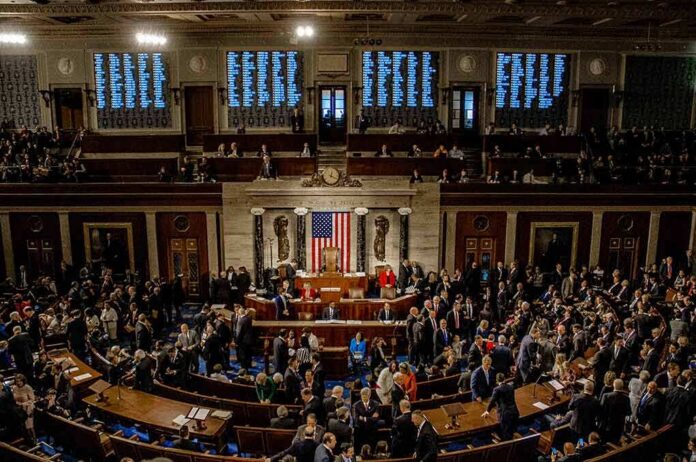
Washington rarely agrees on lunch, let alone on punishing itself, yet the Senate just advanced Senator John Kennedy’s resolution on a 99–0 procedural vote to tie senators’ pay to government shutdowns . This was not a backbench stunt tucked in a drawer. The Senate Rules and Administration Committee had already moved it forward unanimously, signaling institutional buy-in from both parties . When a club famous for protecting its perks votes to constrain itself, something in the politics has clearly shifted.
The core idea is refreshingly blunt. If Congress fails to fund federal agencies on time and the government shuts down, senators stop getting paid. Their salaries are parked in an escrow account and released only after the shutdown ends [4]. Kennedy sells it as an issue of basic fairness: hundreds of thousands of federal workers, including Transportation Security Administration screeners and Federal Emergency Management Agency staff, go without pay during a shutdown; senators should not cash checks while those workers scramble to pay rent [4].
Shared Sacrifice Or Clever Optics?
The resolution’s power rests less in the dollars than in the symbolism. Senators earn a healthy salary, and escrowed pay eventually shows up in their bank accounts. But the rule would make shutdowns personally inconvenient for the people orchestrating them. No more gliding through a crisis with uninterrupted income while 670,000 federal workers sit at home, as happened during the forty‑three‑day shutdown that became a national embarrassment [3]. That alignment between rhetoric and personal risk resonates with common sense conservative values about skin in the game.
Critics answer that symbolism is not the same as reform. Past objections from Democrats such as Patty Murray and Dick Durbin argued that Kennedy’s earlier bills failed to guarantee full pay for federal workers and could let a president pick which employees get paid based on political favor, while senators absorbed only a temporary delay in their paychecks [1]. Senator Rand Paul complained that Congress should focus first on ensuring military members, air traffic controllers, and other essential workers receive pay during shutdowns, with lawmaker pay treated as secondary theater [1]. That critique speaks to a legitimate hierarchy of priorities.
The Constitutional Guardrails And The House Gap
The resolution’s delayed start date is not a bug so much as a constitutional brake. The Twenty‑Seventh Amendment bars any law that changes the compensation of members of Congress from taking effect until after the next election of the House of Representatives. Kennedy cites that amendment, along with the 2013 “No Budget, No Pay” approach, to justify the use of escrow and the requirement that the rule only bite after the 2026 elections [4]. That timing undercuts the idea of an immediate deterrent but anchors the policy in established constitutional ground.
The second big limitation is institutional. This rule applies only to the Senate; it does not touch House members’ pay [3][4]. That asymmetry means shutdown politics in the House remain largely untouched. A determined House faction could still treat shutdowns as leverage, knowing their own paychecks continue while only senators feel the squeeze. For voters who think the entire political class lives by different rules, a Senate‑only fix feels like a halfway step—better than nothing, but not the full accountability remodel the town badly needs.
Will Hitting Senators’ Wallets Change Shutdown Behavior?
No one can honestly claim to know whether escrowed paychecks will shorten or prevent shutdowns; there is no robust dataset proving that lawmakers behave better when their own income is at risk . What exists is intuitive incentive theory and public anger. Each prolonged shutdown of the modern era has spawned some version of “no budget, no pay,” yet shutdowns keep returning. Still, politics runs on perception, and a chamber that ignores a 99–0 vote for shared sacrifice would be daring voters to punish it for hypocrisy .
🗳️ SENATE VOTE ✅
On Cloture on the Motion to Proceed: Motion to Invoke Cloture on the Motion to Proceed to S. Res. 526; A resolution withholding the pay of Senators if a Government shutdown occurs.
📊 Result: PASSED (99-0, needed 60)
🔴 GOP: 52Y-0N | 🔵 Dem: 45Y-0N | ⚪ Ind:…
— congressX (@Congress_X) May 14, 2026
The deeper question is whether this marks an early crack in Washington’s habit of insulating itself from consequences. A Congress that finally admits its members should feel the same pinch as Transportation Security Administration officers in a crisis is, at minimum, bowing to a reality many Americans already live by: if you do not do your job, you do not get paid. For conservatives who believe in responsibility tethered to results, that is a modest but meaningful step toward sanity. The danger is that leaders bank the political credit and never tackle the structural reforms that would make shutdowns rare rather than ritual.
Sources:
[1] Web – Democrats block Kennedy resolution to withhold senators’ pay …
[3] Web – Senate Advances Bill To Withhold Lawmakers’ Pay During …
[4] Web – Senate unanimously advances resolution to suspend … – WSET