A single person slipping past a barrier near the White House can force the most powerful security apparatus in America to show its seams in public.
Quick Take
- Secret Service agents arrested an unnamed suspect after a barrier breach near The Ellipse, adjacent to the White House, during King Charles III’s Washington visit.
- Authorities have not released the suspect’s identity, motive, or whether weapons played any role; criminal charges were still pending.
- The breach landed in a city already on edge after a separate shooting incident tied to the White House Correspondents’ Dinner.
- Royal-level protection relies on layered “rings” of security, but the outer layers meet the public, where unpredictability lives.
A Barrier Breach During a Royal Visit Tests the Outer Ring
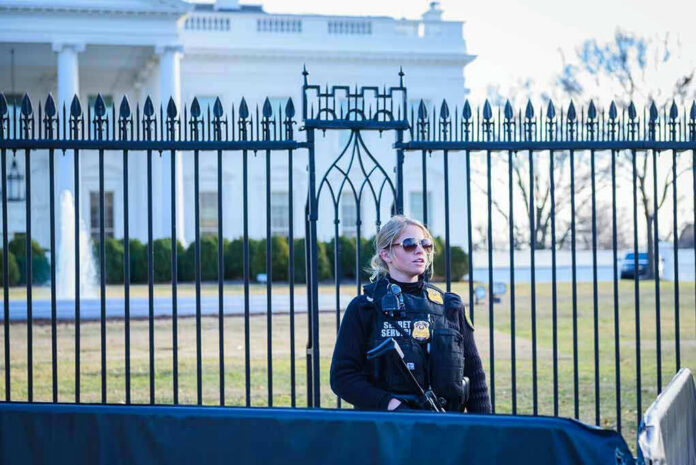
Secret Service officers detained and arrested a suspect Tuesday after the person breached a security barrier near The Ellipse, the stretch of parkland just south of the White House. King Charles III and Queen Camilla were in Washington for a state visit, which automatically triggers a sharper security posture. Officials said charges were pending and withheld the suspect’s identity, motivation, and any details about weapons.
The most important detail is also the least cinematic: the barrier held until it didn’t, and the response came fast enough to keep the incident contained. That containment matters because these moments aren’t judged only by whether anyone gets hurt. They’re judged by what the public learns about the boundaries—where they are, how firm they feel, and how easily one person can create a ripple big enough to drown out diplomacy.
Why “No Motive Released” Is the Detail That Changes Everything
Authorities often stay quiet early for good reasons—ongoing investigations, mental-health concerns, copycat risk. For ordinary citizens, though, “no motive disclosed” reads like an unsolved riddle at the worst possible time. A breach near the White House can be anything from reckless curiosity to a deliberate probe of response times. Common sense says you plan for the worst while you hope for the mundane, because the next intruder may not arrive empty-handed.
The Secret Service’s restraint on details also reflects a conservative truth about security: information is power, and public institutions should not hand tactical lessons to the next person looking for attention. Still, confidence depends on transparency where it doesn’t compromise methods. People will accept inconvenience—fences, screening, restricted zones—when leaders level with them about the nature of threats, not the politics of them.
Washington’s “Turbulent Week” Context Raises the Stakes
The timing made the breach more combustible. Reports tied the broader security tension to a separate incident days earlier at the White House Correspondents’ Dinner involving alleged gunfire and an evacuation, with a named suspect facing serious charges. Whether or not the two episodes connect, the sequence creates a predictable public reaction: the sense that the capital has entered a season where the unthinkable tries to become routine.
That’s where responsible judgment matters. One barrier breach doesn’t automatically equal a systemic collapse, and it shouldn’t be exploited for partisan theater. It does, however, highlight the reality that political violence and high-profile travel compound each other. When a visiting monarch lands in the middle of a jittery security environment, every breach becomes a headline that competitors and adversaries can weaponize as a narrative of American disorder.
The “Ring of Security” Is Real—And the Outer Ring Is the Hardest
High-level protective operations don’t depend on one fence or one agent. They depend on layers: barricades, controlled perimeters, surveillance, undercover teams, vehicle checks, and the kind of planning that treats crowds as variables, not scenery. Royal visits typically intensify that architecture. The public sees the metal and uniforms, but the real work happens in coordination—who talks to whom, how quickly a report becomes a response, and how cleanly a perimeter can be reset.
The outer ring remains the hardest because it touches ordinary life. Tourists drift. Protesters test lines. The mentally unstable wander into history. The attention-seekers chase a viral moment. Security succeeds when it makes the obvious routes inconvenient and the reckless routes short-lived. A breach can still occur, but the system’s job is to prevent that breach from turning into proximity, and proximity from turning into tragedy.
What This Incident Suggests About Security, Politics, and Trust
Conservatives tend to value order, clear consequences, and institutions that do their core job without ideological distractions. This incident argues for all three. First, barriers and enforcement aren’t symbolic; they are functional. Second, charges and prosecution matter because deterrence matters, especially around national security sites. Third, public trust grows when agencies focus on mission performance instead of public relations, while elected leaders avoid cheap outrage that turns real risks into campaign props.
The open question isn’t whether the Secret Service can tackle someone at a fence. The open question is whether America can maintain normal civic life while accepting that some fraction of the population will try to puncture it—out of anger, delusion, or ambition. The royal visit continued, but the breach leaves a lingering lesson: the nation’s most famous address sits in a city where the next test could arrive on an ordinary Tuesday.
US Secret Service arrests suspect after barrier breach near White House during King Charles' visit https://t.co/Ao3chD7XZf
— Hot Talk 99.5 WRNN (@995WRNN) April 29, 2026
Expect the security footprint around future high-profile events to grow less forgiving. More standoff distance, more controlled entry points, and faster crowd compression will frustrate locals and visitors, but that frustration is the price of preventing improvisation near leaders and dignitaries. The public doesn’t need every operational detail to feel confident; it needs evidence that rules are enforced consistently, and that breaches end in custody, not chaos.
Sources:
US Secret Service arrests suspect after barrier breach near White House during King Charles’ visit
King Charles security: ‘Ring of security’ in place after Trump incident
King Charles’ US visit amid security tensions after Trump incident