

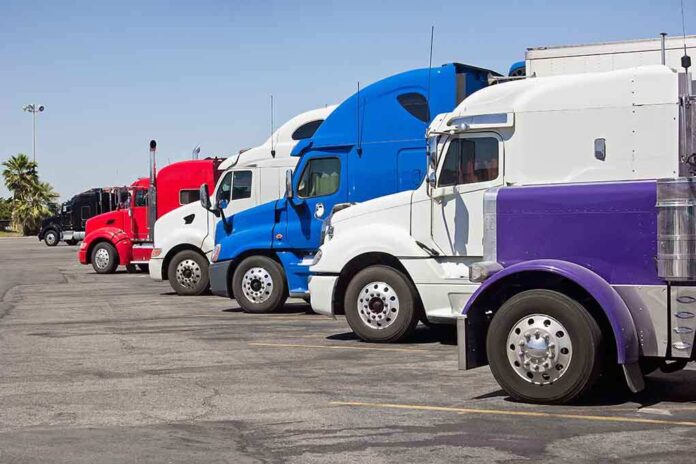
California’s trucking industry stands at a crossroads as the state grapples with federal mandates and contentious regulations that could reshape its economic landscape.
Story Overview
- Federal pressure mounts on California over commercial driver’s licenses for non-citizen drivers.
- State faces a potential $200 million loss in federal highway funds.
- California’s regulations may push truckers out of the state.
- The dispute highlights tension between federal and state priorities.
Federal vs. State: A Regulatory Tug-of-War
California’s trucking industry faces uncertainty as the federal government pressures the state to adhere to stricter commercial driver’s license (CDL) regulations. The U.S. Department of Transportation (DOT) has withheld $160 million in federal funds, adding to an earlier $40 million penalty, due to California’s delay in revoking licenses for approximately 17,299 non-citizen drivers. These drivers’ licenses were found to be non-compliant following a federal audit that revealed issues with work authorization and legal status.
The federal crackdown began after high-profile fatal crashes involving unauthorized immigrant truckers, sparking concerns over highway safety. California’s decision to extend these licenses until March 6, 2026, has only intensified the conflict, with federal authorities insisting on immediate compliance to ensure safety standards are met. This impasse not only affects California’s transportation budget but also raises broader questions about state versus federal authority in regulatory matters.
California’s Regulatory Environment Under Scrutiny
Beyond the CDL issue, California’s stringent regulatory environment has been cited by trucking associations as a factor driving some truckers out of the state. The California Air Resources Board (CARB) emissions regulations and AB-5 contractor rules have long been contentious. These regulations increase operational costs for truckers, pushing independent operators to either leave the California market or avoid state loads altogether. While claims of “thousands leaving” are often estimates, the sentiment reflects ongoing frustration within the industry.
The broader implications of these regulations extend beyond individual truckers. California’s policies have positioned the state at the forefront of environmental and labor rights advocacy. However, this stance has also placed it at odds with federal priorities, particularly under the Republican-led U.S. DOT. The current standoff over CDLs exemplifies the challenges of balancing progressive state policies with federal compliance demands.
The Stakes for Truckers and Industry Stakeholders
The CDL dispute directly impacts thousands of drivers, particularly those within immigrant communities like the Sikh truckers, who are heavily represented among the affected license holders. These drivers face potential job losses and economic hardship if licenses are revoked. Legal challenges from immigrant-rights organizations argue that many of these drivers are lawfully authorized, highlighting the intersection of civil rights and regulatory enforcement.
For California’s freight and logistics sectors, the potential loss of a substantial portion of its trucking workforce could lead to capacity constraints, particularly for routes and sectors reliant on immigrant drivers. However, given that non-domiciled licenses constitute about 5% of all CDLs nationwide, the broader national impact may be less severe. Yet, the financial hit from withheld federal funds threatens to strain California’s transportation infrastructure projects and budgets.
The Road Ahead: Navigating Compliance and Policy
California’s response to this regulatory challenge will shape the future of its trucking industry and its broader economic policies. As the state seeks to negotiate compliance with federal authorities without compromising its regulatory values, the outcome could set a precedent for how similar disputes are handled nationwide. The situation underscores the need for a balanced approach that addresses safety concerns while safeguarding the rights and livelihoods of immigrant workers.
Moving forward, the trucking industry, advocacy groups, and government officials must collaborate to resolve this complex issue. As California navigates this regulatory crossroads, the stakes remain high for all involved, with potential long-term implications for state-federal relations, industry regulation, and economic strategy.