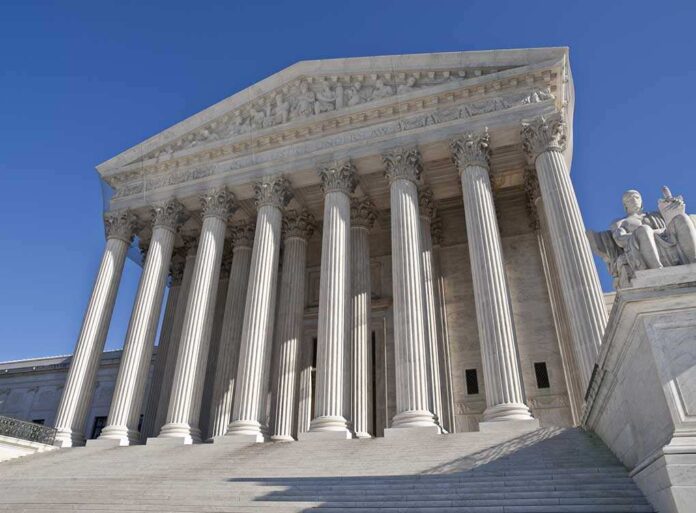
One Supreme Court case about a single man on Alabama’s death row may quietly decide how America defines who is humanly accountable and who is constitutionally off-limits for the ultimate punishment.
Story Snapshot
- The Supreme Court in Hamm v. Smith will decide whether a bare IQ score can be the gatekeeper between life and death.
- The ruling could either cement or hollow out two decades of protections from Atkins, Hall, and Moore.
- The case pits clinical science and disability advocates against states demanding bright-line rules and finality.
- The Court’s definition of “intellectual disability” here could spill into disability, education, and benefits law far beyond capital cases.
Why Hamm v. Smith Is About Much More Than One Alabama Inmate
Joseph Clifton Smith is not a law professor’s hypothetical; he is a man Alabama wants to execute for a 1997 murder, and he says he is intellectually disabled. Under Atkins v. Virginia, that should end the death-penalty conversation, because the Eighth Amendment bars executing people with intellectual disability. Yet Alabama insists that because Smith’s IQ scores clear a numerical bar, courts can ignore clinical diagnoses and adaptive deficits and still green-light his execution.
That conflict between a single test number and a lifetime of functioning is what brought Hamm v. Smith to the Supreme Court. Disability advocates warn that if Alabama wins, states will have a simple formula: pick a cutoff score, label everyone above it “not disabled,” and sidestep the constitutional ban. That would turn a constitutional protection into a math problem, one that favors efficiency and finality over nuance and human limits.
How We Got From Atkins to Alabama’s IQ-Only Bid
Back in 2002, Atkins recognized a national consensus that executing people with intellectual disability is cruel and unusual punishment. But the Court let states flesh out the details, and some seized that opening by hard-wiring rigid IQ thresholds often 70 into their statutes and case law. That set off a predictable cycle: borderline scores, disputed testing, and states using the hardest possible edge of the line to keep death sentences intact.
Hall v. Florida stepped in twelve years later and said, in effect, “Numbers are not enough.” Florida’s hard 70 cutoff ignored the standard error of measurement and blocked defendants from presenting evidence of adaptive deficits. The Court said states must be “informed by the medical community’s diagnostic framework,” not their own DIY criminal-justice shortcuts. Moore v. Texas doubled down, rejecting lay stereotypes and outdated “Briseño factors” in favor of current clinical standards from groups like AAIDD and the APA.
The Clash Between Clinical Reality and State-Controlled Bright Lines
Clinically, intellectual disability rests on three pillars: significantly subaverage intellectual functioning, substantial limits in adaptive behavior, and onset before adulthood. IQ scores matter, but only as one data point interpreted within a range, with errors, across a lifetime. Professionals describe the condition as “lifelong” and “complex,” diagnosable only through a holistic assessment by qualified experts. Alabama’s approach essentially saws off two legs of that three-legged stool and calls the result stable.
From a conservative, common-sense standpoint, there is nothing principled about pretending precision where science itself warns against it. States understandably want administrable rules and finality, but bright lines that contradict professional standards do not conserve tradition; they distort it. The Eighth Amendment’s “evolving standards of decency” never promised evolving toward convenient fictions. It promised that the government, of all actors, will not willfully ignore what we know about human limits when wielding lethal power.
What Is Really at Stake for the Death Penalty and Beyond
Hamm v. Smith will immediately decide whether Smith dies or is permanently removed from death row, likely with a life sentence if he is deemed intellectually disabled under a clinical standard. But the decision’s shadow will stretch over every capital jurisdiction. A ruling that reaffirms Hall and Moore will force states to honor science-based, holistic evaluations, triggering new hearings and resentencings for prisoners screened out by IQ cutoffs. A ruling for Alabama will narrow who counts as disabled and preserve more death sentences in close cases.
The fallout will not stop at the execution chamber. Legal analysts already warn that whatever definition of intellectual disability the Court blesses here will echo into Social Security disability, special education classifications, and other areas where courts and agencies borrow similar criteria. If the Court signals that policy convenience can trump clinical judgment in the most extreme context life or death legislatures will feel freer to trim protections elsewhere.
Why This Case Tests Both Constitutional Memory and Moral Nerve
The current Court is more conservative than the one that decided Atkins and Hall, and some observers expect a push to narrow categorical protections. Disability advocates argue that Alabama is effectively asking the Court to “erase” settled law by reducing intellectual disability to a score sheet. If the Justices accept that invitation, it will not be because new science emerged; it will be because the Court chose deference to state power over the trajectory it set two decades ago.
For readers who value ordered liberty, limited government, and personal accountability, Hamm v. Smith poses a hard but necessary distinction. Holding people responsible for their crimes is essential. Pretending that a person with a clinically established intellectual disability is fully accountable because a test score sits a few points above an arbitrary line is not toughness; it is denial. The Constitution demands better than a checkbox when the state straps someone to a gurney.
Sources:
SCOTUS to Determine Definition of Intellectual Disability