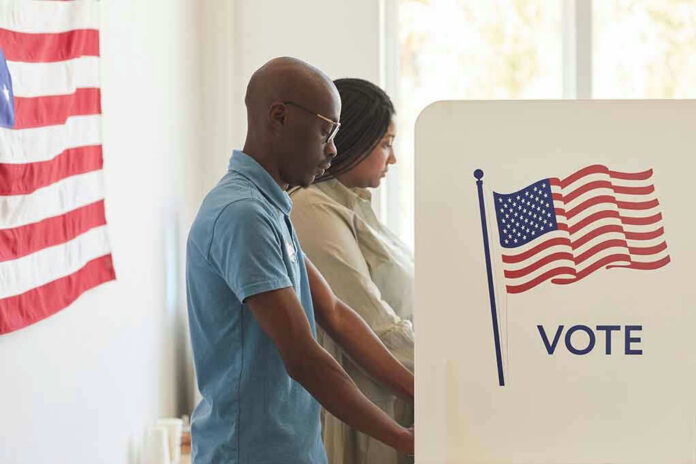
Ohio is about to ask a blunt question this November: should “show your ID to vote” be locked into the state constitution forever.
Story Snapshot
- Ohio senators passed a measure to put a photo voter ID amendment on the November ballot.
- The proposal would elevate current photo ID rules for in-person voting into the state constitution, not create a brand-new system.
- Backers say this protects election integrity from future rollbacks; critics say it is political theater that ignores mail voting.
- Donald Trump has jumped in, pressuring lawmakers and turning a state rule fight into a national 2026 flashpoint.
Ohio’s voter ID fight is not about today, it is about handcuffing tomorrow
Ohio already requires a photo ID when people vote in person, whether on Election Day or during early voting.[2][3] Voters generally show a state driver’s license or ID card, a United States passport, or a military ID.[2][3] The new push, called Senate Joint Resolution 10, does not build a fresh system from scratch. It takes those rules and moves them from regular state law into the Ohio Constitution.[3][6] That change is about power, not paperwork.
Once something sits in a state constitution, the bar to change it jumps. Lawmakers can tweak details around the edges, but they can no longer scrap the core rule with a simple majority in some sleepy future session. Supporters admit that is the point. They say state voter ID rules are under attack in other states and want to “ingrain” Ohio’s requirements so a future legislature or court cannot weaken them.[3][5][6] That is classic conservative instinct: secure the rule before the winds shift.
What the amendment would actually do, and what it would leave alone
The text lawmakers advanced is short and sharp. It says electors must provide identification to vote, and then it lists approved photo IDs: an Ohio driver’s license or ID card, a United States passport or passport card, a United States military ID, an Ohio National Guard ID, or a United States Department of Veterans Affairs ID.[3] It also lets the General Assembly add other photo IDs later, which gives future lawmakers some flexibility as technology changes.[3][6]
The fine print matters more for what it ignores than what it covers. The measure speaks to in-person voting only.[2] It leaves Ohio’s more relaxed rules for mail-in and absentee voting in place.[1][2] That carve-out has split the right. Some Republicans and many conservative activists say if election integrity is the goal, mail ballots should face equal or higher scrutiny, since they are cast outside a polling place.[1][2][4] To them, this amendment looks like a half-built fence with the back gate wide open.
Supporters frame it as common sense; critics call it a solution in search of a problem
Backers of the amendment lean on two big themes. First, they argue that with artificial intelligence making fake utility bills and bank statements easy to print, only government-issued photo ID can keep up with fraud risk.[3][5] Second, they say photo ID is broad public consensus now, not fringe policy, pointing out that more than 30 states have some form of voter ID rule on the books.[5] Their message is simple: it should be easy to vote and hard to cheat, and this locks in that balance.[3][5]
Opponents counter with a different set of facts. Statehouse reporting notes there is no evidence of widespread voter fraud in Ohio, even before the latest photo ID rules took effect.[4] Audits and checks have not uncovered any mass problem that this amendment would fix.[4] Critics also stress that the proposal does nothing to tighten mail-in voting, which covers about one-fifth of Ohio voters.[1][4] From their view, this is not a serious security upgrade; it is a political wedge designed to fire up Republican turnout and send a signal to Donald Trump voters.[1][4]
Trump’s entrance turns a state rules fight into a national 2026 test
Donald Trump has already weighed in, urging Ohio House Republicans to move the resolution and warning them that he is “watching.”[1] That kind of pressure raises the stakes overnight. A technical fight over “code versus constitution” becomes a loyalty test for lawmakers who rely on Trump’s base. National conservative outlets have framed the measure as part of a larger push to secure elections after 2020, while critics see it as relitigating that era instead of dealing with clear current issues.[1][3]
The Ohio State Senate passed a bill last week, putting a constitutional amendment that would mandate voter ID in Ohio elections on the November ballot.https://t.co/UBGBAZMKWD
— Katie Liane (@TheKaterPotater) June 9, 2026
For voters, the real choice is more basic. Do they want current in-person photo ID rules locked in and harder to undo, even if that means accepting a two-track system where mail voting stays looser? From a conservative, common-sense perspective, putting clear identification rules in the constitution is not extreme. It reflects the simple belief that who votes should be as verifiable as who buys a gun or drives a car. The open question is whether Ohio’s voters think the system needs a constitutional padlock, or whether regular law was enough.
Sources:
[1] Web – JUST IN: Ohio State Senate Passes Bill to Put Voter ID Amendment on …
[2] Web – Ohio Legislators Introduce Joint Resolutions Enshrining Voter ID …
[3] Web – Ohio’s New Election Laws | LWV Ohio
[4] Web – Ohio Senate advances photo voter ID amendment measure
[5] Web – [PDF] Secure And Fair Elections – Ohio Attorney General
[6] Web – Voter ID Laws – National Conference of State Legislatures
© restoreamericanglory.com 2026. All rights reserved.