The most unsettling part of the Philippines’ 7.8 earthquake is not the collapsing concrete, but how fast a normal weekday morning turned into a lethal physics lesson about what really fails when the ground decides to move.
Story Snapshot
- A powerful offshore magnitude 7.8 earthquake struck near Mindanao, hammering General Santos City and surrounding communities
- At least dozens were killed and more than 200 injured, many inside damaged or collapsed buildings as concrete and ceilings gave way
- A tsunami of about 1 meter hit nearby coasts and sent smaller waves across the region, triggering wide-area warnings and evacuations
- New video from inside buildings exposes how fragile “normal” becomes when structures, schools, and shops are pushed past their limits
How an Ordinary Morning Turned Into a Structural Stress Test
The quake struck just after 7:30 a.m. local time, offshore from Mindanao, at a magnitude of 7.8 that seismologists rank among the strongest to hit the Philippines this year.[1] People were getting kids to school, opening shops, and heading to work when the shaking began. Within seconds, lights swung, ceilings cracked, and shelves emptied themselves. In General Santos City, a major urban and commercial hub, the shaking intensity reached levels described as very strong and damaging, more than enough to cripple older or poorly detailed structures.[2]
Reports from national and local agencies quickly converged on the same grim basics: an offshore quake, shallow enough to be dangerous, centered near Sarangani province, projected straight at coastal communities and dense urban pockets.[1][2] Office workers fled mid-meeting. Hospital staff scrambled to get patients out as plaster rained down. The first images from phones were not of dramatic skylines but of tiles, glass, and concrete littering floors that people had walked across minutes earlier.
What the “Destruction Inside Buildings” Really Looked Like
Footage from inside several buildings clarifies that this was not a story of a few hairline cracks and some tipped chairs.[3] In one commercial structure, interior walls fractured in jagged patterns, ceiling panels collapsed, and wiring hung exposed like a web over abandoned tables. In a damaged school, chunks of masonry and roofing material landed where students would normally sit, underscoring how close this came to mass casualty in a single building. These scenes match reports of people injured mostly in damaged structures.[1]
Authorities and reporters describe multiple buildings either partially collapsing or suffering heavy cracking, including at least one commercial building that went down during the shaking and other facilities that lost façades or interior support elements.[2][3] Inside, that translated to falling debris, broken glass, and panicked evacuations down dark stairwells. Many of the more than 200 injured were hurt not by the abstract “quake,” but by concrete, glass, and objects that turned into projectiles once the floor began to heave.[1][3]
Death Tolls, Tsunami Waves, and Why the Numbers Never Sit Still
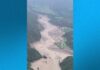
Early casualty numbers ranged from at least 8 dead in initial reports to at least 19 and later 32 as rescuers reached collapsed and isolated areas.[1][2][3] That spread does not signal confusion so much as the usual harsh arithmetic of disaster: numbers climb as search teams move from city centers to outlying villages and as some of the critically injured do not survive. One landslide alone in Sarangani province killed more than a dozen villagers, adding rural tragedy to urban building failures.[1]
Death Toll from Philippines Earthquake Rises to 32..
A powerful 7.8-magnitude #earthquake struck the southern #Philippines on Monday, killing at least 32 people and injuring more than 135 others, according to disaster officials. The quake, centered off the coast of Sarangani… pic.twitter.com/QgyNmQYlNn
— Ayman Mat News (@AymanMatNews) June 8, 2026
The offshore location and magnitude guaranteed that authorities had to treat tsunami risk as real, not hypothetical. The Pacific Tsunami Warning Center projected possible waves up to about 10 feet on some Philippine coasts, and advisories went out across the region.[3] Actual measurements later showed around a 1-meter tsunami along parts of the southern Philippines, including up to roughly 1.4 meters at Kiamba in Sarangani, with smaller waves recorded in Indonesia, Palau, and as far as Japan.[1][2] For coastal communities, that meant a second evacuation on top of the shaking.
Why So Many People Were in Harm’s Way Indoors
Timing and urbanization worked together against residents. The quake hit at the start of the school and workday, when classrooms, offices, and shops were filling up.[2][3] Some teachers say students were outside for flag ceremonies when the ground moved, probably sparing children from being trapped in structurally compromised school buildings.[2] In city centers like General Santos, high occupancy, older construction, and the usual mix of retrofitted and non-retrofitted buildings created a predictable pattern: people hurt by decorative and non-structural elements that were never properly anchored.
The injury patterns reported—over 200 hurt, most in damaged buildings—fit a broader global trend.[1][3] Modern engineering standards can keep many structures from total collapse in strong quakes, but they often do not protect fully against falling ceilings, facades, interior walls, or overloaded shelving. From an American conservative, common-sense perspective, this invites a hard question: if governments claim safety as a core mandate, why do building and code enforcement regimes repeatedly allow the kind of vulnerabilities that turn routine workspaces into lethal obstacle courses?
What This Quake Says About Preparedness and Reality
Authorities recorded aftershocks as high as the mid-6 range, forcing families to sleep outdoors and making every damaged building a potential trap for rescuers.[1][3] Tsunami alerts were lifted after several hours, but the psychological effect of sirens, evacuation orders, and rolling aftershocks will last longer than the waves themselves. The quake’s reach extended beyond Philippine waters, with shaking felt in Malaysia’s Sabah and tsunami readings across a broad swath of the western Pacific.[1]
For viewers watching the destruction-from-the-inside videos, the lesson is both specific and universal. In the Philippines, this event will drive debates about structural standards, coastal zoning, and the balance between economic growth and real-world resilience. For anyone living near a fault line, it quietly rewrites the mental image of an earthquake from a news headline to a ceiling tile over their own head. In disaster math, what fails first is often not the system on paper, but the one you can touch.
Sources:
[1] YouTube – Destruction seen inside building in Philippines after 7.8 magnitude …
[2] Web – Magnitude 7.8 earthquake strikes off the coast of the Philippines, …
[3] Web – A 7.8 magnitude quake in the Philippines kills at least 32
© restoreamericanglory.com 2026. All rights reserved.