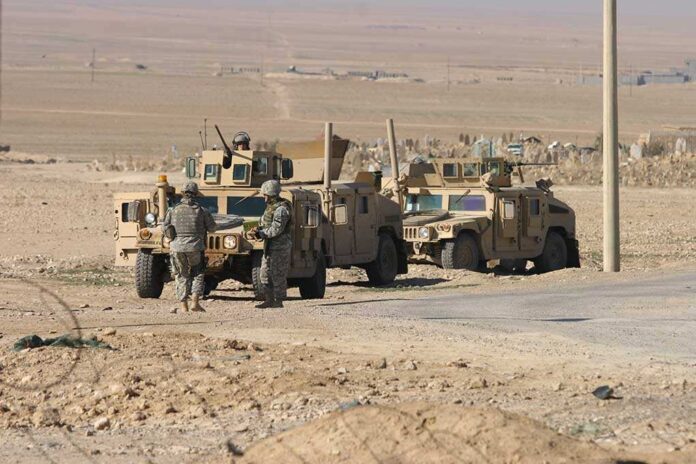
The decision to carve out another militarized zone on the California–Mexico border says more about Washington’s long-term priorities than any campaign speech ever will.
Story Snapshot
- The Trump administration plans a new militarized zone on the California–Mexico border as part of a broader crackdown on unlawful crossings.
- The move signals a long-term shift from flexible border management to permanent security infrastructure.
- The zone will shape local economies, law enforcement culture, and civil liberties debates for years to come.
- The policy exposes the unresolved clash between national sovereignty, humanitarian concerns, and federal overreach.
Border policy turns from revolving door to permanent fortress
The Trump administration’s announcement that it will create another militarized zone on California’s stretch of the U.S.–Mexico border marks a clear line in the sand between the old way of managing migration and a harder, more permanent security posture. Instead of treating border surges as seasonal problems, federal planners now frame unlawful crossings as a semi-permanent security threat that justifies semi-permanent military-style infrastructure, layered patrols, and surveillance technology built to last decades, not election cycles.
Why California became the latest front line
California’s border sectors, long overshadowed by headlines from Texas and Arizona, now sit at the center of a high-stakes policy experiment. Federal officials view the mix of rugged terrain, existing smuggling routes, and major ports of entry as both a vulnerability and an opportunity. A new militarized zone in this region lets Washington test how tightly it can control movement without choking trade, tourism, and local economies that quietly depend on lawful cross-border traffic every single day.
Local communities on both sides of the border will feel those decisions first. Ranchers, small businesses, and trucking operations often support tougher enforcement in principle, yet they tend to bristle when new zones bring checkpoints, delays, and federal agents into what used to be routine daily life. The coming years will reveal whether this militarized footprint can target unlawful crossings precisely or whether it spreads bureaucratic friction across every aspect of border commerce.
Security promises, real-world tradeoffs, and common sense
Supporters of the new zone argue from a straightforward, conservative premise: a sovereign nation that cannot control its borders cannot control its future. They see walls, sensors, and armed patrols as overdue tools to restore order after years of porous enforcement and legal loopholes. From that vantage point, a militarized zone is not a radical step but a late correction, akin to finally locking a door that has been left half-open despite constant break-ins and escalating costs to taxpayers.
Critics counter that militarizing civilian space erodes civil liberties, encourages mission creep, and risks pushing desperate migrants into even more dangerous routes. Their concern aligns with another conservative instinct: skepticism of concentrated federal power that lingers indefinitely once deployed. The credibility of each side’s argument will rest less on rhetoric and more on measurable outcomes—whether the zone actually reduces unlawful entries, trafficking, and cartel activity without punishing lawful travelers and overwhelming local institutions.
Impact on law enforcement culture and local life
New militarized zones do not just add hardware; they reshape the culture of enforcement. Border Patrol and allied agencies shift from reactive interdiction to a more forward-leaning, quasi-military posture, with layered perimeters, rapid-response units, and intelligence-driven operations. That shift can sharpen professionalism and deterrence, but it can also widen the psychological distance between agents and the communities they serve if leaders fail to maintain transparency, accountability, and respect for constitutional limits.
Residents near the zone will adapt to a new normal of visible security, helicopters, drones, night lighting, and more frequent ID checks. Property values, investment decisions, and even school enrollment patterns can tilt in response to perceived safety or disruption. Some communities may welcome the added presence as a stabilizing force against cartels and smuggling corridors. Others will see it as an occupying footprint that complicates daily routines and invites long-term federal entanglement in local affairs.
Trump administration setting up another militarized zone on California-Mexico border https://t.co/5CcfC3xIK4
— Ryan Mancini (@ManciniRA) December 11, 2025
What this reveals about long-term American priorities
Washington’s choice to expand militarized infrastructure in California underlines a broader reality: both parties have talked about “comprehensive immigration reform” for decades, but bricks, barriers, and boots on the ground keep arriving while legislative solutions stall. The Trump-era zone is less an isolated project than a chapter in a longer story of policymakers defaulting to enforcement when consensus on legal pathways, asylum processes, and labor needs proves politically toxic.
For voters, especially those who value national sovereignty, fiscal responsibility, and limited government, the key questions now go beyond whether the zone sounds “tough” on paper. The real test is whether it delivers clear security gains at a cost that aligns with common sense: fewer unlawful crossings, less cartel leverage, and more predictable border management without normalizing a permanent state of exception where military-style zones quietly become the default answer to every policy failure.
Sources:
Trump Administration Adds Militarized Zone in California Along Southern US Border