Mushroom clouds over Nevada may no longer be Cold War relics—they could soon become reality, with President Trump’s order to resume nuclear weapons testing threatening to upend the global order and revive the specter of nuclear fear in America’s backyard.
Story Snapshot
- President Trump has ordered the Pentagon to immediately resume U.S. nuclear weapons testing, ending a three-decade moratorium.
- The announcement, made just before a summit with China’s President, signals a dramatic shift in U.S. nuclear policy and international diplomacy.
- Visible nuclear detonations could return to the Nevada Test Site, raising fears of environmental, health, and geopolitical fallout.
- Experts warn of a new arms race, global treaty erosion, and profound risks for American security and public safety.
Trump’s Announcement: A Shift That Reverberates Globally
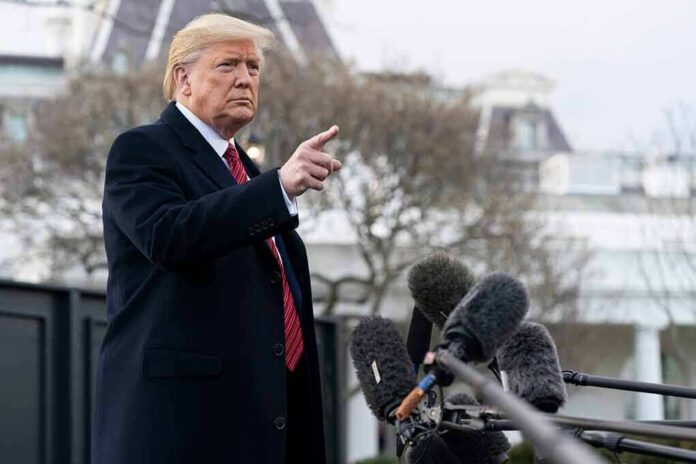
President Donald Trump’s directive for the Pentagon to begin nuclear weapons testing “on an equal basis” with adversaries marks the first such U.S. order since 1992. The announcement, delivered via Truth Social on October 30, 2025, came on the eve of his scheduled meeting with Chinese President Xi Jinping at the Asia-Pacific Economic Cooperation summit. Citing the need to match Russia, China, and others, Trump’s order disrupts a decades-long de facto testing moratorium and injects nuclear brinkmanship into the heart of U.S. foreign and domestic policy. Allies and adversaries alike now brace for the consequences of this abrupt policy reversal.
Decades of cautious restraint, built on the fragile framework of the Comprehensive Nuclear-Test-Ban Treaty (CTBT), now hang in the balance. While the U.S., Russia, and China have signed but not ratified the CTBT, the spirit of the treaty has governed global conduct for over thirty years. Trump’s directive has not only shocked arms control advocates but also ignited debate among lawmakers, defense officials, and the American public about the wisdom—and risks—of reopening the nuclear Pandora’s box in the 21st century.
The Nevada Test Site: From Historical Symbol To Present-Day Flashpoint
The Nevada Test Site, infamous for its Cold War-era mushroom clouds visible from Las Vegas, stands poised to return to the forefront of national and global consciousness. Between 1945 and 1992, this stretch of desert bore witness to more than 1,000 nuclear detonations. The possibility of renewed tests near populated areas has revived long-dormant anxieties about radioactive fallout, public health, and environmental contamination. Residents, local officials, and anti-nuclear groups are mobilizing in anticipation of the social and economic disruptions that full-scale tests could bring.
Experts point to the symbolic danger: detonations in Nevada would not only serve as a technical demonstration but also as a political signal, both to America’s rivals and its own citizens. For many, the return of visible nuclear tests conjures memories of Cold War paranoia and “duck and cover” drills—a potent reminder that the nuclear threat never truly vanished.
Strategic Calculations, International Fallout, and Domestic Backlash
The Trump administration frames the decision as a necessary move to maintain deterrence and demonstrate strength in a world where Russia and China are modernizing their arsenals and North Korea continues to test. Proponents within defense circles argue that America’s aging stockpile requires real-world validation, not just computer simulations and subcritical experiments. Yet, these technical justifications face fierce resistance from arms control advocates, who warn of a cascade effect: if the U.S. breaks the moratorium, Russia and China may follow suit, rendering decades of treaty negotiation and nonproliferation efforts moot.
Internationally, U.S. allies express concern over renewed arms races and diplomatic instability, while adversaries threaten reciprocal actions. Domestically, Congress remains bitterly divided, with some lawmakers demanding robust oversight and others rallying behind the administration’s assertion of American power. Anti-nuclear organizations and environmentalists mobilize protests, while local communities near potential test sites brace for socioeconomic upheaval and renewed exposure to nuclear risk.
The Road Ahead: Unanswered Questions and Open Wounds
As the Pentagon and the National Nuclear Security Administration scramble to prepare for resumption, the nation stands at an inflection point. No test date or location has been confirmed, but preparations are underway, and the world watches for the next shoe to drop. The legal ambiguity of the CTBT—signed but not ratified—means the U.S. faces few binding constraints, but immense moral and diplomatic costs. The lack of recent nuclear tests by Russia and China, despite claims to the contrary, further complicates the administration’s rationale and invites skepticism from both experts and the public.
For many Americans, the prospect of mushroom clouds over Vegas is more than a headline—it is a return to a world they hoped was left behind. The debate over deterrence, security, and morality is poised to intensify, with the shadow of nuclear weapons once again looming large over the nation and the world.
Sources:
Legion.org: Trump orders Pentagon to match other nations with nuclear testing