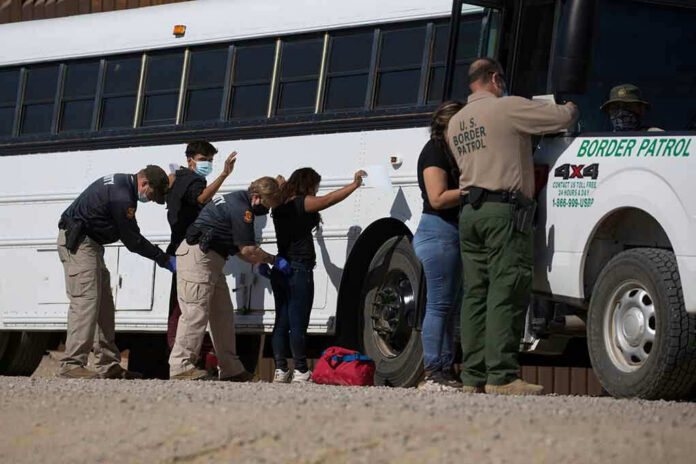
Two men are dead after ICE agents opened fire into their cars, and President Trump’s answer is not retreat but a demand to bring immigration traffic stops roaring back, under new legal powers and old political promises.
Story Snapshot
- Supreme Court cleared aggressive ICE and Border Patrol vehicle sweeps, including race as a factor in suspicion.
- ICE paused most traffic stops after back-to-back fatal shootings in Texas and Maine.
- Trump now urges ICE to restart stops, calling them key to his mass deportation agenda.
- Safety failures, weak training, and missing body cameras fuel bipartisan and international backlash.
Supreme Court greenlights aggressive traffic stops
The Supreme Court’s 6-3 decision in September 2025 reset the ground rules for immigration enforcement on American roads. The Court allowed Immigration and Customs Enforcement and Border Patrol to resume wide sweeps in the Los Angeles area, reversing lower court limits that had barred ethnicity-based roadside stops. Justice Brett Kavanaugh’s concurrence said race can be relevant when officers judge suspicion that someone is in the country illegally, a line that civil rights lawyers saw as an open door to profiling.
Department of Homeland Security leaders quickly treated the ruling as a green light beyond California. They announced expanded operations in Chicago, signaling a broader push to use vehicle stops as a central enforcement tool, not a rare tactic. Under Trump’s second administration, that strategy fits his promise of mass deportations. Former officials describe pressure on agents to ramp up arrests fast, and vehicle stops offer one of the most visible ways to do that in everyday American neighborhoods.
Two shootings force a sudden pause
That aggressive approach collided with deadly reality this July. ICE agents fatally shot two men in less than a week during vehicle stops, one in Houston, Texas, and one in Biddeford, Maine. In both cases, agents fired into vehicles while conducting immigration operations. Homeland Security sources say neither victim was the original target of the raids, raising sharp questions about control and discipline in these fast-moving encounters.
After the Maine killing, Homeland Security Secretary Markwayne Mullin directed ICE to halt most vehicle stops nationwide. Internal guidance told agents in Enforcement and Removal Operations, the division that handles civil immigration arrests, to stop initiating traffic stops except when pursuing serious criminal targets. The pause is described as temporary. Officials say officers will receive new training on vehicle stop tactics before the tool returns in full.
Trump pushes back and demands a restart
Trump has made clear he does not want vehicle stops sidelined for long. He has publicly praised ICE and called traffic stops one of the most important and effective ways to locate and remove people in the country illegally, even as his own administration orders a pause. For a president who promised mass deportations and measures enforcement success in arrest numbers, traffic stops deliver visible action: cars pulled over, suspects removed, and footage that shows officers “doing something.” That optics matter to his base and his agenda.
From a conservative, law-and-order view, Trump’s argument rests on basic common sense. If the Supreme Court says ICE can use reasonable suspicion to stop vehicles, and if federal agents focus on high-risk suspects with long criminal records, then abandoning traffic stops nationwide looks like unilateral disarmament. Supporters argue that dangerous individuals use cars to move freely and that roadside enforcement is necessary to protect citizens when other tools fall short. They see media focus on the worst incidents as ignoring the criminals taken off the street.
Training gaps, body cameras, and rising force
Critics answer that the recent deaths are not isolated flukes but part of a pattern. American Oversight’s work on ICE training shows years of concern over how agents are taught to use force and conduct roadside operations. Federal documents also show a 353 percent jump in use-of-force incidents during the first two months of Trump’s second term, with multiple reports involving both citizens and noncitizens. That spike suggests a serious gap between written policies and real-world behavior.
Two shootings from ICE in the past week.
Trump is singing their praises and directly contradicting his administration’s move to pause traffic stops.
How many more lives will be at risk because of this? pic.twitter.com/fmTPLF8ppl
— Rep. Suhas Subramanyam (VA-10) (@RepSuhas) July 15, 2026
Former acting ICE director John Sandweg warns that immigration agents simply are not trained like city patrol officers. Local police spend their careers on traffic stops and high-risk pulls. ICE historically made most arrests in jails and prisons, not busy streets. When you push those agents into vehicle stops, chase suspects in neighborhoods, and tie their success to arrest quotas, you should expect more edge-of-control encounters. Sandweg notes ICE officers have been involved in multiple fatal shootings while firing at vehicles since Trump returned to office.
Political and legal pressure mounts
The pause on traffic stops came amid growing political heat. Senator Susan Collins of Maine, a Republican known for centrist instincts, asked Homeland Security to end all non-urgent vehicle stops, pointing to “critical questions” about safety and oversight. Democratic Senate hopefuls in several states now frame ICE traffic stops as a referendum on Trump’s immigration agenda, with some openly calling for the agency’s abolition. That turns enforcement tactics into campaign weapons.
Civil rights groups warn that the Supreme Court’s decision and the new stop tactics invite racial profiling. Advocates report stories of people pulled over based on appearance, language, or neighborhood rather than clear evidence of illegal status. The Ninth Circuit Court of Appeals had already found that federal agents violated the Fourth and Fifth Amendments in prior California stops, and that underlying lawsuit still moves through the courts. At the same time, the Federal Bureau of Investigation, the Maine Attorney General, and the Department of Homeland Security Inspector General are investigating the Maine shooting, with no final ruling yet on whether the force was justified.
What comes next for immigration enforcement
Trump’s demand to restart traffic stops sets up the next clash. Homeland Security wants time to retrain agents and calm public outrage. The White House wants road-based enforcement back to drive deportation numbers up. If new training is serious, includes real use-of-force limits, and finally delivers body cameras on agents who carry guns, some conservatives could see that as a fair balance between border security and restraint.
If training is thin, cameras stay missing, and arrests surge again in crowded neighborhoods, expect more deaths, more lawsuits, and more calls from Congress to shut vehicle stops down for good. The Supreme Court may have approved a broad legal path, but the politics will turn on a simple question that every driver understands: when the flashing lights in your rearview mirror belong to immigration agents, does that make the country feel safer or less free?
Sources:
mediaite.com, cbsnews.com, noticias.foxnews.com, youtube.com, deseret.com, post-gazette.com, axios.com, time.com, wtop.com, immigrantdefenseproject.org
© restoreamericanglory.com 2026. All rights reserved.