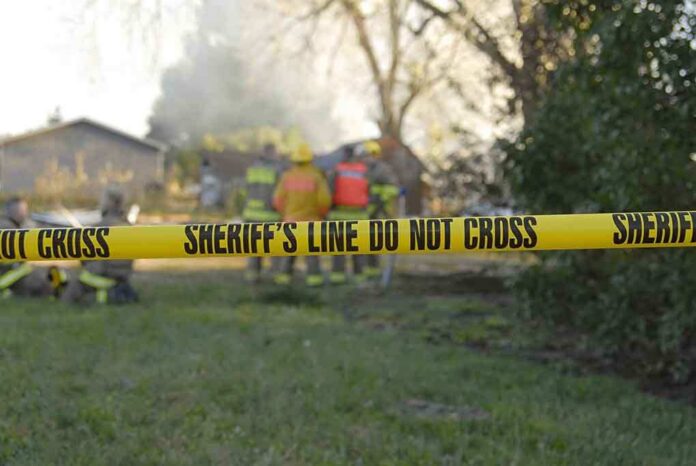
restoreamericanglory.com — Six deaths in a single Iowa family, then a suspect dead by his own hand, left investigators with a grim case that looked simple on the surface and much messier underneath.
Quick Take
- Muscatine police said the preliminary evidence pointed to a domestic dispute involving family members.
- Authorities identified Ryan Willis McFarland as the suspected shooter, and they said he died by suicide.
- Police said the victims were believed to be family members of the deceased suspect.
- No public counterevidence in the record clearly challenges the police’s early explanation.
The First Theory Police Put Forward
Muscatine police said their preliminary investigation indicated the shootings stemmed from a domestic dispute, and they said all of the victims were believed to be family members of the deceased suspect.[1] That is the central fact pattern that shaped early coverage: a family annihilation case, not a random public massacre. The distinction matters because domestic cases often leave fewer immediate answers than people expect, especially when the chief suspect is already dead.
Reporters and broadcasters repeated the same core details in different forms, but the police version remained the anchor: multiple victims, multiple locations, and a suspect who was no longer alive when investigators began sorting through the scene.[3] That sequence tends to freeze the story in its earliest phase. Once a suspect dies, the case can become less about charges and more about reconstructing motive from fragments, which is a slower and less satisfying process for the public.
Why the Domestic-Dispute Frame Stuck So Quickly
The domestic-dispute label is not a proof of motive; it is an early working explanation based on the relationship between the dead suspect and the dead victims.[1] In this case, police told the public that the victims were believed to be relatives, which immediately narrowed the field of possibilities.[1] That does not tell us what triggered the violence, but it does explain why investigators and media outlets converged so quickly on a family-conflict narrative.
That kind of framing can harden before the public sees the underlying records. Autopsy reports, witness statements, phone records, and any search warrants usually arrive later, and sometimes never become fully public. The result is a familiar modern pattern: the first police explanation becomes the story, while the deeper factual record remains locked away. Here, the available record does not show a competing official theory strong enough to dislodge the domestic-dispute account.[3]
What the Public Record Does and Does Not Show
The public-facing evidence in this case supports one broad conclusion: authorities believed Ryan Willis McFarland killed six relatives and then died by suicide.[1][3] The reporting consistently describes the deaths as part of a family shooting, and one outlet said police believed the man shot and killed six family members before taking his own life.[3] Another report said the man killed six members of his own family in what appeared to be a domestic incident.
UPDATE: 7 people dead after murder-suicide in Muscatine; school district responds https://t.co/miuxwEoGgx
— 8News WRIC Richmond (@8NEWS) June 2, 2026
What the public record does not yet provide is equally important. There is no published forensic report, court file, or sworn witness statement in the supplied material that offers a serious alternative motive or contradicts the police’s preliminary domestic-dispute finding.[2][3] That absence does not prove the early theory is complete, but it does mean the current record supports the police version more than any rival account. For now, the case remains a tragedy described more confidently than it is fully explained.
Why These Cases Resonate Beyond One Iowa City
Cases like this force a hard truth into the open: when violence happens inside a family, the first explanation is often the most obvious one, but not necessarily the final one. The police statement gives the public a map, not the whole terrain.[1] In families, the final rupture can hide years of conflict, separation, control, grievance, or desperation that only later records can reveal, if they are ever released at all.
That is why the Muscatine case lands with such force. It combines the horror of a multiple-fatality scene with the silence that follows a suspect’s death. The easy answer is that this was a domestic dispute turned catastrophic. The harder question is what chain of events made that dispute lethal. The current record points strongly toward the first answer and leaves the second one hanging.
Sources:
[1] Web – Police investigate Iowa man suspected of killing six of his relatives …
[2] YouTube – Police investigate Iowa man suspected of shooting 6 of his relatives …
[3] Web – In the US, a gunman killed six family members and himself | УНН
© restoreamericanglory.com 2026. All rights reserved.