
restoreamericanglory.com — The person who said “Please welcome President Donald Trump” at a rally became the story—and the outrage machine did the rest.
Story Snapshot
- A Trump rally introduction triggered rapid, public backlash framed as “some libs were furious,” confirming a real controversy tied to the introducer’s identity and optics [1].
- The broader rally environment sat in the shadow of an assassination attempt, magnifying scrutiny over every stage choice and symbol [1].
- Criticism surged through partisan channels without abundant direct quotes, highlighting how outrage can outrun verifiable detail [1].
- Supporters argued the uproar itself proved Trump’s enduring news dominance, though evidence of concrete gains remains thin [2].
Controversy Over A Simple Sentence
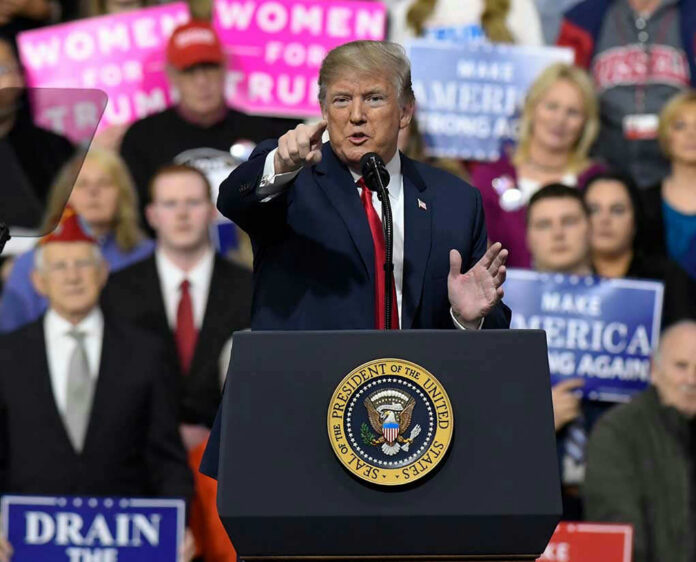
Reporting verified that a controversial figure delivered the Trump introduction at a Republican rally and that backlash followed immediately, promoted as “some libs were furious” [1]. That phrasing captures a familiar media reflex: treat optics as a proxy for values, then argue the optics to exhaustion. The rally-stage greeting, which would normally vanish into applause, became the headline. The core facts are narrow—who introduced him and how people reacted—but the reaction economy inflated those facts into a referendum on judgment and legitimacy [1].
The outrage traveled faster than the details. The material in hand does not supply the introducer’s full identity or the verbatim script from the stage, limiting precision about why critics objected beyond the assertion that the choice offended them [1]. That gap matters. When the public cannot judge exactly what was said and why it mattered, interpretations default to tribe. This is the oldest trick in modern political media: clip the symbol, not the substance, and let partisans fill in the blanks at scale [1].
Heightened Stakes After Violence
The rally backdrop included an assassination attempt, with a gunman opening fire, former President Trump injured on his right ear, one spectator killed, and two critically injured, raising the temperature on every subsequent stage decision [1]. In a post-attack environment, campaigns know microphones carry moral weight. Critics, therefore, read the introducer as a direct expression of priorities and tone. Supporters counter that such readings weaponize grief to police associations and suppress normal campaign activity [1]. The facts confirm the sensitive context; interpretations will diverge predictably.
Campaigns, if prudent, treat programming as policy by other means. A stage introduction signals community, coalition, and intended audience. Absent a transcript or on-record rationale from organizers, the choice remains a Rorschach test. Some will see recklessness; others will see resolve. A practical takeaway for any campaign—left, right, or otherwise—is that post-crisis optics should anticipate maximal scrutiny and preempt with on-record intent, minimizing room for opportunistic spin [1].
Supporters Claim Energy; Evidence Lags
Pro-Trump commentators framed the uproar as proof of enduring media magnetism and cultural reach, arguing that the very visibility of the controversy demonstrates momentum [2]. That claim leans on attention as a proxy for advantage. Attention can signal relevance, but the case for net benefit needs measurable indicators: fundraising lifts, volunteer signups, event RSVPs, or post-event polling movement tied to the moment. The materials offered no such metrics, leaving the “energy” assertion more anecdotal than evidentiary [2].
Common sense tests apply. If a campaign wants to translate spectacle into votes, it should publish receipts: before-and-after small-dollar donations, field growth by county, and targeted demographic movement. Otherwise, opponents can dismiss the episode as sound and fury. Conservative readers rightly prioritize results over vibes; the stronger argument comes from hard numbers that show outrage boomeranged into engagement and organization, not just trending chatter [2].
When Optics Become The Story
The dispute sits inside a larger pattern: modern media converts stagecraft into substantive politics because symbols spread faster than policy. Scholars and reporters have chronicled how rally moments, celebrity cameos, and “who stood next to whom” drive coverage and cement identity lines, especially around Trump, whose events consistently dominate cycles [3][4]. Critics seize on the introduction to argue about character; supporters point to the backlash to argue about bias. Both sides exploit ambiguity; both claim vindication when the clip goes viral.
Jaxson Dart introduced President Donald Trump at a campaign event in Suffern, drawing cheers from supporters gathered for the rally. After the introduction, Trump took the stage and delivered remarks to attendees at the event pic.twitter.com/X1Nsv6jXvO
— LiveNOW from FOX (@livenowfox) May 22, 2026
Two practical lessons emerge. First, documentation matters. Full video, transcript, and on-record rationale reduce room for narrative distortion. Second, restraint beats escalation when the national mood sits on edge after violence. Selecting an introducer with clear, defensible relevance to the audience—then explaining why—converts a rhetorical flashpoint into a coalition story. If the goal is persuasion, not just provocation, choose proof over provocation and receipts over reaction. The country could use more of both right now.
Sources:
[1] YouTube – Assassination Attempt at Trump Rally: Security Under Scrutiny
[2] YouTube – Lawmakers, community groups react after Trump rally …
[3] Web – Donald Trump: Domestic affairs – Miller Center
© restoreamericanglory.com 2026. All rights reserved.