

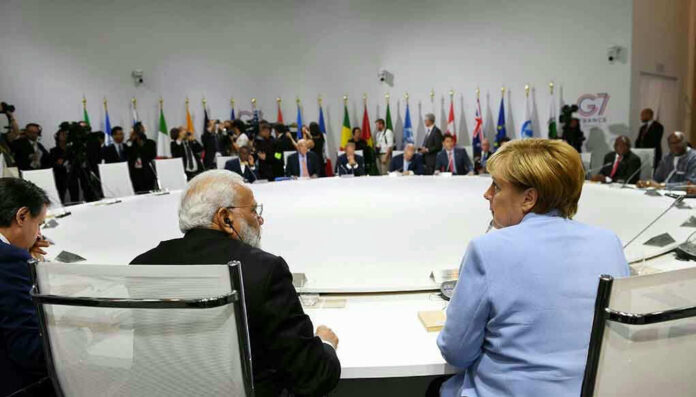
President Trump’s decision to exclude South Africa from the 2026 G20 Summit in Miami marks an unprecedented diplomatic move with global implications.
Story Summary
- Trump announced via Truth Social on November 26, 2025, that South Africa would not be invited to the 2026 G20 Summit.
- The U.S. also suspended all payments and subsidies to South Africa, escalating tensions.
- The exclusion is based on disputed claims of white farmer persecution in South Africa.
- International reactions are mixed, with many defending South Africa’s rights as a G20 member.
Diplomatic Tensions Rise
On November 26, 2025, President Trump declared South Africa’s exclusion from the 2026 G20 Summit in Miami. This decision came alongside the suspension of U.S. financial support to South Africa, signaling a significant diplomatic escalation. Trump’s justification centered on allegations of persecution against white South African farmers, a narrative that has been contested and lacks empirical support. This move is unprecedented, as no U.S. president has previously attempted to exclude a G20 member in such a manner.
South Africa’s response was swift and firm. President Cyril Ramaphosa rejected Trump’s allegations, describing them as misinformation. He emphasized South Africa’s commitment to active participation in all G20 processes, citing the country’s sovereign rights as a member. The exclusion attempt raises questions about U.S. multilateral engagement and challenges the G20’s foundational principles of inclusivity and cooperation among major world economies.
Background and Context
The Trump administration’s focus on alleged persecution of white South African farmers dates back to his first term, supported by South African-born Elon Musk and former Fox News host Tucker Carlson. The administration granted refugee status to white South Africans in May 2025, highlighting the prioritization of this narrative. A meeting between Trump and President Ramaphosa further escalated tensions when Trump presented videos purporting to show genocide against white farmers, claims that Ramaphosa directly challenged.
The G20, an international forum representing major economies, includes South Africa as a member since 2010. The 2026 summit in Miami presents a critical opportunity for the U.S. to influence global economic discussions. However, Trump’s exclusion attempt jeopardizes this dynamic, as it sets a concerning precedent of unilateral exclusion based on disputed claims.
International Reactions and Opposition
International actors, including Germany and India’s opposition Congress Party, have defended South Africa’s G20 membership rights. Germany’s ambassador publicly supported South Africa’s participation, while India’s Congress Party criticized the exclusion as undermining G20 principles and as “new imperialism” against the Global South. These reactions underscore a broader concern about the politicization of multilateral institutions and the potential erosion of their legitimacy.
While Trump, as host nation, holds procedural authority over the summit, the G20’s consensus-based decision-making model and foundational principles constrain unilateral exclusion attempts. South Africa’s international support strengthens its position, challenging the legitimacy of Trump’s decision under G20 rules.
Potential Implications and Future Concerns
If Trump’s exclusion of South Africa succeeds, it could fundamentally undermine the G20’s legitimacy as an inclusive forum for addressing global economic challenges. This would weaken the organization’s ability to coordinate responses to crises and set a dangerous precedent for host nations to weaponize multilateral forums for political purposes. The situation highlights broader tensions regarding U.S. commitment to multilateral institutions and the need for reform to ensure equitable representation and decision-making.
The exclusion attempt also has significant implications for U.S.-South African relations, potentially affecting bilateral cooperation and trade. For South Africa, the suspension of U.S. payments and subsidies could impact development programs and economic partnerships. The broader Global South may view the exclusion as a reflection of diminished respect for African sovereignty and an imbalance in global power dynamics.