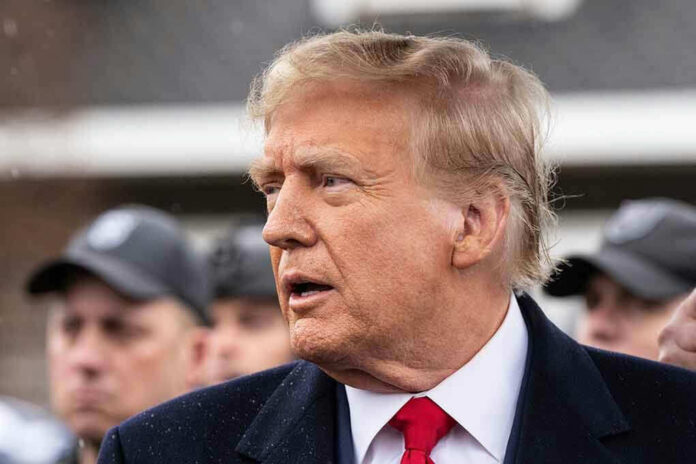
One ultimatum—three or four days to decide—now holds the fate of Gaza, and possibly Middle East peace, in a vice grip as Trump’s high-stakes deadline leaves the world breathless, wondering who will blink first and what “a very sad end” really means.
Story Overview
- Trump’s 20-point Gaza peace plan demands a rapid, public response from Hamas, with open threats of dire consequences.
- The plan proposes a ceasefire, hostage release, Hamas disarmament, and a new governance structure for Gaza.
- Israel and much of the international community back the plan, but Hamas rejects key terms, notably disarmament.
- The war’s next phase—and countless lives—hang on Hamas’s response to an unprecedented American ultimatum.
Trump’s Deadline: A Clock Ticking Toward Peace or Catastrophe
President Donald Trump announced a sweeping Gaza peace initiative with Israeli Prime Minister Benjamin Netanyahu at his side, but this was no standard diplomatic overture. The spectacle at the White House was underscored by Trump’s signature bravado: Hamas would have “three or four days” to accept the plan—or the group would face “a very sad end.” The message was clear, the tone was unmistakable, and the world’s attention snapped into focus. Trump’s gambit fused urgency with threat, setting a new bar for public, time-bound diplomacy in one of the world’s most intractable conflicts.
The plan itself is nothing short of audacious. It calls for an immediate ceasefire, the release of Israeli hostages, complete disarmament of Hamas, and a transition to a new governance structure in Gaza that would sideline the group permanently. For Israel, represented by Netanyahu’s full-throated endorsement, the proposal checks every box: end Hamas’s military power, secure the hostages’ return, and put Gaza under international and Palestinian Authority auspices. For Gaza’s rulers, the plan is a bitter pill, potentially fatal to their grip on power and their very identity as an armed resistance movement.
Roots of the Crisis: A Region Scarred by War and Missed Chances
The Gaza Strip’s fate has been marred by bloodshed and broken promises for nearly two decades. Since Hamas seized control in 2007, the enclave has weathered repeated wars with Israel, peaking after the catastrophic Hamas attack of October 7, 2023, which killed 1,200 Israelis and triggered Israel’s most punishing response yet. Failed ceasefires, collapsed negotiations, and mounting humanitarian misery have defined the years since. More than 66,000 Palestinians are dead, Gaza’s infrastructure lies in ruins, and the world’s patience has thinned to a fraying thread.
Previous U.S. efforts—remember the 2020 “Deal of the Century”?—fell flat, undone by irreconcilable demands and deep mistrust. International bodies, from the UN to regional powers, have tried and failed to broker peace. Trump’s new plan, offered with the blunt force of a deadline, is both a break from the past and a gamble that the threat of overwhelming force will do what diplomacy could not: force Hamas to yield—or be destroyed. For a war-weary region, this is both a glimmer of hope and the shadow of catastrophe.
The Stakeholders: Power, Survival, and the Anatomy of an Ultimatum
Trump and Netanyahu, united in purpose, are betting that an unambiguous ultimatum will tip the diplomatic scales. Trump seeks a legacy-defining triumph and renewed American clout. Netanyahu seeks to fulfill Israel’s war aims and end the existential threat posed by Hamas. The Palestinian Authority, sidelined for years, stands to regain a role in Gaza’s governance if the plan proceeds. The international community, from Europe to the Gulf, backs the proposal, eager to stem the bloodshed and open the gates to Gaza’s reconstruction.
Yet Hamas remains the wildcard. The group’s leaders signal a willingness to consider hostage releases, but flatly oppose any hint of disarmament or political surrender. To accept the plan would be to abandon the very rationale for their existence; to reject it risks unleashing the full might of Israel’s military, with Trump’s blessing. The power dynamic is stark: Israel and the U.S. hold the cards, while Hamas clings to its last, desperate levers of negotiation. The Palestinian people, as ever, are caught in the crossfire, their fate hostage to decisions made in rooms far from Gaza’s shattered streets.
What’s Next: High Stakes, Open Questions, and the Meaning of Consequence
The next few days will determine whether the Trump ultimatum is a masterstroke of peacemaking or a prelude to even greater violence. If Hamas accepts, a ceasefire could take hold, hostages could come home, and the long road to reconstruction might begin. If Hamas rejects the deal, as their rhetoric suggests, Israeli forces—emboldened by explicit American support—are poised to strike, and the “very sad end” Trump promised could become a horrifying reality for Gaza’s remaining population.
Experts argue over what the plan really means for the region. Some see the possibility of a new beginning—a rare opportunity for peace and eventual Palestinian statehood. Others warn that the plan’s demands are simply too much for Hamas to accept, and that the public ultimatum may have only hardened their resolve. For the world’s diplomats, the next seventy-two hours are a test of whether the threat of overwhelming force can finally bring a century-old conflict to heel, or whether it will trigger yet another cycle of destruction and loss. The clock is ticking, and every second counts.
Sources:
Wikipedia: Donald Trump’s September 2025 Gaza Strip proposal
Breitbart: Trump Releases 20-Point Gaza Peace Plan; Hamas Has Not Agreed Yet
Africanews: Trump and Netanyahu agree to new US peace plan to end war in Gaza
Axios: Trump Gaza peace deal Israel Hamas