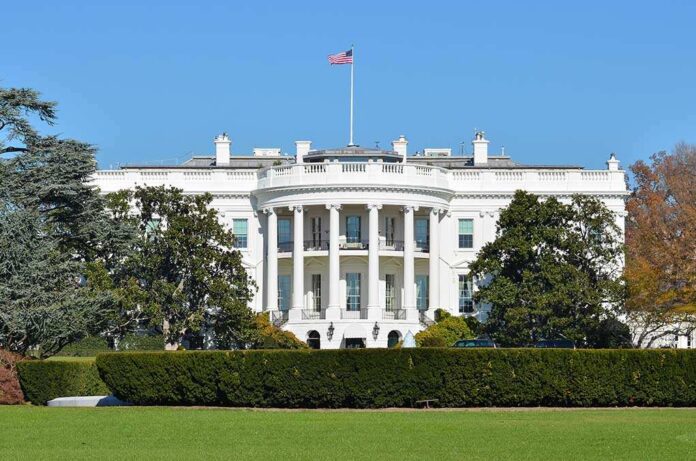
President Donald Trump has repeatedly told White House aides he’ll pardon everyone who has come within 200 feet of the Oval Office before his second term ends in 2029, a promise that hovers somewhere between presidential humor and preemptive legal immunity.
Story Snapshot
- Trump joked he would pardon anyone within 200 feet of the Oval Office, sparking debate over whether the quip signals serious intent
- The White House dismissed the remark as humor while affirming the president’s absolute constitutional pardon authority
- Trump has already issued approximately 1,600 pardons during his current term, including nearly all January 6 convicts
- Aides note Trump often jokes about ideas he later pursues seriously, a pattern established during his first term
- The promise follows precedent set by Biden’s end-of-term pardons, which Trump previously criticized as invalid
The Joke That Nobody’s Quite Laughing Off
The Wall Street Journal broke the story based on anonymous aide accounts of private meetings where Trump floated the sweeping pardon idea. White House Press Secretary Karoline Leavitt responded that the Journal should learn to take a joke, yet she simultaneously emphasized that the president’s pardon power remains absolute under Article II of the Constitution. This dual message captures the peculiar limbo of Trump’s governing style, where offhand remarks carry the weight of potential policy. The 200-foot radius quip might sound absurd on its surface, but it aligns with a documented pattern from Trump’s first term, when former Press Secretary Stephanie Grisham recalled him casually offering pardons to staff facing potential Hatch Act violations.
A Presidential Pardon Spree Without Modern Parallel
Trump has already granted roughly 1,600 clemency actions in his second term, a figure that dwarfs typical presidential pardons and includes high-profile cases like Ross Ulbricht, former Honduran President Juan Orlando Hernández, and Representative Henry Cuellar. The most politically charged pardons covered nearly every January 6 rioter convicted of federal crimes. This establishes a clemency infrastructure that makes mass staff pardons less of a hypothetical leap and more of a logical extension. The absence of specific legal exposures among aides makes these potential pardons preemptive rather than reactive, a shield against unknown future prosecutions rather than relief from existing charges.
Biden’s Shadow and Trump’s Constitutional Theater
The irony thickens when you recall Trump’s vocal criticism of Biden’s end-of-term pardons for Hunter Biden and Anthony Fauci, which Trump claimed were invalid because Biden allegedly used an autopen rather than personally signing them. That legal argument holds no water under established constitutional interpretation, but it demonstrated Trump’s awareness of pardon politics as a loyalty marker and political weapon. Now Trump appears poised to mirror Biden’s approach at a vastly larger scale, converting what was once extraordinary executive clemency into a routine exit strategy for sitting presidents. The constitutional framers granted presidents nearly unlimited pardon power for federal offenses, excluding only impeachment cases, but they likely didn’t envision it as a blanket immunity tool for entire White House staffs.
The Loyalty Premium in Trump’s Executive Branch
Aides who spoke to the Journal noted that Trump frequently tests ideas through humor before pursuing them seriously, a psychological pattern that keeps staff simultaneously entertained and uncertain about his true intentions. This creates a peculiar power dynamic where subordinates must treat every presidential joke as potential policy while maintaining plausible deniability for public consumption. The promise of pardons functions as both carrot and leash, rewarding loyalty while implicitly acknowledging that working closely with Trump might eventually require legal protection. No formal announcements have emerged, and no specific recipients have been named, leaving the entire matter in a state of controlled ambiguity that serves Trump’s management style while frustrating those who prefer transparent governance.
🤡Trump promises mass pardons to staff before leaving office https://t.co/f82ptMvLnI https://t.co/OiORl3VRgE
— Kevin Paul (@kpElectricSoul) April 11, 2026
The practical implications extend beyond individual staff members to the broader question of executive accountability. Mass preemptive pardons normalize the idea that government service in politically charged environments comes with built-in immunity from federal prosecution, a concept that sits uneasily with rule-of-law principles regardless of partisan affiliation. If Trump follows through, he will set a precedent that future presidents of both parties will face pressure to match, transforming pardons from acts of mercy or justice correction into routine political hygiene. The constitutional authority exists, but its exercise at this scale would represent something genuinely new in American governance, testing whether unlimited power wisely restrained differs meaningfully from unlimited power enthusiastically deployed.
Sources:
Trump promises mass pardons for staff before leaving office – WSJ
Trump Allegedly Promises Pardons to Staff Members
Trump Promises to Pardon Everybody
Trump promises sweeping pardons for staff before leaving office: WSJ