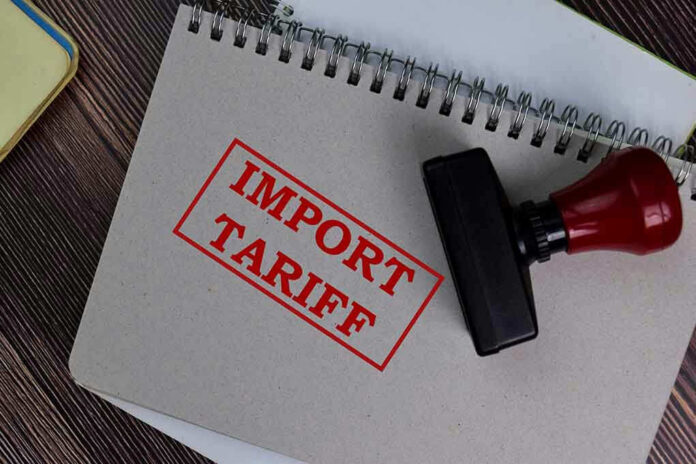
Trump’s blunt admission that his own 157% tariff on China is “not sustainable” cracks open a rare window into the collision of economic reality and political bravado at the heart of American trade policy.
Story Snapshot
- Trump publicly concedes the 157% China tariff cannot last, yet refuses to change it.
- This stance reflects ongoing tensions between economic consequences and political messaging.
- U.S. businesses and consumers continue to bear the brunt of tariff-induced price hikes and supply disruptions.
- Global trade patterns and U.S.-China relations remain deeply unsettled by this policy.
Trump’s Admission: Economic Reality Meets Political Intransigence
Donald Trump’s statement in October 2025 acknowledging the unsustainability of the 157% tariff on Chinese goods punctures years of hardline rhetoric. The tariff, a centerpiece of his trade war strategy since 2018, aimed to force China’s hand on alleged unfair trade practices and intellectual property theft. Trump’s rare public concession signals his awareness of the economic strain but reveals little appetite for reversing course. The message: the policy hurts, but the politics of appearing tough on China matter more for now.
Trump’s refusal to consider a rollback, despite mounting evidence from economists, business leaders, and even some political allies, underscores the complexity of U.S.-China trade relations. The tariff, originally set as a negotiating bludgeon, has become a fixture of Trump’s political identity and a litmus test for his protectionist base. The contradiction—recognizing harm while refusing change—spotlights the tension between economic logic and political imperatives.
Ramifications for U.S. Businesses, Consumers, and the Broader Economy
American manufacturers, retailers, and consumers have felt the impact of the tariffs in ways impossible to ignore. Higher import costs ripple through supply chains, raising prices on everyday goods and squeezing margins for U.S. firms reliant on Chinese inputs. Inflationary pressures have accelerated, with some sectors reporting job losses and diminished competitiveness. Industry groups and trade associations have ramped up lobbying efforts, arguing that the tariffs threaten to erode America’s manufacturing edge rather than protect it.
Consumers, meanwhile, see the effects in the checkout aisle—from electronics to apparel, the cost of living inches upward. Public frustration simmers, and political polarization over trade policy intensifies as election cycles approach. For many, the tariff debate is not an abstract geopolitical chess match but a concrete driver of economic uncertainty and household strain.
Global Trade Dynamics and the U.S.-China Relationship
The 157% tariff represents not just a bilateral spat, but a pivot point in global trade. China, led by Xi Jinping, has responded with its own retaliatory measures, escalating tensions and fueling talk of economic decoupling. The world’s two largest economies remain locked in a cycle of escalation and negotiation, with each round of tariffs reshaping supply chains and trade flows beyond their borders.
Other nations, watching the drama unfold, recalibrate their own trade strategies. Companies diversify sourcing, seek alternative markets, and hedge against future shocks. The lasting legacy may be a less integrated, more fragmented global economy—one where the costs of protectionism ripple out in unpredictable ways.
Expert Perspectives: Economic Unsustainability and Calls for Change
Leading economists and trade experts have long warned that such steep tariffs are unsustainable and ultimately harmful to both the U.S. and China. Academic studies and policy analyses consistently show that the costs outweigh the benefits, undermining growth and global competitiveness. Some policymakers hold firm, arguing that extreme measures are needed to force structural reforms in China. Others advocate negotiation and gradual reduction, seeking a path back to economic stability.
The AOL report, quoting Trump directly, anchors this debate in the present moment. His admission validates what many experts have predicted: policies designed as short-term leverage cannot stand indefinitely without inflicting damage. The question now is whether political considerations will continue to override economic sense, or if pressure from business, academia, and the voting public will force a course correction.
Sources:
AOL: Trump admits that his 157% tariff on China is ‘not sustainable’ but shrugs off changing it