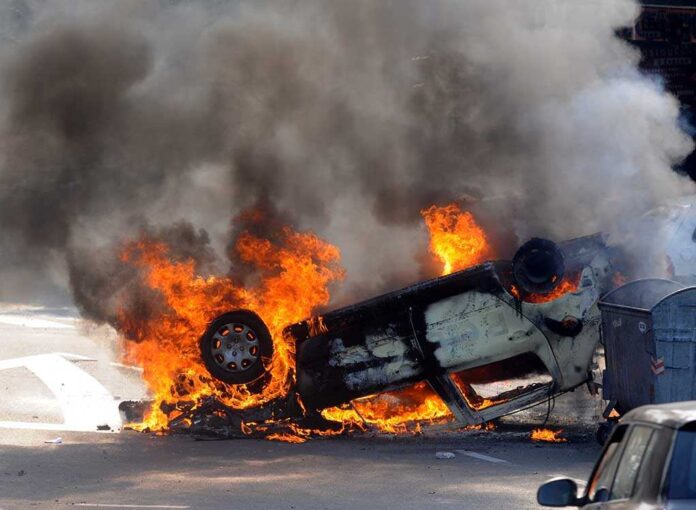
A senior Russian military commander lies dead in Moscow, killed by a bomb planted beneath his car, raising urgent questions about who orchestrated the attack and what it means for fragile peace negotiations happening thousands of miles away.
Quick Take
- Lieutenant General Fanil Sarvarov, head of the Operational Training Department of the General Staff of the Russian Armed Forces, was killed in a car bombing in Moscow on December 22, 2025
- The explosion occurred around 7:00 a.m. Moscow time in a parking lot on Yaseneva Street, with the blast so ferocious it destroyed the vehicle entirely
- Russian investigators are examining whether Ukrainian intelligence services orchestrated the attack, marking the third car bombing targeting Russian military officials in 2025 alone
- The timing is explosive in more ways than one—the bombing happened just hours after Ukrainian and U.S. representatives concluded weekend peace talks
Moscow’s Elite Face an Escalating Threat
Moscow has transformed into a hunting ground for Russia’s leadership. The capital, once considered secure enough to protect the nation’s most powerful figures, has become the stage for a deadly pattern of targeted assassinations. Sarvarov’s death represents the third car bombing attack on Russian military or political figures in 2025, suggesting either a coordinated campaign or a deliberate shift in tactics by those seeking to destabilize Russian command structures from within.
A General’s Final Morning
Lieutenant General Fanil Sarvarov held one of Russia’s most consequential military positions. As head of the Operational Training Department, he shaped how Russia’s armed forces prepared for combat operations. On the morning of December 22, Sarvarov arrived at his parking space on Yaseneva Street in Moscow, unaware that an explosive device had been placed beneath his vehicle. The blast killed him, and Russian investigators immediately launched a full-scale inquiry into what happened and who was responsible.
The Ukrainian Question Hangs Over Everything
Russian authorities are investigating whether Ukrainian intelligence services planted the bomb. Ukraine has not claimed responsibility for the attack, nor has it issued any public statement about the incident. However, the pattern is unmistakable. Ukraine demonstrated its capability and willingness to conduct similar operations approximately one year prior, establishing both motive and precedent. The timing creates additional suspicion—why kill a senior Russian general hours after peace negotiations conclude unless the goal is to send a message that military operations continue regardless of diplomatic engagement?
Peace Talks Meet Battlefield Reality
The bombing’s timing cannot be dismissed as coincidence. Ukrainian and U.S. representatives had just wrapped up weekend peace negotiations when Sarvarov was killed. This juxtaposition reveals a brutal truth about modern conflict: diplomatic efforts and military operations operate simultaneously, sometimes at cross purposes. The assassination suggests that whoever orchestrated it either opposes peace negotiations or seeks to strengthen their negotiating position through demonstrated military capability and willingness to strike at Russia’s highest levels.
Security Failures and Strategic Vulnerabilities
The successful execution of this bombing exposes significant vulnerabilities in Russian security protocols. Sarvarov held a position requiring the highest level of protection, yet someone managed to plant an explosive device beneath his vehicle in a Moscow parking lot. Either Russian security services failed catastrophically, or someone within those services provided the intelligence necessary for the attack. Either scenario damages Russian credibility and raises uncomfortable questions about the reliability of Russia’s internal security apparatus during a period of active conflict.
The Pattern That Cannot Be Ignored
Three car bombings targeting Russian military leadership in a single year represents an escalating campaign, not isolated incidents. The consistency of methodology and target selection suggests coordinated operations with sophisticated planning. Each attack demonstrates tactical competence and access to sensitive information about targets’ movements and schedules. This pattern indicates a deliberate strategy to degrade Russian military command capacity through targeted elimination of senior leadership, a tactic that proves more effective than traditional military engagement in certain contexts.
Sources:
Moscow car bomb kills Russian general, investigators say