
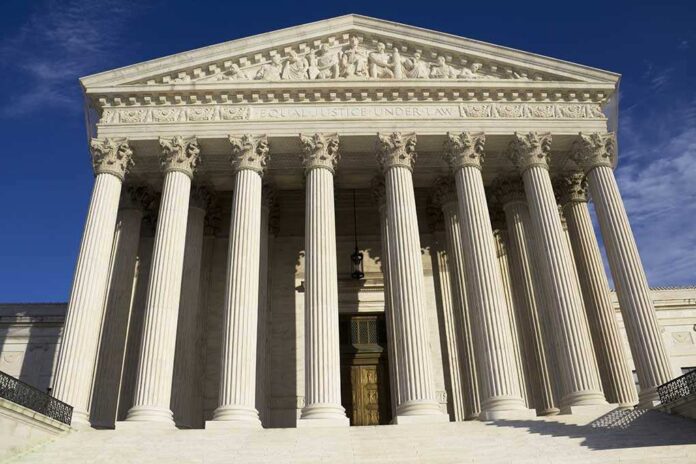
The Supreme Court appears poised to restore Election Day to its original meaning: one single day, not a rolling week of ballot counting that transforms democratic certainty into administrative chaos.
Story Snapshot
- Supreme Court heard oral arguments in Watson v. Republican National Committee on March 24, 2026, challenging Mississippi’s five-day post-election ballot counting grace period
- Conservative justices signaled skepticism toward 14 states’ laws allowing ballots postmarked by Election Day to be counted up to five days later
- Justice Alito compared Election Day to other single-day holidays like Independence Day, emphasizing the statute’s plain meaning
- The ruling, expected before November 2026 midterms, could eliminate grace periods nationwide and reestablish uniform federal election procedures
- Biden Administration filed brief supporting challengers, arguing post-election counting undermines federal election integrity
When Election Day Became Election Week
Fourteen states have quietly transformed what federal statute defines as “the Tuesday next after the 1st Monday in November” into something resembling a rolling deadline. Mississippi’s law permits election officials to count mail-in ballots arriving up to five business days after Election Day, provided those ballots bear an Election Day postmark. Thirteen other states maintain similar grace periods. The Republican National Committee, joined by the Libertarian Party of Mississippi, argues this practice directly violates federal law establishing a uniform national election day for congressional and presidential contests.
The Constitutional Tug of War
The case exposes fundamental tensions between federal authority and state election administration. State legislatures retain primary constitutional authority for setting election rules, yet Congress possesses statutory power to alter these state-level defaults. Paul Clement, arguing for the challengers, framed Election Day as “the date where the election is consummated.” Justice Alito pressed this textualist interpretation, questioning why Election Day should be treated differently from Labor Day or Independence Day. These aren’t elastic concepts stretching across multiple days; they’re fixed points on the calendar with clear statutory meaning.
Liberal Justices Mount State Flexibility Defense
Justice Kentanji Brown Jackson countered by highlighting federal statutes acknowledging post-Election Day deadlines for military and overseas voters, suggesting Congress implicitly permitted state flexibility in ballot counting procedures. Justice Elena Kagan challenged Republican attorneys on voter qualification concerns, probing whether their position would disenfranchise eligible voters whose ballots arrive late through no fault of their own. These exchanges revealed the Court’s ideological divide: conservatives emphasizing statutory clarity and uniform national standards versus liberals defending state administrative discretion and voter access.
Election Integrity Versus Administrative Convenience
The Biden Administration’s decision to file an amicus brief supporting the challengers deserves scrutiny. The brief argues post-Election Day ballot counting “undermines federal election integrity,” a remarkable position given Democrats’ general support for mail-in voting expansion. This suggests the legal argument transcends simple partisan positioning. The conservative position rests on common sense: if federal law establishes a uniform election day, permitting states to extend counting deadlines effectively nullifies that uniformity. States defending grace periods invoke administrative necessity, yet administrative convenience cannot supersede congressional statutory authority without rendering federal election law meaningless.
The Broader Pattern of Supreme Court Election Intervention
Watson v. Republican National Committee fits within the Supreme Court’s recent pattern of scrutinizing state election procedures. The Court has already curtailed early voting in Ohio, ended same-day registration in North Carolina, and blocked Wisconsin’s voter ID implementation. Critics characterize these interventions as voter suppression; defenders view them as necessary corrections when states exceed constitutional or statutory boundaries. The pattern reveals a Court increasingly willing to enforce federal election standards even when such enforcement restricts state flexibility. Legal precedent demonstrates justices maintain low tolerance for lower courts altering voting laws close to elections, prioritizing electoral stability over procedural experimentation.
Midterm Elections Hang in the Balance
The decision timeline carries immediate practical consequences. The Court expects to rule before November 2026 midterms, meaning election officials in 14 states may need to overhaul ballot counting procedures within months. States with grace periods including Illinois and Mississippi would face compressed timelines for revising election laws, training poll workers, and communicating new requirements to voters. Military and overseas voters, who currently receive special post-Election Day counting protections under federal statute, represent a distinct category the Court must address. Any ruling eliminating general grace periods while preserving military exceptions would create a two-tiered system requiring careful statutory interpretation.
The Supreme Court Seems Ready to Make ELECTION DAY Great Again. Thank God. https://t.co/3hWPac9EVL
— Victoria Taft, The Adult in the Room, FITF Squad (@VictoriaTaft) March 24, 2026
The conservative justices’ skepticism during oral arguments suggests a majority may establish Election Day as a fixed, singular deadline nationwide. Such a ruling would vindicate those arguing federal election law means what it says: one day, not a flexible window subject to state-by-state variation. Whether this represents restoring Election Day’s original meaning or restricting legitimate state authority depends entirely on whether you believe statutory text should govern or whether administrative convenience justifies perpetual reinterpretation. The answer will reshape American election administration for generations, determining whether federal election law establishes genuine national uniformity or merely aspirational suggestions states may disregard when inconvenient.
Sources:
Supreme Court considers laws allowing mail-in votes to be counted after election day – Maine Public
Supreme Court hears arguments in case about mail-in ballots arriving after Election Day – WGME
Supreme Court stays busy ruling on state voting laws – Washington Examiner