
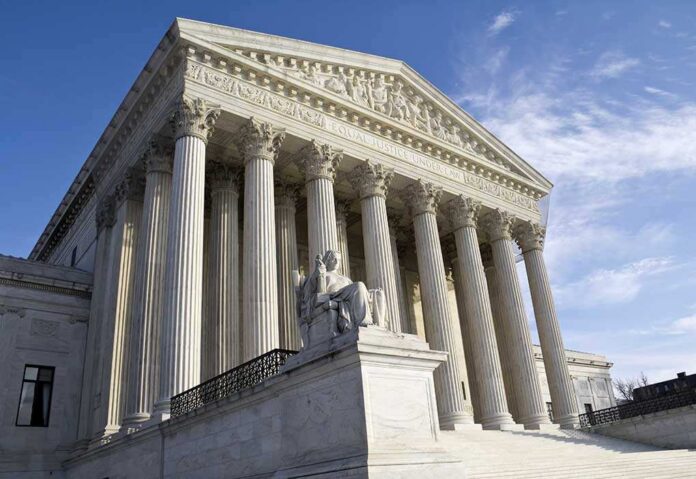
The Supreme Court slammed the door on a progressive infiltrator’s bid to hijack Ohio’s Republican primary, exposing the fragility of party primaries to sabotage.
Story Snapshot
- Samuel Ronan, former DNC chairman candidate, disqualified from Ohio’s 15th District GOP primary for lying about his party affiliation.
- Ohio Secretary of State Frank LaRose removed him under state law demanding good faith candidacy.
- Federal courts, including the Supreme Court, upheld the decision, prioritizing fraud prevention over First Amendment claims.
- Republican voter Mark Schare uncovered Ronan’s scheme with public statements admitting intent to trick GOP voters.
- Ruling reinforces states’ power to protect primaries from cross-party tricks ahead of 2026 midterms.
Ronan’s Infiltration Attempt Unravels
Samuel Ronan filed as a Republican for Ohio’s 15th Congressional District primary, targeting incumbent Rep. Mike Carey. He signed a declaration under penalty of falsification, affirming good faith affiliation with GOP principles. Public statements soon surfaced where Ronan boasted of running Democrats in deep red districts to trick voters and gain leverage. These admissions revealed his true progressive roots as a former DNC chairman candidate. Ohio’s law, R.C. 3513.05, bars such insincere entries to safeguard intra-party contests.
Local Vigilance Triggers Disqualification
Republican voter Mark Schare protested to the Franklin County Board of Elections, presenting social media posts and interviews as evidence. The board split 2-2, prompting Ohio Secretary of State Frank LaRose to cast the deciding vote against Ronan in February. LaRose enforced the good faith requirement, citing Ronan’s history and statements as proof of misrepresentation. This action protected the primary from potential vote-splitting by an outsider. Courts later validated LaRose’s authority without hesitation.
Courts Reject First Amendment Defense
Ronan sued in federal district court, arguing First Amendment violations. Chief Judge Sarah D. Morrison dismissed the case, ruling the state holds a substantial interest in preventing fraudulent declarations. She stated the Constitution does not force states to accept liars on partisan ballots. A federal appeals court denied restoration. Justice Brett Kavanaugh referred Ronan’s Supreme Court emergency petition to the full bench, which rejected it on April 9 without explanation or dissents. This shadow docket decision left lower rulings intact.
Common sense aligns with Morrison’s view: Free speech stops at sworn lies on official forms. Ronan’s prior Democratic runs and sabotage admissions provided ironclad evidence, outweighing his suppression claims. Conservative values demand honest elections, not deceptive plants disrupting party choice.
Precedents and Broader Ramifications
Ohio’s enforcement echoes historical defenses against tactics like 2012’s Operation Chaos, where crossovers aimed to dilute primaries. Federal precedent, including Storer v. Brown in 1974, upholds states’ rights to restrict insincere candidacies. Nebraska recently disqualified Democrat Cindy Burbank similarly. Short-term, Rep. Carey avoids a fake challenger; long-term, states may tighten rules nationwide. This deters infiltration amid 2026 midterm tensions in polarized districts like Columbus-area Ohio’s 15th.
Supreme Court REJECTS Appeal from So-Called ‘Republican’ Candidate After Being Exposed as a Democrat Plant https://t.co/0xFrXkr3ra #gatewaypundit via @gatewaypundit
— TRUMPGIRL (@TRUMPGIRL_STL) April 10, 2026
Politically, the ruling signals judicial backing for election integrity, chilling spoiler schemes. Voters gain clarity, focusing on genuine Republicans. Democrats lose a tool for chaos, forcing straightforward competition. As midterms approach with early voting underway, this preserves faith in the process.
Sources:
Supreme Court blocks candidate after alleged GOP infiltration scheme exposed
Supreme Court keeps former DNC candidate off Ohio GOP primary ballot