

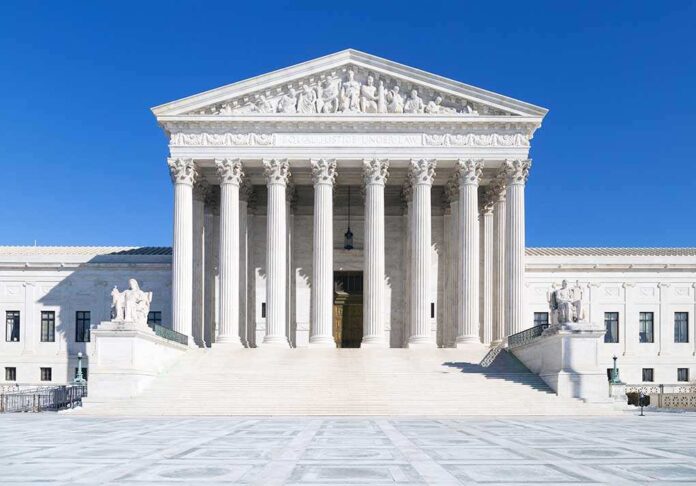
The Supreme Court may soon decide whether the right to marry whomever you love in America is as permanent as many believed—or as vulnerable as one county clerk’s refusal might suggest.
Story Snapshot
- The Kim Davis case asks the Supreme Court to revisit the legality of same-sex marriage.
- Davis’s refusal to issue marriage licenses after Obergefell v. Hodges set off a national legal and cultural battle.
- The Court’s decision could unsettle hard-won rights and reignite religious liberty debates.
- Anxiety among LGBTQ+ communities is rising as justices weigh whether to hear the case.
Supreme Court Faces a Defining Test of Rights and Beliefs
America’s most powerful court is grappling with a case that, on its surface, concerns the personal liability of a former Kentucky county clerk. Kim Davis’s refusal to issue marriage licenses to same-sex couples after the Supreme Court’s 2015 Obergefell v. Hodges decision became a lightning rod for the culture war between religious liberty and LGBTQ+ rights. Now, Davis’s appeal is not just about her own fate—it’s a direct challenge to the constitutional foundation of marriage equality itself.
When Davis cited religious objections and denied marriage licenses, she defied both her state’s duties and a historic Supreme Court mandate. The ensuing lawsuits, her brief jailing for contempt, and her persistent appeals have propelled her case all the way back to the justices whose ruling she resisted. Her legal team’s petition urges the Court to reconsider Obergefell, arguing that the decision trampled religious freedom and exceeded judicial authority. The stakes extend far beyond one clerk: millions of couples and countless families are left wondering if their unions could again become a political battleground.
Legal and Cultural Lines Drawn in the Sand
The legal question at hand is finely balanced. Davis asserts qualified immunity—a doctrine shielding officials from personal liability—and insists her religious beliefs should exempt her from enforcing laws she deems immoral. Plaintiffs, couples denied marriage licenses, seek accountability for violations of rights the Supreme Court had just affirmed. Lower courts sided with the couples, awarding damages and rejecting Davis’s immunity claim. Yet it’s Davis’s push to revisit Obergefell itself that raises the specter of a seismic shift in American law.
LGBTQ+ advocacy groups, including GLAD Law and Lambda Legal, have warned that the Court’s willingness to even consider the case stirs unease. Legal experts acknowledge that the case, on its face, is about damages and immunity—not the right to marry. Still, as Supreme Court watchers know too well, the justices can choose to widen the scope of any case, especially in an era when precedent feels less unassailable than before. The conservative majority on the Court has already reversed or narrowed landmark rulings on other issues.
Ripple Effects and the Shadow of Precedent
Should the Supreme Court grant review, the implications will ripple far beyond Davis and the courthouse in Rowan County. Same-sex couples across the nation, many of whom married in the decade since Obergefell, would face legal and emotional uncertainty. The possibility—however remote—of the Court narrowing or overturning marriage equality would upend lives, disrupt family law, healthcare benefits, and more. Religious liberty advocates, meanwhile, view Davis as a champion for conscience rights, hoping for a ruling that shields public officials who refuse participation in actions they oppose on faith grounds.
The anxiety has already mobilized advocacy groups and political operatives. With the Supreme Court scheduled to discuss whether to hear Davis’s case, activists on both sides are preparing for a renewed battle. If the Court denies review, the decision could come within days, leaving the Obergefell precedent intact—at least for now. If the justices take up the case, the nation could be headed for another divisive legal showdown over whose rights the Constitution ultimately protects.
Expert Views: Legal Technicality or Looming Tidal Wave?
Legal scholars and advocacy organizations largely agree: Davis’s case is a longshot for overturning Obergefell outright. The Court rarely uses narrow disputes over damages or immunity to rewrite constitutional precedent. Yet, in today’s climate, few are willing to predict with certainty. GLAD Law’s legal director underscores that while the legal question is technical, the broader risks are real. Even a ruling ostensibly limited to Davis’s liability could contain language inviting future challenges to marriage rights. Conservative legal thinkers, meanwhile, argue that religious liberty demands robust protection even against Supreme Court mandates—a view that resonates with many Americans who fear government overreach into matters of faith.
The outcome of the Kim Davis appeal will be a bellwether for the balance of rights and freedoms in modern America. The Supreme Court’s decision—whether to intervene or stand aside—will either reaffirm the permanence of marriage equality or signal that no victory is ever truly settled when it comes to fundamental rights.