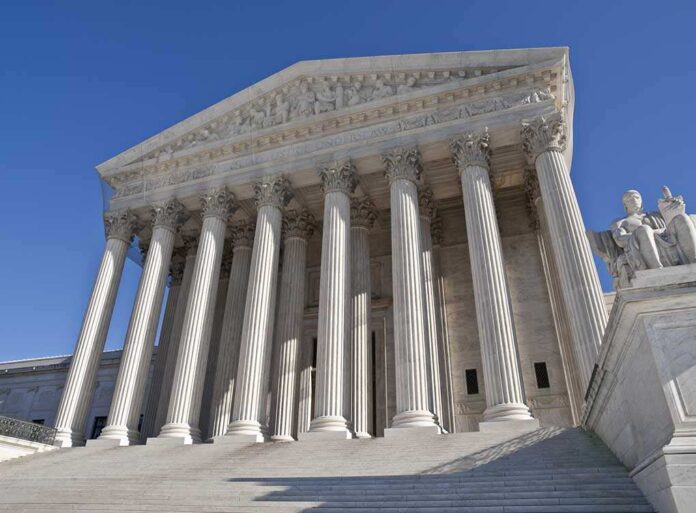
California’s Prop 50 maps face Supreme Court scrutiny for alleged racial gerrymandering.
Story Overview
- Supreme Court orders California Democrats to justify Prop 50 maps.
- Proposition 50 approved new congressional district maps favoring Democrats.
- Claims of racial gerrymandering challenge Proposition 50 in District 13.
- Decision could impact the 2026 midterm elections significantly.
Supreme Court Challenges Proposition 50
The U.S. Supreme Court has intervened in California’s political landscape, ordering state Democrats to justify congressional district maps approved under Proposition 50. This directive comes after the California Republican Party filed an emergency request to block the maps, citing racial gerrymandering in violation of the Voting Rights Act. The essence of this legal maneuver lies in its timing, as the decision could drastically alter the political dynamics ahead of the 2026 midterms.
This is a paragraph.
Background and Context
Proposition 50, passed in November 2025 with 64% voter approval, enabled the redrawing of 52 congressional districts, ostensibly favoring Democrats. This was seen as a strategic countermeasure to the Republican gains in Texas, where a similar redistricting effort secured five additional House seats. California’s approach bypassed the state’s independent Citizens Redistricting Commission, raising eyebrows and leading to legal challenges.
The federal court had previously upheld the maps, dismissing claims of racial gerrymandering. However, the Supreme Court’s order for a reevaluation signals a potential shift, especially given the Department of Justice’s support for the Republican claims.
Supreme Court Orders CA Dems To Justify 'Prop 50' Mapshttps://t.co/fSIQElVEHc
— Tom Pauken II. (@tmcgregorchina) January 26, 2026
Key Stakeholders and Legal Proceedings
The California Republican Party, supported by the Department of Justice, spearheads the challenge against Proposition 50. They argue that the redistricting emphasizes racial lines, particularly in District 13, and seek to protect Republican incumbents. On the other side, Governor Gavin Newsom and state Democrats, who pushed for the special election leading to Prop 50’s passage, defend the maps as a necessary partisan equalizer.
Justice Elena Kagan’s order requires California’s response by January 29, with a significant ruling anticipated soon after. The outcome could determine whether the current maps stand or revert to previous configurations, impacting Democratic plans for the 2026 elections.
Potential Implications and Broader Impact
The Supreme Court’s decision could set a precedent for mid-decade redistricting efforts nationwide. In the short term, a map block would disrupt candidate filings due by February 9, potentially reverting to older district lines and affecting Democratic strongholds. Long-term, the ruling could redefine the balance of power in the House of Representatives, influencing national policy directions.
Beyond politics, the ruling touches on themes of racial justice and equitable representation, scrutinizing whether race or partisan advantage predominated in the district designs. The broader implications extend to similar cases in states like Texas and Louisiana, where redistricting battles continue to shape the political landscape.
Sources:
Trump Lawyers Urge Supreme Court to Block California’s New Election Map While Upholding Texas
Supreme Court Orders CA Dems to Justify Prop 50 Maps
2025 California Proposition 50
DOJ Urges Supreme Court to Block California Map, Calls Newsom-Backed Plan Racial Gerrymander