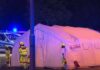
One delayed celebrity arrival, a surging crowd, and a political dream turned catastrophe—how did a rally meant to launch Vijay’s new era in Tamil Nadu politics end in one of India’s deadliest crowd disasters?
Story Snapshot
- At least 41 killed and over 80 injured in a crowd crush at Vijay’s political rally in Karur, Tamil Nadu.
- Vijay’s late arrival triggered a fatal surge; crowd size far exceeded official estimates.
- Judicial inquiry launched, party officials face criminal charges, and national debate erupts over crowd management at mass gatherings.
- Event raises urgent questions about celebrity-driven politics and public safety in India.
Celebrity Politics Meets Deadly Chaos
Karur, Tamil Nadu —thousands of fans and hopeful voters gathered under the relentless sun, drawn by the promise of seeing Vijay, the film icon, reinvented as a political crusader. Anticipation turned anxious as hours passed with little shade, water, or information. When Vijay finally arrived, nearly six hours behind schedule, the crowd’s patience snapped. The surge toward the stage broke through barricades, crushing bodies and overwhelming the thin line of security. The death toll climbed rapidly from 10 to 41 overnight, with more than 80 injured and some still missing.
Emergency responders struggled to reach those trapped in the chaos, hindered by the sheer density of the panicked crowd and the inadequate infrastructure of the rally site. Images and videos circulated globally within hours, showing the grim aftermath—abandoned sandals, shattered barricades, and desperate relatives searching for survivors. The incident ignited nationwide grief and outrage, but the shock waves hit hardest in Tamil Nadu, where political rallies serve as both civic spectacle and barometer of public fervor.
The Anatomy of a Preventable Tragedy
Vijay’s Tamilaga Vettri Kazhagam (TVK) party, launched only a year before, was riding a wave of popularity that even seasoned politicians envied. Permissions for the Karur rally capped attendance at 10,000, yet between 30,000 and 60,000 people crowded Velusamypuram’s open grounds, lured by the promise of proximity to their cinematic idol. The infrastructure—few entry points, minimal crowd control, and no real buffer zones—proved hopelessly inadequate. Women, children, and the elderly were among those caught in the deadly crush, many collapsing from exhaustion or suffocation before help could arrive.
The delayed arrival of Vijay was the flashpoint. When his campaign vehicle appeared around 7:40 pm, the crowd, already restless from hours in the heat, surged forward. The barricades gave way, trapping people in a human vise. Emergency protocols faltered. Police and party volunteers, outnumbered and unprepared, could not stem the tide. In the aftermath, forensic teams and a judicial commission began sifting through evidence. The Tamil Nadu government appointed retired High Court judge Aruna Jagadeesan to lead the inquiry, while TVK officials faced charges of culpable homicide and negligence under India’s new criminal code.
Accountability, Fallout, and the Crisis of Crowd Management
The political and legal consequences were immediate. Vijay, visibly shaken, halted his speech to call for missing children and distribute water to the distressed crowd. He demanded a Central Bureau of Investigation (CBI) probe, while TVK officials, including senior leaders, were booked by police. The Karur district administration and Tamil Nadu police faced scrutiny over their failure to anticipate turnout and enforce safety protocols.
State and national leaders issued condolences and announced compensation for victims’ families, but public anger focused on the apparent disregard for basic safety. Critics cited a longstanding pattern of deadly crowd incidents at Indian mass gatherings, from religious festivals to political rallies. Experts argued that the combination of celebrity magnetism and political ambition, without a commensurate investment in planning and crowd science, made such tragedies inevitable. Crowd control failures, lack of amenities, and underestimation of turnout were not new—just newly catastrophic.
Long Shadows Over Celebrity-Driven Politics
The Karur crowd crush has cast a pall over Vijay’s political ascent. TVK’s campaign momentum now faces questions about competence and priorities. For survivors and families of the deceased, the wounds are raw—grief compounded by anger at a system that failed to protect them. The incident has already prompted calls for stricter regulations on mass gatherings, mandatory crowd science training for event organizers, and a fundamental rethink of how political events are staged in India’s high-stakes, personality-driven arena.
For a nation familiar with the perils of unchecked crowds, this tragedy is both a warning and a test: whether public safety can take precedence over spectacle, and whether accountability will be more than a fleeting campaign promise. As the inquiry unfolds and political calculations shift, one question lingers—how many more lives must be lost before the lessons of Karur are finally heeded?
Sources:
Wikipedia: 2025 Karur crowd crush