

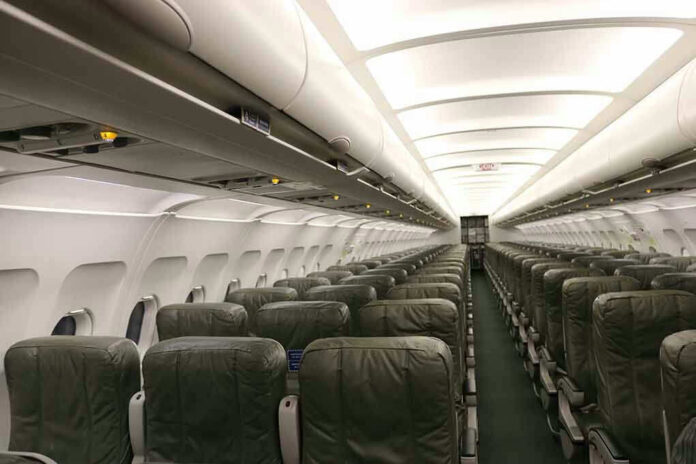
Alaska Airlines brought the entire US air travel system to a sudden, silent halt—grounding every last plane, from Seattle to Miami, not because of a storm or strike, but because of a single point of failure buried deep in its technology backbone.
Story Snapshot
- Alaska Airlines grounded all flights nationwide for hours after a major IT outage triggered by a critical hardware failure at a data center.
- The disruption led to 229 flight cancellations, stranded thousands of passengers, and forced a scramble to reposition crews and aircraft.
- Operations resumed within a day, but ripple effects lingered as the airline and airports worked to clear the backlog.
- The incident highlights how modern air travel relies on fragile, centralized digital systems—raising urgent questions about risk, redundancy, and who’s really in control when things go wrong.
What Happened, and Why It Matters
The outage began early Thursday, when a hardware failure at one of Alaska Airlines’ data centers knocked out the systems that manage flight operations, scheduling, and passenger management. The airline’s response was immediate and sweeping: a complete grounding, affecting both Alaska Airlines and its subsidiary, Horizon Air. Hawaiian Airlines, recently acquired by Alaska Air Group but operating on separate systems, continued flying without interruption.
This was not a minor glitch. It was a full stop. No departures. No arrivals. No exceptions. Passengers already in the air were allowed to land, but those waiting to board were told to step away from the gate. The scene at airports was one of confusion and frustration, as travelers scrambled for information, rebooking, and compensation—while Alaska Airlines staff worked to contain the chaos.
The Anatomy of a Modern Airline Meltdown
Airlines have become digital enterprises with physical wings. Flight plans, crew assignments, baggage tracking, even passenger check-in—all depend on real-time data flowing through centralized IT systems. When those systems fail, the entire operation grinds to a halt. Alaska Airlines’ outage was a textbook example of this vulnerability: a single point of failure cascading into a nationwide disruption.
Industry experts point out that such outages are becoming more common, not less. Airlines have invested heavily in customer-facing technology—mobile apps, self-service kiosks, in-flight Wi-Fi—but underlying infrastructure often lags behind, with aging hardware and software that hasn’t kept pace with the demands of modern operations. The result is a system that’s efficient when it works, but brittle when it doesn’t.
Who’s Really Flying the Plane?
Alaska Airlines pilots and flight attendants are highly trained professionals, but on Thursday, their hands were tied. The real authority lay with IT administrators and data center operators—people most passengers will never see or meet. This shift in control raises hard questions about accountability and preparedness. If a hardware glitch can shut down an entire airline, who’s responsible for making sure it doesn’t happen again?
For passengers, the experience was a stark reminder of how little control they have over their travel plans in the digital age. For Alaska Airlines, the incident was a blow to its reputation for reliability—one it will need to work hard to repair. For the industry as a whole, it’s a wake-up call: invest in redundancy, or risk more meltdowns.
Broader Implications: Trust, Technology, and the Future of Flight
The immediate impact was clear: thousands of disrupted trips, financial losses, and a public relations headache. But the long-term consequences could be more significant. Passengers may think twice before booking with an airline that’s had a high-profile outage. Regulators may push for stricter standards on IT resilience. Competitors may seize the moment to highlight their own reliability.
Perhaps most importantly, the incident underscores a reality that’s easy to forget when everything’s running smoothly: in today’s air travel system, the most critical component isn’t the jet engine or the pilot’s skill—it’s the server in a data center, humming away until the moment it doesn’t.
What Comes Next
Alaska Airlines resumed operations by Friday, but warned that disruptions could continue as crews and aircraft were repositioned and the backlog cleared. The airline has pledged to review its systems and procedures, but the industry as a whole faces a deeper challenge: balancing the drive for efficiency with the need for resilience.
For now, the lesson is clear. When your business depends on technology, you’re only as strong as your weakest server. And when that server fails, everyone—passengers, employees, executives—feels the turbulence.
Sources:
KSL: Alaska Airlines resumes operations after an IT outage grounded its flights for hours
OPB: Alaska Airlines resumes operations after an IT outage grounded its flights for hours