

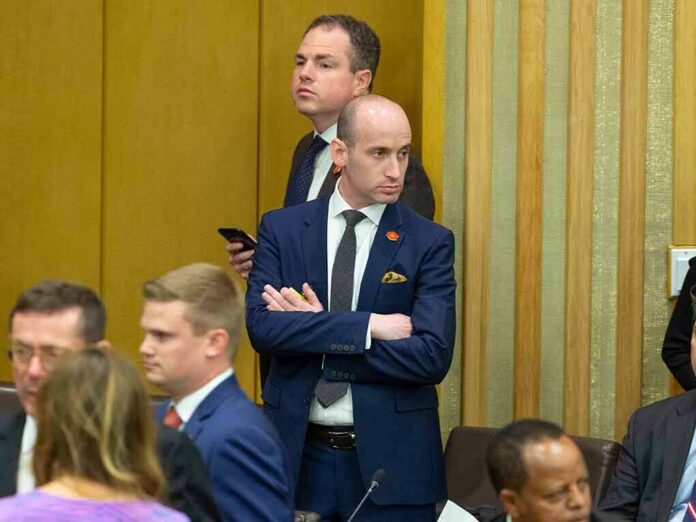
The first major White House departure landed within days of Stephen Miller taking the wheel.
Story Snapshot
- President Trump named Stephen Miller White House chief of staff, replacing Susie Wiles.
- Deputy Chief of Staff Richard Walters resigned but will assist from outside, per Miller.
- The move centralizes authority with a trusted aide tied to border and immigration policy.
- Critics call it a hardline turn after midterm losses and warn of partisan gridlock.
What Changed And Why It Matters Right Now
President Trump installed Stephen Miller as the 33rd White House chief of staff on November 6, 2026, with the role beginning November 9. The White House called Miller a veteran adviser with deep experience and direct access to the president. That signals less ramp-up time and tighter control of priorities from the Resolute Desk outward. Susie Wiles, who had managed operations, shifted to the political operation. The personnel shift followed Republican midterm losses and framed a new phase of execution.
Richard Walters, the deputy chief of staff, became the first major departure as Miller organized his team. Axios reported the resignation as amicable. Miller said Walters would keep helping the administration from outside the building. That line suggests continuity of relationships even as reporting described a broader shake-up. The immediate exits matter because early moves often define how a chief of staff sets pace, demands outcomes, and assigns clear lanes.
Why Miller’s Appointment Concentrates Power
Trump chose a trusted insider who has stood next to him for years. The White House highlighted Miller’s role as a “driving force” behind major initiatives in the administration. That continuity cuts delay and reduces the number of gatekeepers between the president and action. It also consolidates policy direction with an adviser known for strict border enforcement and immigration stances. International outlets read the move as a strong push after a political setback, not a pause for reflection.
Supporters of this approach argue that trust speeds decisions. A chief of staff who knows the president’s style can translate intent into tasking fast. That aligns with conservative priorities: order at the border, accountability in agencies, and a White House that runs on chain of command. The claim that this will improve operations needs time and metrics to confirm. But the basic bet is clear: fewer mixed signals, more clarity on goals, and tougher follow-through.
The Early Friction And What To Watch
Democratic leaders and immigration advocates blasted the appointment. They warned of more aggressive immigration enforcement and said Miller’s selection rejects a call for moderation after the midterms. Some critics predicted more partisan conflict on Capitol Hill and less room for bipartisan deals. These are political judgments. They reflect values about enforcement and tone, not yet the operational results under the new structure.
Claims about Miller’s management style surfaced again as he rose. Reports described him as demanding and, at times, harsh with staff on information gaps. One outlet said he supported forcing journalists to reveal confidential sources during past internal debates. Those reports, if accurate, suggest an executive who prizes speed and control. That can cut fog in a slow system, but it can also burn out teams if not paired with discipline and fair process.
The Practical Scorecard That Will Prove This Out
White House chiefs of staff often have short tenures, and turnover alone does not prove failure. The job is hard because it blends management, politics, and crisis response. Research on past presidencies found little clear change in a president’s daily work patterns just from switching chiefs. What will matter here are measurable outcomes: faster clearances, cleaner interagency coordination, and fewer policy reversals after launch.
Roll Call confirms it: President Donald J. Trump named Stephen Miller his chief of staff on Friday, with deputy Richard Walters already exiting ahead of the takeover. The immigration hard-liner now runs the West Wing.
— Frontier Signal (@FrontierSigHQ) November 9, 2026
Three tests will show if this consolidation works. First, border and interior enforcement coherence: clear tasking from the White House to the Department of Homeland Security and the Department of Justice with visible, lawful results. Second, Hill engagement: fewer crossed wires with Congress and steadier vote counts on priorities. Third, leak control and stability: fewer anonymous knifings, steadier staff retention, and policy rollouts that stick. Results, not press releases, will settle the debate.
Sources:
axios.com, whitehouse.gov, afp.com, dw.com, nytimes.com, washingtonpost.com, charlotteobserver.com, cleveland.com, pbs.org
© restoreamericanglory.com 2026. All rights reserved.